










Torrent Power Q2 revenue rises 24%, EBITDA increases 26%
Key highlights
- Torrent Power's Q2 FY27 revenue from operations rose 24% to Rs 9,801 crore.
- Torrent Power's Q2 FY27 EBITDA increased 26% to Rs 1,988 crore from Rs 1,584 crore.
- Torrent Power's Q2 FY27 TCI rose by Rs 105 crore to Rs 835 crore despite higher finance costs.
- Torrent Power has 6.8 GWp of installed generation capacity and about 4.3 GWp of renewable projects under development.
powered by IRIS
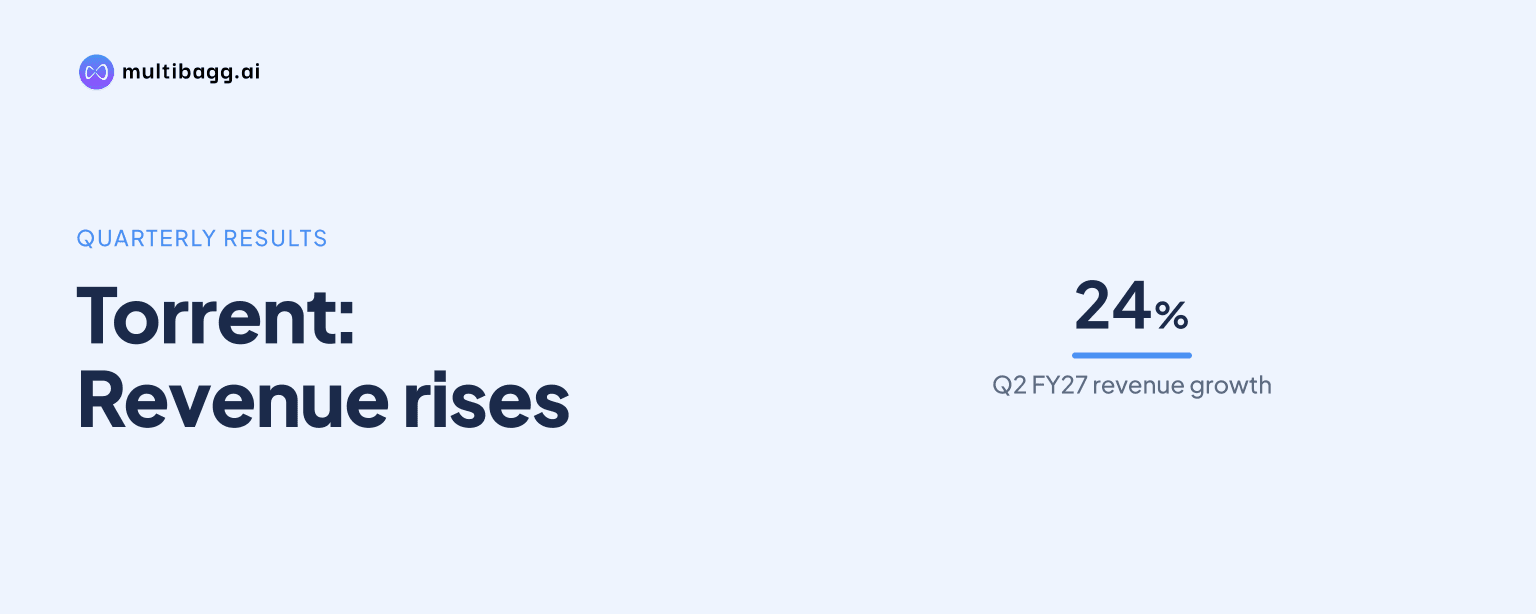
Torrent Power Limited (Torrent Power) reported Q2 FY 2026-27 revenue from operations of Rs 9,801 crore, up 24% year on year, while EBITDA rose 26% to Rs 1,988 crore and total comprehensive income increased 14% to Rs 835 crore for the quarter ended September 30, 2026.
Know Torrent Power inside out
Results, valuation, peers and who's buying, in one view.
How did Torrent Power's Q2 FY27 financial results change?
Torrent Power increased revenue, EBITDA and total comprehensive income in Q2 FY27, with EBITDA rising faster than revenue. Revenue from operations increased by Rs 1,925 crore to Rs 9,801 crore from Rs 7,876 crore in Q2 FY26. Earnings before interest, tax, depreciation and amortisation, or EBITDA, rose by Rs 404 crore to Rs 1,988 crore from Rs 1,584 crore, while total comprehensive income, or TCI, rose by Rs 105 crore to Rs 835 crore.
The Rs 404 crore EBITDA increase exceeded the Rs 105 crore rise in TCI during Q2 FY27. Torrent Power attributed the TCI movement to improved distribution operations, better renewable performance and a contribution from the Nabha acquisition, partly offset by higher finance costs associated with increased borrowings.
What drove Torrent Power's Q2 operating-profit growth?
Torrent Power said adjusted EBITDA increased 29% in Q2 FY27, driven by distribution operations, renewable energy performance and consolidation of the Nabha acquisition. This compares with reported EBITDA growth of 26%, or Rs 404 crore, to Rs 1,988 crore. Torrent Power specifically identified improved operational performance across its distribution businesses as a contributor to the quarter's Rs 105 crore increase in TCI.
Renewable operations contributed through higher plant load factors and output from commissioned projects, according to the November 4, 2026 release. Torrent Power also cited an increase in contribution from Nabha. Its adjusted EBITDA includes Rs 54 crore of principal recovery relating to the Nabha acquisition, recognised in the balance sheet under applicable lease-accounting principles.
The release distinguishes between 29% adjusted EBITDA growth and 26% reported EBITDA growth because of the Rs 54 crore principal-recovery item. It does not provide standalone quarterly revenue, EBITDA or TCI for distribution, renewable energy or the Nabha acquisition, so the contribution of each operation cannot be separately measured from the disclosed Q2 FY27 figures.
How did Torrent Power perform in the first half of FY27?
Torrent Power reported 14% growth in both first-half revenue and EBITDA, while TCI was Rs 1,474 crore compared with Rs 1,469 crore a year earlier. Revenue from operations for H1 FY 2026-27 rose by Rs 2,144 crore to Rs 17,926 crore from Rs 15,782 crore. EBITDA increased by Rs 435 crore to Rs 3,606 crore from Rs 3,171 crore.
Q2 FY27 revenue growth of 24% was higher than the 14% growth reported for H1 FY27, and Q2 EBITDA growth of 26% was also above the half-year rate. In contrast, H1 TCI rose by Rs 5 crore, less than the Rs 105 crore gain reported in Q2 alone. Torrent Power cited higher finance costs from increased borrowings as an offset to quarterly operating and acquisition-related gains.
Torrent Power reported consolidated figures for the quarter and six months ended September 30, 2026. The release does not disclose a finance-cost amount, borrowing balance or segment-profit breakdown for Q2 FY27. It therefore establishes that higher finance costs constrained TCI, but does not quantify their effect on the difference between EBITDA and TCI growth.
Got a follow-up? Ask IRIS
What operating base supports Torrent Power's results?
Torrent Power disclosed aggregate installed generation capacity of 6.8 gigawatt peak, or GWp, comprising 2.7 gigawatt of gas-based capacity, 2.3 GWp of renewable capacity and 1.8 gigawatt of coal-based capacity. It also had about 4.3 GWp of renewable projects, 3 gigawatt of pumped-storage capacity and 1.6 gigawatt of coal-based capacity under development as of the November 4, 2026 release.
Including projects under development, Torrent Power stated total generation capacity of about 12.7 GWp and pumped-storage capacity of 3 gigawatt. Higher plant load factors and projects already commissioned supported renewable performance in Q2 FY27. The release does not give commissioning dates, capital expenditure amounts or revenue expectations for the 4.3 GWp renewable, 3 gigawatt pumped-storage and 1.6 gigawatt coal development pipeline.
Torrent Power distributes nearly 31 billion units to around 4.29 million customers across locations in Gujarat, Dadra and Nagar Haveli and Daman and Diu, Maharashtra, and Agra in Uttar Pradesh. Its Gujarat service areas include Ahmedabad, Gandhinagar, Surat, Dahej Special Economic Zone and Dholera Special Investment Region, while its Maharashtra areas include Bhiwandi, Shil, Mumbra and Kalwa.
The distribution base was relevant to the Rs 105 crore quarterly TCI increase because Torrent Power cited improved performance across its distribution businesses. Torrent Power also said its Gujarat licensed areas have the country’s lowest distribution losses and best reliability indices, although the release did not provide a loss percentage, reliability measure or Q2 FY27 comparison.
Conclusion
Torrent Power combined 24% Q2 FY27 revenue growth to Rs 9,801 crore with 26% EBITDA growth to Rs 1,988 crore, while TCI increased 14% to Rs 835 crore. Distribution and renewable operations, alongside the Nabha acquisition, supported the operating result, while higher finance costs from increased borrowings limited the gain in TCI.
The next disclosed execution markers are the development of about 4.3 GWp of renewable projects, 3 gigawatt of pumped-storage capacity and 1.6 gigawatt of coal-based capacity. Future disclosures can show whether commissioned renewable projects, plant load factors and finance costs continue to affect the relationship between EBITDA and TCI.