










Tracxn launches AI tools and plans token-based upsells
Key highlights
- Tracxn launched MCP connectors, an in-platform AI Assistant and planned investor agents in Q2 FY27.
- Tracxn plans Pro and Power packs with larger token allowances plus token purchases after allowances are exhausted.
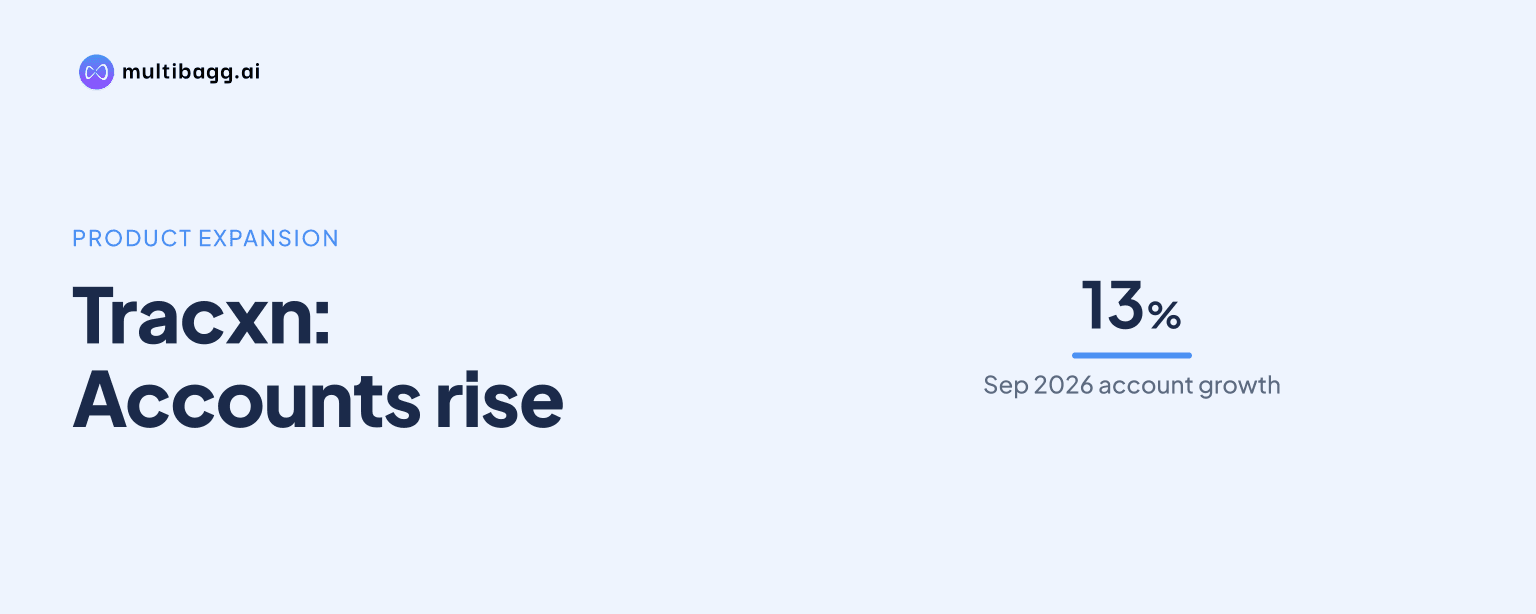
- Tracxn had 2,419 paid accounts and 6,854 users at September 2026, up 13% and 16% year on year.
- Tracxn covers 66 million legal entities and detailed financials for 7.5 million companies across more than 20 countries.
powered by IRIS
Tracxn launched AI connectors for Claude and ChatGPT, an in-platform AI Assistant and planned investor agents in Q2 FY27, while management said premium packs with larger token allowances and additional token purchases could become a meaningful revenue segment. The company had 2,419 paid accounts at September 2026, but disclosed no AI revenue or usage figures.
Know Tracxn Technologies inside out
Results, valuation, peers and who's buying, in one view.
What AI products has Tracxn launched?
Tracxn has introduced three AI-native access routes: a Model Context Protocol, or MCP, connector for external AI tools, an AI Assistant on its platform, and investor-focused agents under development. The MCP is listed on the Claude and ChatGPT marketplaces and also works with Gemini and Cursor. Management said paid users can retrieve Tracxn’s real-time company intelligence in these workflows with faster responses and lower token consumption.
The AI Assistant lets users query Tracxn data in plain English and undertake more complex tasks within the platform. The investor agents are not yet launched: management described customisable tools that combine a fund’s internal information with Tracxn data for deal diligence, competition benchmarking, sector landscaping and scouting lists. These agents can be tailored to a fund’s processes and templates.
How does Tracxn plan to make money from AI?
Tracxn plans to monetise AI through Pro and Power packs carrying higher token allowances, followed by token purchases when a customer uses its included balance. Management said the Assistant can support sales of these higher packs and that customers have a provision to purchase more tokens. It did not disclose pack prices, token prices, conversion rates or revenue from either route.
The commercial evidence remains early because management said the in-platform offering launched only in the month before the Q2 FY27 call. Management said it would cover early results in subsequent quarterly calls, making its expectation of a meaningful revenue segment a forward-looking view rather than a reported contribution. At September 2026, Tracxn’s 2,419 paid accounts and 6,854 users, up 13% and 16% year on year, respectively, form the initial customer base for the offering.
Token consumption would be separate from Tracxn’s existing seat-expansion mechanism. Management said it uses internet protocol, or IP, location data to identify likely shared log-ins and prompt customers to buy more seats or full-team packs. It said this process accounts for half of upgrades, whereas token sales would depend on AI usage after a customer reaches its allowance.
How does AI fit Tracxn’s growth plan?
Tracxn is positioning AI access alongside a three-phase model of specialised sales teams and segment-specific data additions. India revenue grew nearly 7% quarter on quarter in Q2 FY27, which management annualised at about 30%, and India accounted for more than half of revenue. Management attributed that growth to the vertical-team playbook, not to the recently launched AI tools.
The model begins with a dedicated team for a customer segment, followed by three to four quarters of filling product and data gaps, then scaling the sales team to roughly four times its initial size. Management said phase one typically raises the pace of new customer acquisition by around 50%, while the scale-up phase can add 1% to 2% of market share each month. AI connectors could make the resulting datasets available in the tools customers already use.
Investment banking is Tracxn’s disclosed example. After adding Live Deals, expanding investor information and private-company financial coverage, it said new-customer acquisition reached around 20 a month, nearly double the starting level. Revenue in this segment rose 11% quarter on quarter in Q2 FY27, versus roughly 20% growth in the prior financial year, according to management; planned investor agents could extend this workflow into diligence and benchmarking.
Got a follow-up? Ask IRIS
What data can support Tracxn’s AI products?
Tracxn’s AI proposition draws on a dataset covering 66 million legal entities across the United States, United Kingdom, Japan, India, Australia and other markets. It reported revenue data for 3.1 million companies and detailed financials for 7.5 million companies across more than 20 countries. The company also tracks shareholding patterns for more than 1.8 million companies across over 15 countries after fivefold growth in cap-table coverage over nine months.
Management said this expansion did not require a significant increase in data-production headcount because of automation and AI in its data infrastructure. In the United Kingdom, private-company financial coverage reached 5.2 million entities, around 16 times its March 2025 level. Other international additions include stealth-company coverage, Talent Signals for founders, estimated private-company revenue and historical merger-and-acquisition valuations.
The addressable users include investment firms and corporate teams. At the end of Q2 FY27, investment-industry customers accounted for 49% of accounts and corporates for 45%, with the latter including corporate development, innovation, strategy and sales functions. Management is also developing an AI Scout agent for innovation teams to identify five to 10 companies in a specific technology area, but gave no release date or commercial terms.
What results should readers watch next?
The principal measure is whether AI access leads to higher adoption of Pro and Power packs, paid token top-ups or broader account expansion among Tracxn’s 2,419 paid accounts. Management has not set a revenue target, token-sales target or timetable for AI monetisation. Its stated near-term commitment is to provide early results on subsequent quarterly calls.
Other operating indicators may show whether Tracxn can extend the products through its sales and acquisition channels. It recorded more than 17 million organic visits in H1 FY27, with a current run-rate of nearly 30 million, and around 350,000 Tracxn Lite sign-ups since launch. Its closing-sales team rose from 34 at the beginning of 2026 to nearly 56 by September, against a plan for slightly more than 60 by December 2026.
Management also expects the one-time cost step-up for sales and data investments to be completed within one to two quarters, after which it expects cost growth to return to low single digits. International verticals remain earlier in the three-phase model than India, although 48% of H1 FY27 revenue came from outside India. Whether those units show conversion and revenue gains after their data-build phase will be relevant alongside AI uptake.
Conclusion
Tracxn has made its proprietary company data available through external AI platforms, created an in-platform conversational interface and outlined investor agents for recurring research tasks. The revenue model is defined as higher-token packs followed by token top-ups, but the company has not yet reported pricing, usage, conversion or revenue evidence from the initiative.
The next disclosures to watch are management’s promised early AI results in subsequent quarterly calls, progress on investor agents and the AI Scout tool, and completion of the plan to grow the closing-sales team to slightly above 60 by December 2026. Management also expects sales and data investment costs to settle within one to two quarters, while international business units move through their data-development phases.