










Tracxn India revenue runs at 30% annualised pace in Q2 FY27
Key highlights
- Tracxn said India revenue rose 6.9% quarter on quarter in Q2 FY27, implying a nearly 30% annualised run-rate.
- Tracxn reported 2,419 paid customer accounts at September 2026, up 13% year on year.
- Tracxn’s investment-banking vertical grew revenue 11% quarter on quarter in Q2 FY27.
- Tracxn expanded its closing-sales team from 34 at the start of 2026 to nearly 56 by September 2026.
powered by IRIS
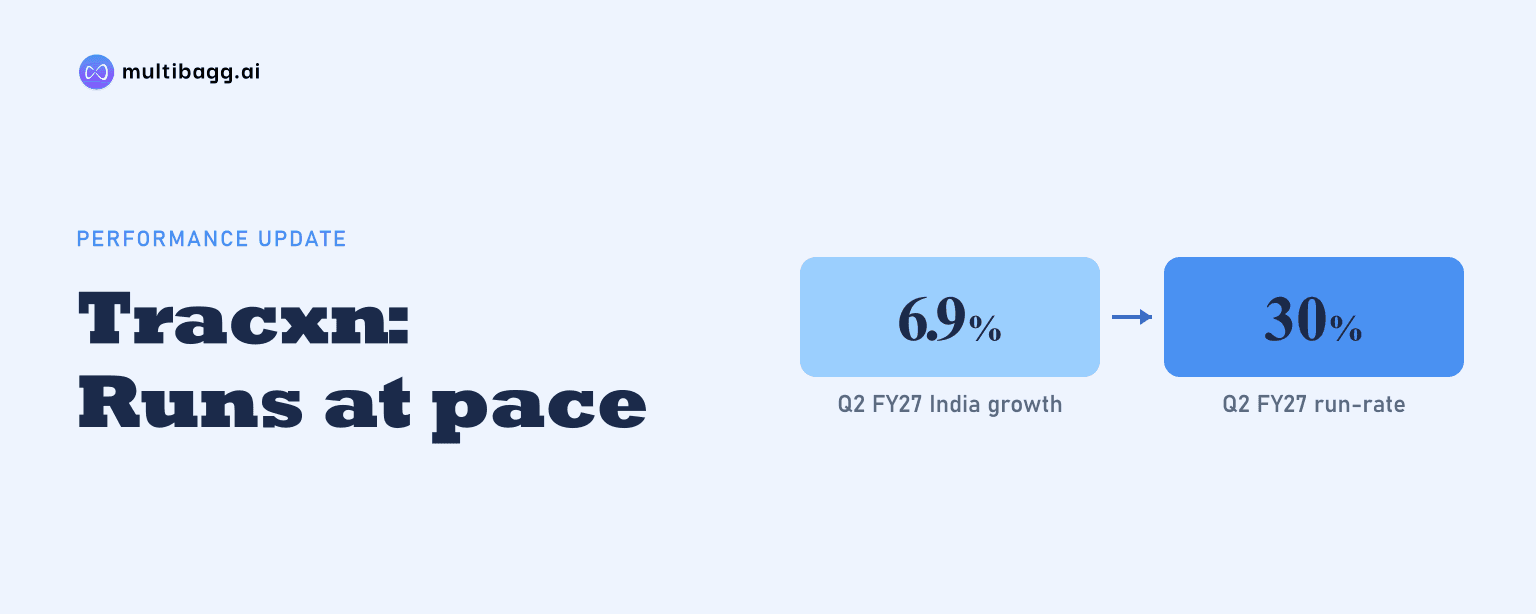
Tracxn Technologies Limited said India revenue increased 6.9% quarter on quarter in Q2 FY27, which management annualised at nearly 30%, as its investment-banking vertical grew revenue 11% sequentially. India accounted for more than half of revenue, whereas consolidated revenue from operations rose 1.1% to Rs 21.3 crore.
Know Tracxn Technologies inside out
Results, valuation, peers and who's buying, in one view.
How fast is Tracxn’s India revenue growing?
Tracxn’s India revenue is growing at a management-stated annualised run-rate of about 30%, based on 6.9% quarter-on-quarter growth in Q2 FY27. Management said India’s growth rate has accelerated over the past two years after investments in specialised data and sales teams for specific customer segments. Consolidated revenue from operations was Rs 21.3 crore in Q2 FY27, up 1.1% quarter on quarter, showing that the faster India trajectory has not yet been matched across the whole business.
Tracxn’s paid customer accounts grew faster than consolidated revenue. Accounts reached 2,419 at September 2026, up 13% year on year, while users increased 16% to 6,854. Deferred revenue, or payments received for services to be recognised later, stood at Rs 38.1 crore at the end of Q2 FY27, up 9% year on year. Management said the reported account count includes paid customers only and excludes free users.
Why has Tracxn’s customer growth not translated proportionately into revenue?
Tracxn said revenue has lagged account additions because its customer mix shifted towards newer segments with lower initial pricing and towards India, where average selling price is about half that in international geographies. Management said customer acquisition normally rises first after a specialist business unit is launched, while revenue accelerates later as the product improves, sales win rates increase and existing customers upgrade. It expects revenue growth to catch up with account growth in a couple of quarters.
The mix shift followed a slowdown in Tracxn’s formerly largest venture-capital segment, according to management. It said private-market deal volume remains at a 10-year low in India and globally, prompting it to prioritise other segments over the past two years. Management said building an offering for a new segment, launching a team and adding relevant data takes about two to three quarters. India grew nearly 20% in H1 FY27, it said, after newer business units were introduced.
How is Tracxn scaling its investment-banking vertical?
Tracxn is scaling investment banking through a three-phase model: launch a specialist team, improve segment-specific data, and then expand sales capacity. Management said phase one generally lasts about two quarters and raises the pace of new customer acquisition by roughly 50%. Phase two takes three to four quarters and addresses product gaps to improve sales win rates. In phase three, Tracxn typically scales the sales team to about four times its initial size.
For investment banks, Tracxn added Live Deals to identify companies seeking mergers and acquisitions, or M&A, and fundraising, enriched its investor database for outreach, and expanded private-company financial data. Management said new investment-banking customer additions reached around 20 a month, nearly double the level at the start of the initiative. The vertical gained around 1% incremental market share a month for the past 12 months, according to management, and Q2 FY27 revenue rose 11% quarter on quarter versus roughly 20% growth in the prior financial year.
Got a follow-up? Ask IRIS
What is Tracxn investing in to extend the playbook?
Tracxn is applying its India model to international business units, where management said the work is at an earlier stage. It has invested in data and sales across overseas segments and expects the investments to start contributing to international growth in coming quarters. International markets generated 48% of H1 FY27 revenue, and Tracxn had customers in more than 50 countries. Its five largest markets by customer accounts were India, the US, UK, Singapore and Germany.
Tracxn expanded its closing-sales team from 34 at the start of 2026 to nearly 56 by September 2026, against a plan for around 60 by December. Sales and marketing represented nearly 30% of total headcount in Q2 FY27, compared with 25% a year earlier. Management described the related cost increase as a one-time step-up, which it expects to be completed within one to two quarters, followed by cost growth returning to historical low-single-digit levels. Total H1 FY27 expense was Rs 52.7 crore, with team costs representing about 86%.
Which data products could support Tracxn’s next growth phase?
Tracxn is adding datasets intended to improve conversion in targeted segments. Its private-company financial-data coverage reached 3.1 million companies with revenue information and 7.5 million companies with detailed financials across more than 20 countries, following nearly 11-fold growth. It also tracks shareholding patterns for more than 1.8 million companies across over 15 countries after expanding cap-table coverage fivefold over the previous nine months.
In India, Tracxn introduced a proprietary industry taxonomy covering nearly 3 million legal entities and increased private-company cap-table and shareholding coverage by more than five times to near-complete coverage. International launches included stealth-company coverage, Talent Signals for founders, estimated private-company revenues and historical M&A-deal valuations. In the UK, private-company financial coverage reached 5.2 million entities, about 16 times the March 2025 level. Management said these datasets were added without a significant increase in data-production headcount because of automation and artificial intelligence, or AI, in its data infrastructure.
How is Tracxn building corporate and AI-related use cases?
Tracxn has active specialist teams serving corporate M&A, innovation and sales functions, which management said are in phase two of developing their product offerings. Management said the M&A team was receiving a good customer response and could start delivering better results in about a quarter. It expects innovation and corporate-sales teams to show results in three to four quarters as their data and workflows develop.
Tracxn has also launched an MCP connector, or Model Context Protocol connector, for AI tools, listed on the Claude and ChatGPT marketplaces and compatible with Gemini and Cursor. Paid customers can use the connector to access Tracxn data in AI workflows, while its in-platform AI Assistant supports plain-English data queries. Management is also developing agentic workflows for tasks including deal diligence, competition benchmarking, sector landscaping and scouting lists, and said it expects AI-native access to become a meaningful revenue segment.
Conclusion
Tracxn’s Q2 FY27 results show India growing faster than the consolidated business, with 6.9% sequential growth translating to a management-stated annualised pace of nearly 30%. The investment-banking vertical illustrates the mechanism: specialist sales coverage, relevant datasets and sales scaling were followed by 11% quarter-on-quarter revenue growth, while lower-priced newer Indian segments have caused customer accounts to grow faster than revenue.
The next indicators are whether more business units enter the scale-up phase and whether international teams reproduce the India approach. Management plans to take the closing-sales team slightly above 60 by December 2026, expects the one-time investment phase to be substantially complete within one to two quarters, and said corporate M&A could show stronger results in about a quarter while innovation and corporate sales may take three to four quarters.