










Transrail Lighting Q2 Revenue Hits Record ₹2,056 Crore
Key highlights
- Transrail reported record Q2 FY27 revenue of ₹2,056 crore, up 31.7% year-on-year.
- Q2 FY27 EBITDA rose 28% year-on-year to ₹238 crore, with an EBITDA margin of 11.6%.
- Consolidated Q2 FY27 profit after tax was ₹103.9 crore, up 12.4% year-on-year.
- Transrail's Q2 FY27 order book stood at ₹14,218 crore, with ₹1,747 crore of additional orders secured after the quarter.
powered by IRIS
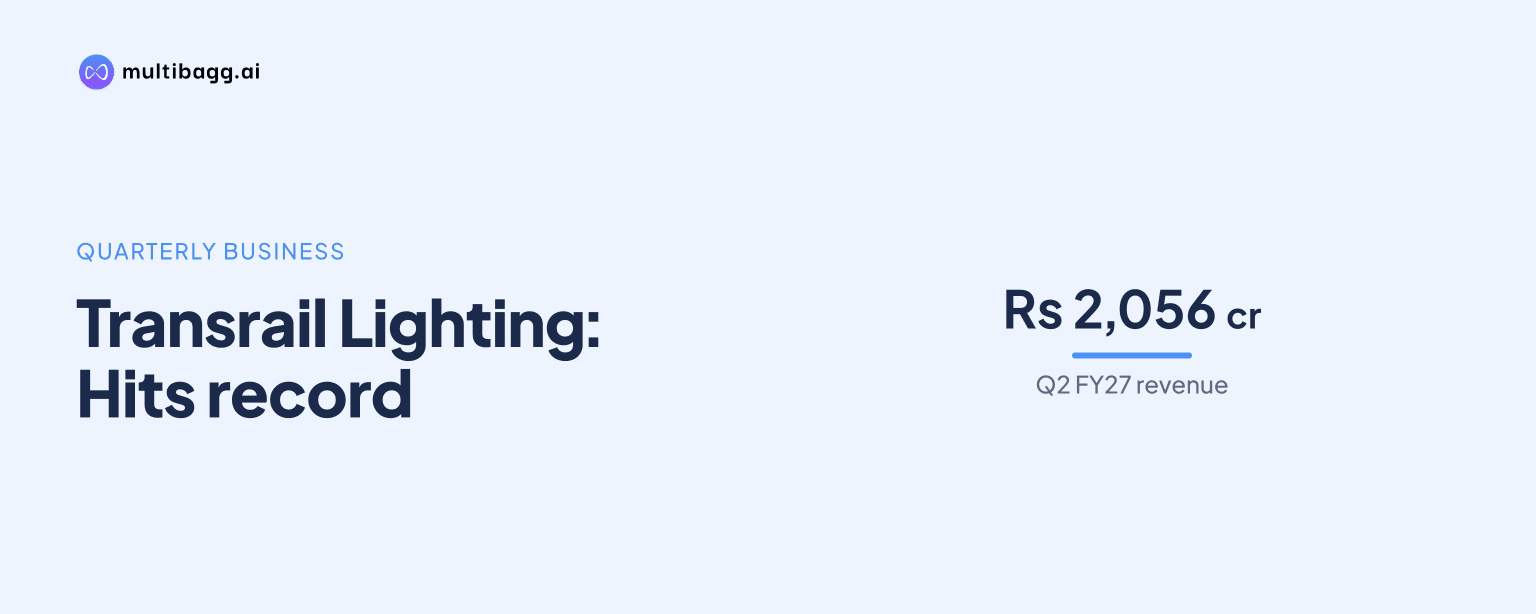
Transrail Lighting Limited reported record Q2 FY27 revenue of ₹2,056 crore, up 31.7% year-on-year, with EBITDA of ₹238 crore and an 11.6% margin despite supply-chain disruptions. The result matters because the company retained its growth and margin guidance while executing a large transmission and distribution order book.
Know Transrail Lighting inside out
Results, valuation, peers and who's buying, in one view.
What did Transrail report for Q2 FY27?
Transrail reported consolidated revenue from operations of ₹2,056 crore for the quarter ended September 30, 2026, compared with ₹1,561 crore in Q2 FY26. Revenue was also 18.45% higher than the ₹1,736.03 crore reported in the preceding quarter, making this its highest quarterly revenue disclosed in the available material.
EBITDA increased 28% year-on-year to ₹238 crore. The EBITDA margin was 11.6%, compared with 11.9% in the year-ago quarter. Consolidated profit after tax was reported at about ₹104 crore, up roughly 12% year-on-year. The company separately disclosed standalone net profit of ₹104.70 crore, up 14% from ₹91.81 crore.
The difference between revenue growth and profit growth reflected factors identified in the call summary, including a one-time tax impact and higher interest costs linked to working-capital limits. Transrail disclosed a ₹14.30 crore one-time tax impact related to a block return filed for the period from April 1, 2019 to March 29, 2026.
How did Transrail sustain growth amid supply-chain disruptions?
Transrail attributed the quarterly performance to execution momentum and its backward-integration approach, which management said helped maintain internal supply security during supply-chain disruptions. The call summary specifically referred to resilience against logistics issues affecting the Middle East, while the company continued to execute transmission and distribution projects.
Backward integration is relevant for a transmission engineering, procurement and construction business because material availability and delivery schedules can affect project execution. The company said its internal supply capability also strengthens export potential, although it did not provide a separate export revenue figure in the material available.
The company has a conductor brownfield expansion plan, but the call summary indicated that the planned Q1 FY27 completion had not been confirmed and a Q2 start remained pending approvals. This is an operational item to track because the broader strategy places importance on increasing internal supply capacity.
What is Transrail's order book and revenue outlook?
Transrail ended the quarter with an order book of ₹14,218 crore and said it secured an additional ₹1,747 crore after the quarter. The call summary also referred to an order book of ₹16,035 crore in the context of order intake, indicating the scale of business visibility after subsequent order additions.
Management maintained its FY27 revenue-growth guidance of 20% to 22%, with an EBITDA margin target of at least 11%. For the longer term, it guided for about 20% annual revenue growth over the next three years and identified a ₹12,000 crore revenue target for FY29.
The company linked demand visibility to India's transmission and distribution investment cycle. Renewable-energy evacuation and grid modernisation are supporting the need for new transmission infrastructure, while the GEC-III programme was cited as a source of a large potential project pipeline. No order-win forecast or quantified GEC-III opportunity was provided in the supplied material.
Got a follow-up? Ask IRIS
Why is the renewable-generation investment relevant?
Transrail is entering renewable generation through a 49% stake in a special-purpose vehicle associated with a 990 MW renewable-generation opportunity. This marks an expansion beyond its core transmission and distribution execution activities, although the available information does not state the investment amount, commissioning schedule, or expected financial contribution.
The move is connected to the wider build-out of renewable power capacity and associated grid infrastructure. Renewable generation requires evacuation networks to deliver power to demand centres, a factor that supports transmission investment alongside the company's own participation in a renewable-generation venture.
For investors, the immediate reported financial story remains the core project business: record revenue, a double-digit operating margin, and a large order book. The renewable investment is strategically relevant, but its effect on revenue or profitability cannot be assessed from the disclosed information.
How did the earnings call affect investors and operating priorities?
The November 4, 2026 earnings call ran for 52 minutes, from 12:31 PM to 1:22 PM IST, and covered unaudited results for the quarter and half year ended September 30, 2026. Management's message was that the company remains on track with its revenue and margin guidance despite logistics disruptions and higher working-capital requirements.
For investors, the key positive data points were 32% reported revenue growth, an 11.6% EBITDA margin, and the ₹14,218 crore order book. The key items requiring monitoring are the slower growth in profit after tax, interest costs, the one-time tax item, and approval-related timing for the conductor brownfield project. The supplied material contains no share-price movement for Transrail, so no direct market-price conclusion can be drawn.
Transrail's financing profile also received support in August 2026, when India Ratings & Research upgraded its long-term bank-loan facilities to IND AA- with a Stable Outlook from IND A+. Its short-term rating was upgraded to A1+. These ratings are separate from operating performance, but they are relevant to a business with project execution and working-capital needs.
Conclusion
Transrail delivered a record Q2 FY27 revenue performance of ₹2,056 crore while maintaining an 11.6% EBITDA margin. The results show continued execution strength in transmission and distribution projects, supported by backward integration and a sizeable order book, although net-profit growth was affected by a one-time tax charge and higher interest costs.
The next disclosures to watch are progress on the conductor brownfield expansion pending approvals, conversion of the order pipeline into intake, and delivery against FY27 guidance of 20% to 22% revenue growth with an EBITDA margin of at least 11%. Investors will also need further details on the 49% SPV stake linked to the 990 MW renewable-generation opportunity.