










Turtlemint sees FY28 service EBITDA protected by direct business
Key highlights
- Turtlemint reported H1 FY27 service EBITDA of Rs 85 crore, up nearly 66% year on year.
- Management said more than 90% policyholder contactability could support direct servicing after a POSP exits.
- Turtlemint said 76% of platform premium comes from POSPs operating across eight or more insurance companies.
- H1 FY27 renewal revenue exceeded Rs 136 crore, growing 52% year on year.
powered by IRIS
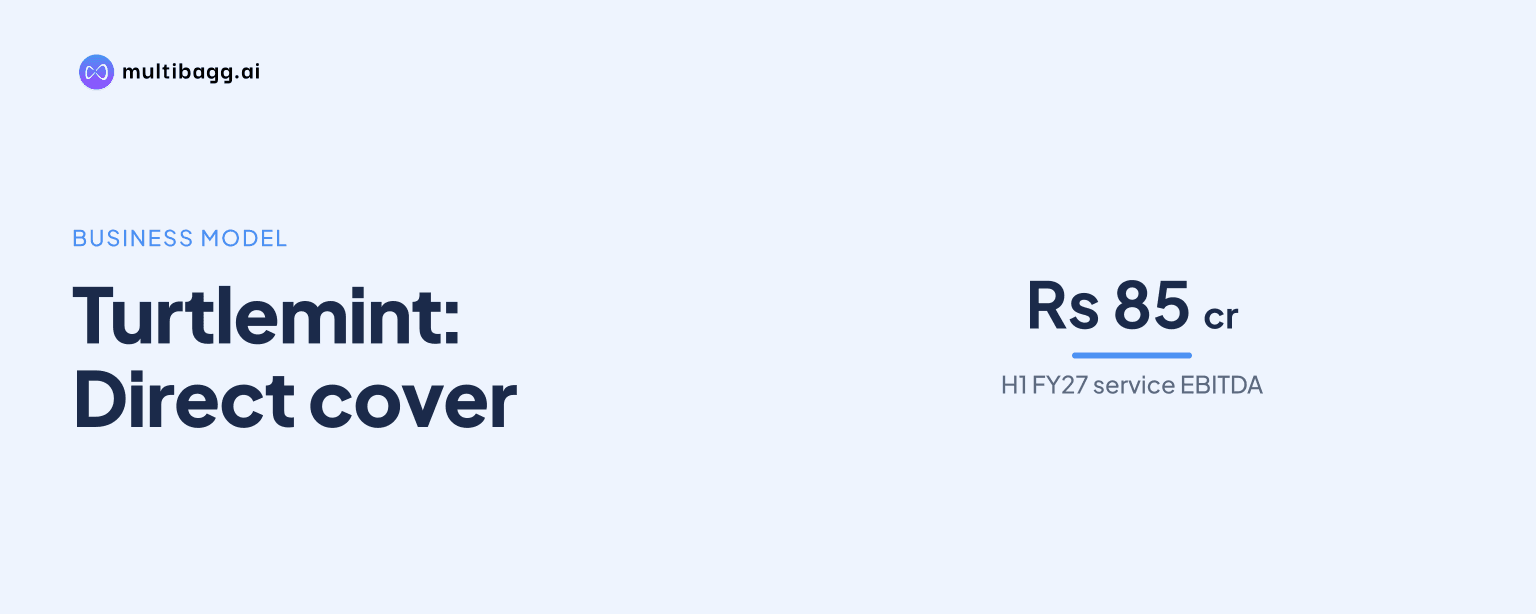
Turtlemint expects financial year 2028 service EBITDA to remain at its original planned absolute value if draft distribution reforms cause low-volume POSPs to exit, because it can service and renew their customers directly. Management cited more than 90% policyholder contactability and first-half FY27 service EBITDA of Rs 85 crore as support for that view.
Know Turtlemint Fintech Solutions inside out
Results, valuation, peers and who's buying, in one view.
How would Turtlemint retain customers when POSPs exit?
Turtlemint expects customers sourced by departing POSPs, or seller partners, to become business-to-consumer direct customers because it maintains direct policyholder engagement. Management said contactability exceeds 90%, while its contract-maintenance policy provides renewals, claims support and document servicing after a POSP churns.
The mechanism is aimed at low-volume or single-product POSPs that management said may not continue under recalibrated distribution economics. Rather than assume that every seller exit means lost premium, Turtlemint expects to retain the policyholder relationship and pursue renewal income through direct servicing. Management cautioned that this outcome rests on assumptions because the distribution-reform draft is not final.
Turtlemint described its model as a triadic platform involving the policyholder, the seller and the company. That structure separates the customer relationship from the seller relationship: a departing POSP could change the distribution route, while the policyholder remains eligible for servicing, claims assistance and renewal reminders from Turtlemint.
What does Turtlemint expect for FY28 service EBITDA?
Turtlemint expects FY28 service EBITDA, or earnings before interest, tax, depreciation and amortisation before specified corporate costs, to match the absolute value in its original plan. Management said the service EBITDA margin could rise if a portion of POSP-sourced business converts to direct business, but it gave no numerical FY28 forecast.
Management clarified that “protect” does not mean a commitment to grow service EBITDA. It said the expectation is for a similar absolute service EBITDA number to the original FY28 plan, with a potentially higher margin. Exact modelling will depend on the final rules and the level of POSP exits.
The current base was Rs 85 crore of service EBITDA in H1 FY27, up nearly 66% year on year and equal to about 13% of Rs 637 crore revenue. Platform premium was Rs 2,419 crore, up about 52%, while revenue increased 38%, giving management the reported operating base from which it is assessing the regulatory scenario.
Costs below service EBITDA rose only about 2.5% to 3% in H1 FY27 from the prior-year period, according to management. Those costs fell to 21% of revenue from 28%, and adjusted EBITDA loss narrowed to 7% of revenue from 17%. In Q2, corporate overhead declined to 19% of revenue from 26%, while adjusted EBITDA loss narrowed to 6% from 14%.
Got a follow-up? Ask IRIS
Which POSPs and products underpin Turtlemint’s response?
Turtlemint’s response centres on multi-brand, multi-category POSPs and a broader product range spanning health, life and small and medium enterprise insurance, mutual funds and loans. Management said 76% of platform premium comes from POSPs working across eight or more insurance companies, and more than 60% comes from POSPs selling over four insurance subcategories.
This differs from a seller such as a garage owner using a quick-response code to sell only two-wheeler insurance. Management said that profile may have limited scope to cross-sell and may not remain active. In contrast, POSPs that can offer a broader solution can use Turtlemint’s digital workflow, training and backend experts to sell motor insurance alongside health, life, mutual funds or loans.
Management said 40% of premium already comes from POSPs that cross-sell. It identified higher health and life cover, workmen’s compensation, small-group health and other small and medium enterprise products as potential additions. Proposed removal of caps on life-insurance sum insured could expand what sellers can offer, although the proposal remains subject to final rules.
Management said a seller could potentially maintain prior income by making one or two health or life sales, or one small and medium enterprise or value-added-service sale. That is management’s scenario, not a quantified forecast. Loan distribution began about 18 months before the call, while management said monthly loan activity has been growing at a healthy compound annual growth rate without disclosing the rate.
What operating evidence supports Turtlemint’s plan?
Turtlemint had 96,368 active digital partners in the 90 days ending September, compared with 80,253 a year earlier. Renewal revenue exceeded Rs 136 crore in H1 FY27, rising 52% year on year and faster than the 38% revenue increase, which management attributed to improved renewal rates across insurance categories.
More than 50% of Turtlemint’s business comes from difficult-to-reach districts with five or fewer general-insurer offices. Its learning platform had more than 55,000 average monthly active users, and an artificial-intelligence-based product-training tool produced a two-times higher learning-to-action conversion during the quarter, according to management.
Nearly 85% of policies are issued end to end digitally on the platform. Turtlemint’s Ninja AI assistant supports sellers with quotes, issuance, payments, renewals, endorsements and claims, with management targeting three-times higher productivity. Management also said most new code is generated using artificial intelligence and expects that adoption to help keep employee cost flat as revenue streams diversify.
Management reported an EBITDA loss of Rs 16.7 crore, or about 5% of revenue, for the period discussed on the call. Cash balance was Rs 740 crore at quarter-end, and management expected a slightly higher balance by March 31 after working-capital movements, refunds and tax utilisation.
Conclusion
Turtlemint’s central case is that regulatory-driven POSP exits need not mean equivalent customer or earnings losses. Its more than 90% policyholder contactability, renewal revenue exceeding Rs 136 crore in H1 FY27, and 40% of premium from cross-selling POSPs support management’s expectation that direct servicing can preserve FY28 service EBITDA at the original planned absolute value.
The key item to watch is the final distribution-reform framework, which management said is needed before it can provide exact FY28 modelling. Investors can also monitor active digital partners, renewal growth, the direct-business mix and progress toward Ninja AI’s three-times productivity target, as these measures will indicate whether the proposed margin expansion materialises.