










Turtlemint narrows H1 adjusted EBITDA loss margin to 7% of revenue
Key highlights
- Turtlemint’s H1 FY27 revenue increased 38% to Rs 637 crore from Rs 463 crore.
- Turtlemint’s H1 FY27 service EBITDA rose 66% to Rs 85 crore, lifting margin to 13% from 11%.
- Turtlemint’s H1 overhead costs declined to 21% of revenue from 28% a year earlier.
- Turtlemint’s Q2 FY27 adjusted EBITDA loss margin narrowed to 6% from 14%.
powered by IRIS
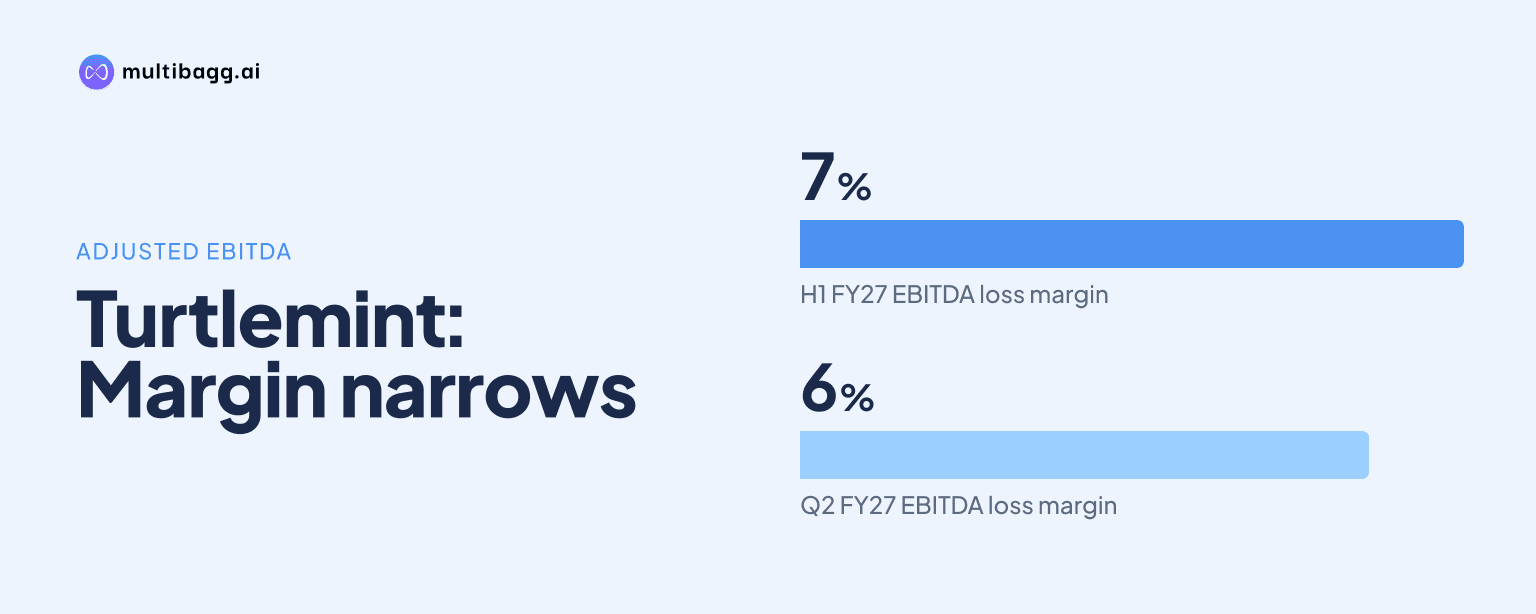
Turtlemint Fintech Solutions narrowed its adjusted EBITDA loss margin to 7% of revenue in H1 FY27 from 17% a year earlier, as revenue grew 38% to Rs 637 crore and overhead costs declined to 21% of revenue from 28%. Service EBITDA rose 66% to Rs 85 crore in the six months.
Know Turtlemint Fintech Solutions inside out
Results, valuation, peers and who's buying, in one view.
How did Turtlemint reduce its H1 FY27 adjusted EBITDA loss?
Turtlemint reduced its H1 FY27 adjusted EBITDA loss margin by 10 percentage points to 7% of revenue from 17% in the prior-year half. Management attributed the movement to 38% revenue growth, faster service EBITDA expansion and a cost base below service EBITDA that increased by only about 2.5% to 3% from the prior-year half. The company did not disclose an absolute adjusted EBITDA loss amount for H1 FY27.
Service EBITDA, the company’s reported earnings measure before costs below that line, increased nearly 66% to Rs 85 crore in H1 FY27 from Rs 51 crore a year earlier. Its margin rose to about 13% of revenue from 11%. Revenue increased by Rs 174 crore year on year, from Rs 463 crore to Rs 637 crore, while service EBITDA increased by Rs 34 crore.
Management said costs below service EBITDA are fixed in nature and expected to increase broadly in line with inflation. Revenue growth of 38% therefore exceeded the reported 2.5% to 3% increase in those costs, allowing a greater share of the Rs 85 crore service EBITDA to absorb overhead and narrow the adjusted EBITDA loss margin.
Why did Turtlemint's overhead cost ratio decline?
Turtlemint’s H1 overhead cost ratio declined to 21% of revenue from 28% in the corresponding prior-year half because revenue rose to Rs 637 crore while costs below service EBITDA increased by only about 2.5% to 3%. Management also said the absolute value of overhead costs had broadly remained the same, indicating that the ratio change was driven principally by revenue growth.
The same pattern appeared in Q2 FY27. Corporate overhead declined to 19% of revenue from 26% in the year-earlier quarter, while the adjusted EBITDA loss margin improved to 6% from 14%. Q2 revenue grew 35% to Rs 342 crore and platform premium grew 55% to Rs 1,214 crore.
The half-year and quarterly comparisons show that the improvement was present in both reporting periods. H1 adjusted EBITDA loss margin improved by 10 percentage points, compared with an eight-percentage-point improvement in Q2. Turtlemint did not disclose quarterly service EBITDA, absolute quarterly overhead or a reconciliation between service EBITDA and adjusted EBITDA.
What drove Turtlemint's revenue and service EBITDA growth?
Turtlemint’s H1 FY27 revenue growth was supported by a 52% increase in platform premium to Rs 2,419 crore and expansion of its digital-partner network. The number of partners active during the three months ending September, defined by management as 90-day active partners, rose to 96,368 from 80,253 a year earlier.
Renewal revenue exceeded Rs 136 crore in H1 FY27, increasing 52% year on year and faster than the 38% growth in overall revenue. Management attributed the increase to improved renewal rates across insurance categories. The quicker expansion in renewals coincided with service EBITDA growth of 66%, compared with revenue growth of 38%.
Turtlemint added 69,000 digital partners during H1 FY27, taking its digital-partner base to 7,28,000. Management said a major share of premium came from Tier 3 and Tier 4 markets, while more than 50% of business came from districts with five or fewer general-insurer offices. These distribution channels supported the H1 platform premium of Rs 2,419 crore.
Got a follow-up? Ask IRIS
Can Turtlemint use AI to contain costs while growing?
Turtlemint’s management said artificial intelligence, or AI, could help keep employee costs flat as it grows and diversifies revenue, but this is a management expectation rather than financial guidance. It said most new code is generated using AI and reported productivity gains across product, technology, marketing, content and analytics teams.
The company launched an AI-based product-training tutor in Q2 FY27 and said it delivered two-times higher learning-to-action conversion. Its learning platform had more than 55,000 average monthly active users. Management said the tutor provides live interactive training in a user’s preferred language and can be scaled to products including mutual funds, loans and fixed deposits.
Turtlemint also launched Ninja AI, an assistant for agents that supports quotes, issuances, payments, renewals, endorsements and claims. Management set a target of three-times higher productivity for digital partners and frontline sales and support staff. Nearly 85% of policies are issued end to end digitally, providing the workflow where the company intends to apply the AI tools.
What could affect Turtlemint's next profitability steps?
Turtlemint’s next profitability steps may be affected by proposed insurance-distribution reforms, which management said could alter partner earnings and product access. Management said 76% of platform premium comes from point-of-sales persons, or POSPs, distributing products from more than eight insurance companies, while more than 60% comes from POSPs selling across more than four insurance subcategories.
Management said 40% of premium comes from POSPs that cross-sell products. It expects proposed removal of product caps in health, life and small and medium enterprise insurance to support broader distribution alongside mutual funds, loans and fixed deposits. These expectations are based on a consultation paper rather than final regulations.
In response to an analyst question on cash burn in FY28 and FY29, management did not provide specific forecasts because the draft regulations were not final. It said it expects to protect service EBITDA in absolute terms next year and expects service EBITDA margin to rise as some business becomes business-to-consumer. Management said its assessment depends on assumptions about partner behaviour, renewals and the final rules.
Conclusion
Turtlemint’s H1 FY27 results show its reported operating leverage: revenue rose 38% to Rs 637 crore, service EBITDA increased 66% to Rs 85 crore and overhead costs declined to 21% of revenue from 28%. Those movements reduced the adjusted EBITDA loss margin to 7% from 17%, while Q2 loss margin also narrowed to 6% from 14%.
The next issue to watch is the final form of the proposed distribution regulations, after which management said it could provide closer modelling. Management also plans to use AI to target three-times higher productivity for partners and frontline staff, while expecting employee costs to remain flat and next year’s absolute service EBITDA to stay in line with its original plan.