










TVS Motor expects Q4 commodity costs to stabilise or ease
Key highlights
- TVS Motor said material costs rose 1.9% from Q1 to Q2, against a 1.6% increase in selling prices.
- Management said Q4 commodity costs could stabilise or ease after unprecedented increases in Q1 and Q2.
- TVS Motor said electric-vehicle activity was at about 60,000 to 65,000 units and capacity is being expanded to about 80,000 units.
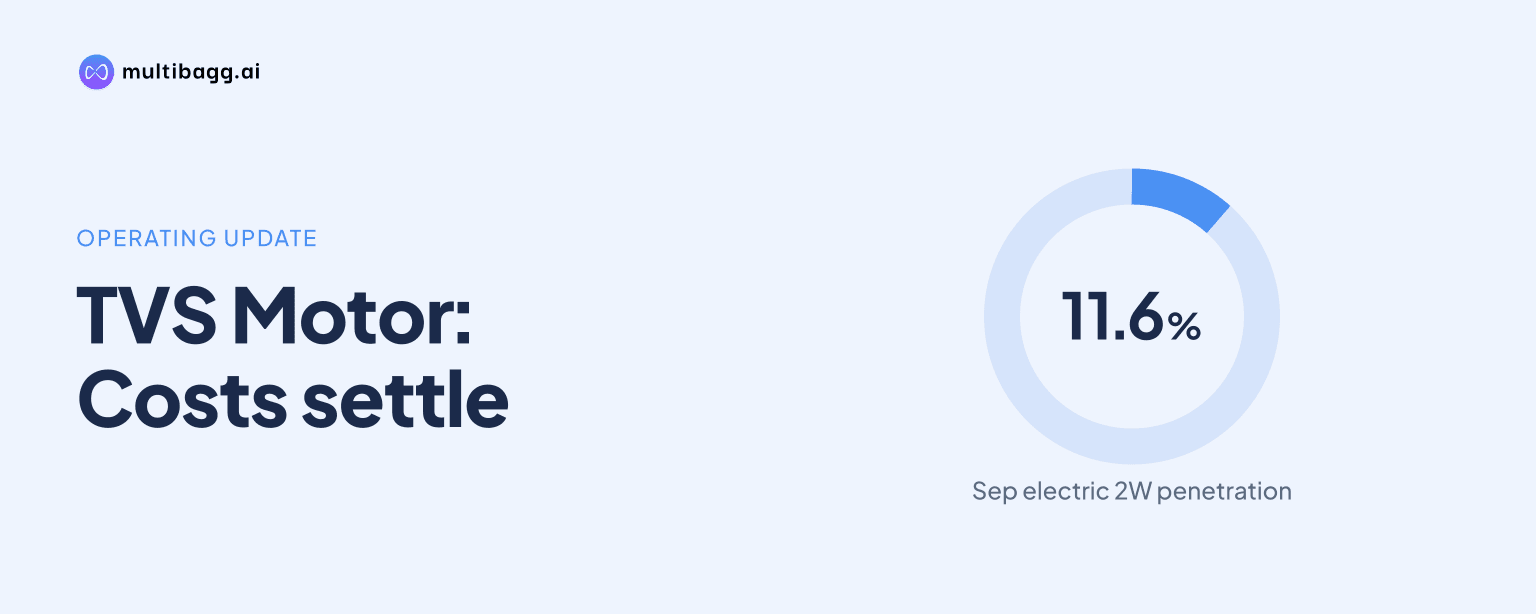
- Electric two-wheeler penetration was 11.6% in September, while electric three-wheeler penetration was almost 47%.
powered by IRIS
TVS Motor Limited said Q4 commodity costs should stabilise or even ease after material costs increased 1.9% from Q1 to Q2, while selling prices rose 1.6%. Management said it would balance selective pricing with product mix, material-cost reduction and revenue growth across its two-wheeler and three-wheeler portfolio.
Know TVS Motor Company inside out
Results, valuation, peers and who's buying, in one view.
What happened to TVS Motor’s material costs and pricing?
TVS Motor reported a 1.9% increase in material costs from Q1 to Q2, compared with a 1.6% increase in selling prices. Management described the increases in the first two quarters as unprecedented and said it had not passed through all cost movements because it also considered customers’ ability to absorb price increases.
The 0.3-percentage-point difference between the reported material-cost and selling-price increases shows that pricing was only one part of TVS Motor’s response. Management cited material-cost reduction, higher-priced variants and product mix as the other levers, applying them across domestic and international operations as well as two-wheelers and three-wheelers.
TVS Motor said it had implemented small price increases at the beginning of Q3, the October-to-December period, and would review the position after Diwali. Management said the review would cover demand and costs rather than treat the Q1-to-Q2 1.6% price increase as full recovery of the 1.9% rise in material costs.
Why does TVS Motor expect costs to ease by Q4?
TVS Motor expects the scale of commodity-cost increases in Q3 and Q4 to be lower than in Q1 and Q2, and management said it was hopeful conditions would stabilise or even ease in Q4. It said small increases could still occur, but that further rises were unlikely to match those experienced in the first half.
Management based this view on its description of a cost cycle in which increases can run for two or three quarters before inputs either soften or remain unchanged. TVS Motor did not identify individual commodities, disclose supplier pricing, or quantify a Q4 cost reduction, so the comment is an outlook rather than formal cost guidance.
TVS Motor said material costs can increase on the first day of a month, whereas selling-price changes and cost-reduction actions take longer. That timing gap is why management described its approach as a continuing process involving price, mix, cost reduction and demand monitoring through Q3 rather than a single price reset.
How could product mix support TVS Motor’s margins?
TVS Motor said top-line and volume growth ahead of the industry would give it flexibility to improve variants and product mix, supporting earnings before interest, tax, depreciation and amortisation, or EBITDA, and profit before tax, or PBT. Management did not provide an EBITDA or PBT margin target for Q3 or Q4.
The company said electric-vehicle profitability was improving quarter after quarter as scale increased and it introduced variants. TVS Motor cited the iQube and Orbiter electric two-wheelers and an electric cargo three-wheeler, but it did not disclose standalone gross profit, EBITDA, or profitability excluding production-linked incentive, or PLI, benefits for either electric two-wheelers or three-wheelers.
TVS Motor said PLI benefits were about 1.3% to 1.4% of turnover and that it had crossed 10,000 cumulative units for a 2% boost rate. Management said electric volumes and the electric share of its portfolio were growing in two-wheelers and three-wheelers, while not quantifying how much PLI, pricing, mix or material-cost reduction contributed to company-level margins.
Got a follow-up? Ask IRIS
What demand and capacity trends affect TVS Motor’s outlook?
TVS Motor expects good single-digit growth for the internal-combustion-engine, or ICE, industry in Q3, while cautioning that November and December face a higher prior-year base. Management said ICE two-wheeler industry growth was about 15.8% in the first half, with about 10% growth in Q1 and almost twice that pace in Q2.
Management said dealer stock for most models was about 21 to 30 days, with many dealers carrying less than 21 days. TVS Motor said it uses the same inventory principle internationally and views cash-and-carry distribution, product availability and customer-led demand as relevant to sustaining revenue and volume growth.
Electric demand is part of the portfolio mix case. TVS Motor said electric two-wheeler penetration reached 11.6% in September and was almost 22% among scooters, while electric three-wheeler penetration was almost 47%. Management also said the electric two-wheeler industry grew almost 75% in the first half.
TVS Motor said it was operating at about 60,000 to 65,000 units in electric vehicles, including domestic activity and exports, and was expanding capacity to about 80,000 units. It also said capacity expansion would help Orbiter availability in Q4 after the product began exports and received greater focus across markets.
How is TVS Motor managing investment alongside costs?
TVS Motor said it would continue investment in brands and future capabilities while managing input costs. Responding to an analyst’s reference to employee costs rising about 33% year on year, management said it had added software, electronics and digital-analytics capabilities for connected vehicles in ICE, electric vehicles and three-wheelers.
Management also linked spending to Ronin’s expansion. It said Ronin started at 1,000 and 2,000 units and that it was confident the model could move beyond 15,000 units, supported by new variants. TVS Motor said it was not increasing marketing costs disproportionately, but considered brand investment necessary for future growth.
Capacity investment extends beyond electric vehicles. TVS Motor said it would exceed 8 million two-wheeler capacity and reach almost 0.4 million three-wheeler capacity soon, while planning for next year as market pull remained positive. These plans do not constitute a near-term margin target, but management linked them to its aim of supporting revenue growth and product availability.
Conclusion
TVS Motor’s outlook depends on input-cost pressure moderating after the 1.9% Q1-to-Q2 material-cost increase, while selective pricing, mix and material-cost reduction continue to support the portfolio. The company raised selling prices by 1.6% in the same period and did not present pricing as the sole mechanism for recovering cost movements.
The next item to watch is management’s post-Diwali assessment of Q3 demand and pricing against the higher November and December comparison base. TVS Motor also plans to expand electric-vehicle capacity from about 60,000 to 65,000 units to about 80,000 units, while maintaining dealer stock in its stated 21-to-30-day range.