










UFO Moviez: Product mix held EBITDA below revenue growth
Key highlights
- Q2 FY27 consolidated revenue rose 17% year on year to Rs 129.9 crore.
- Q2 FY27 EBITDA declined 2% year on year to Rs 21.3 crore.
- Product sales rose 66% to Rs 42.2 crore from Rs 25.4 crore in Q2 FY26.
- Management said the incentive component of manpower cost increased by about Rs 1 crore year on year.
powered by IRIS
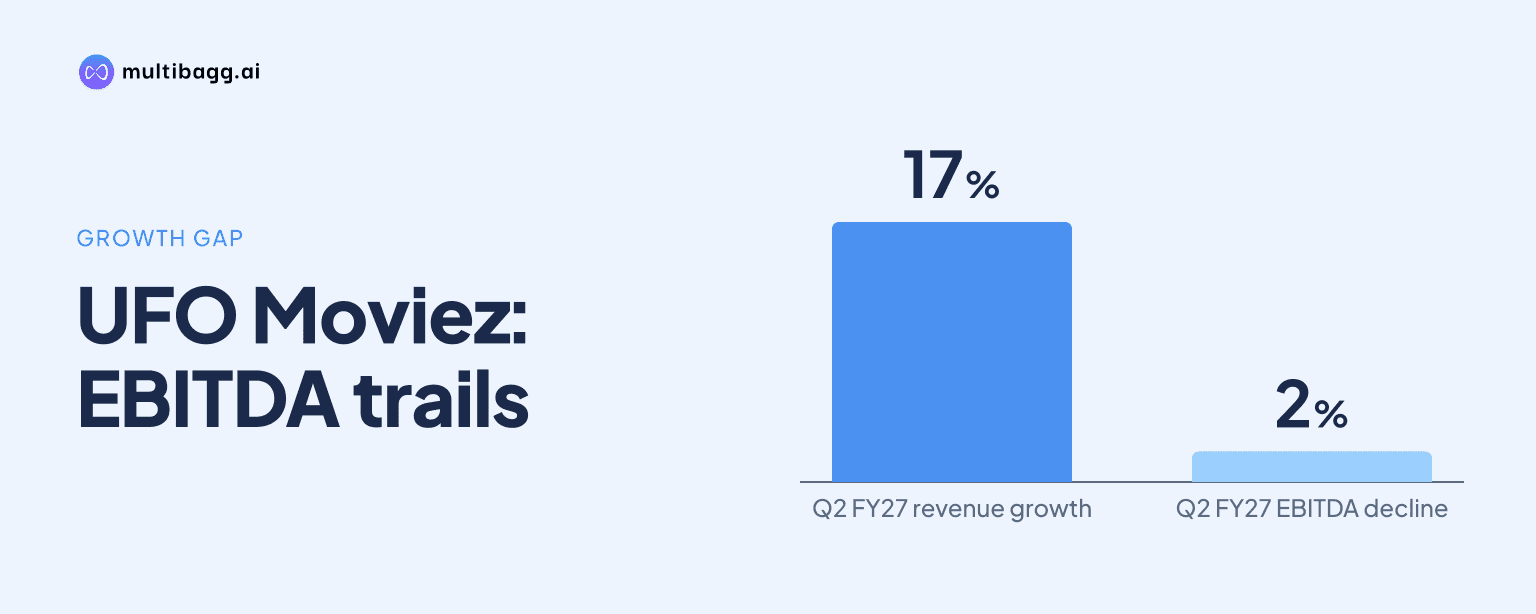
In Q2 FY27, UFO Moviez India Limited's earnings before interest, tax, depreciation and amortisation (EBITDA) fell 2% year on year to Rs 21.3 crore despite 17% revenue growth to Rs 129.9 crore. Management attributed the gap principally to a greater contribution from lower-margin product sales and about Rs 1 crore of additional incentive accrual within manpower costs.
Know UFO Moviez India inside out
Results, valuation, peers and who's buying, in one view.
Why did UFO Moviez's EBITDA fall despite revenue growth?
UFO Moviez's EBITDA fell because revenue growth did not have the same margin profile as its service business, while manpower costs included a higher incentive allocation. Q2 FY27 consolidated revenue increased to Rs 129.9 crore from Rs 111.3 crore in Q2 FY26, but EBITDA decreased to Rs 21.3 crore from Rs 21.8 crore.
The pressure was principally year on year rather than sequential. EBITDA rose from Rs 18.9 crore in Q1 FY27, while net profit increased from Rs 5.7 crore in Q1 FY27 to Rs 6.4 crore in Q2 FY27; however, Q2 net profit remained below Rs 7.5 crore in Q2 FY26.
The first-half figures showed a similar divergence. H1 FY27 revenue rose to Rs 241.7 crore from Rs 220.3 crore in H1 FY26, while EBITDA declined to Rs 40.2 crore from Rs 41.1 crore and net profit fell to Rs 12.1 crore from Rs 14.1 crore.
How did product sales affect UFO Moviez's Q2 FY27 margins?
Product sales reduced the consolidated margin mix because they carry lower gross margins than UFO Moviez's service revenues. Product sales rose 66% to Rs 42.2 crore in Q2 FY27 from Rs 25.4 crore a year earlier, and management identified the related cost of goods sold as the main driver of a 28% year-on-year increase in operating direct costs.
Management said product gross margins have historically ranged from 18% to 24% over about 20 quarters. By comparison, it placed advertising revenue margins above 55%, while Virtual Print Fee (VPF) and Cinema Distribution Charges (CDC) margins were in the 60% to 65% range.
The higher direct cost was linked to a corresponding increase in product revenue, rather than being an unrelated expense, according to management. It said the net margin contribution from the product revenue stream increased 68% year on year, but acknowledged that its gross margin is materially lower than that of services.
UFO Moviez did not disclose a separate reported EBITDA measure excluding product sales. Management said removing product revenue and its direct costs would allocate all remaining manpower and selling, general and administrative (SG&A) expenses to services, so shared costs would instead need to be allocated across revenue streams to assess net profitability.
Got a follow-up? Ask IRIS
What increased UFO Moviez's manpower cost in Q2 FY27?
A roughly Rs 1 crore increase in the incentive component of manpower cost reduced UFO Moviez's Q2 FY27 EBITDA, management said. The company said the Q2 FY26 and H1 FY26 incentive allocations were lower, whereas the policy was applied more realistically from the beginning of FY27.
Management said EBITDA would have risen 2% year on year if the higher variable incentive element were excluded. It also cited higher fixed salaries and a smaller increase in SG&A expenses as reasons EBITDA did not rise in line with the 17% increase in Q2 revenue.
The CFO said the incentive had been rationalised in line with revenue and that costs were budgeted for the next two quarters. That is management's outlook, not reported guidance: the call did not disclose Q3 FY27 or Q4 FY27 manpower and SG&A expense targets.
Management said a substantial reduction in manpower and SG&A had already been completed about 2.5 years earlier as the business emerged from the COVID period. It did not identify a new cost-reduction programme, saying the focus was now on generating operating leverage from incremental revenue.
When could operating leverage improve at UFO Moviez?
Management said UFO Moviez's existing advertising and service-revenue base was at a level where operating leverage could begin to improve results. It did not provide a revenue threshold or formal advertising-revenue guidance for Q3 FY27 or Q4 FY27.
As an illustration rather than a forecast, management said Rs 6 crore of additional advertising revenue could generate at least a 70% profit-before-tax (PBT) margin. It estimated this could add about Rs 4.2 crore to reported PBT of Rs 9.6 crore, implying an increase of roughly 45% to 50% under that scenario.
Management linked that illustration to film performance and advertiser budgets. It said Toxic: A Fairy Tale for Grown-ups underperformed during Q2 FY27, while Hanuman Ansh exceeded initial expectations, and argued that stronger film outcomes can support higher advertising allocation.
For the second half, management cited Ramayana Part 1, King, Avengers: Doomsday, Eetha and Yeh Prem Mol Liya, following October releases including Jailer 2 and Drishyam 3. It said advertisers were showing interest in buying against groups of films, but declined to commit to a quarterly advertising-revenue figure, including an analyst's Rs 40 crore suggestion.
Conclusion
UFO Moviez's Q2 FY27 result indicates that the 17% rise in revenue did not produce comparable EBITDA growth because Rs 42.2 crore of product sales carried lower margins than advertising, VPF and CDC services. About Rs 1 crore of higher incentive accrual, alongside fixed-salary and SG&A growth, also contributed to EBITDA declining to Rs 21.3 crore.
The next results will show whether the cited H2 FY27 film slate generates the additional advertising revenue management says can produce operating leverage. Management also said board-level discussions on a capital-distribution policy had started and it may give a clearer indication by Q3 or Q4, without committing to a dividend or buyback.