








UniHealth says mature India hospitals can reach 24-27% EBITDA
MAX Plan at ₹4,999/yr

Find your next multibaggerBe a Pro Investor
Research stocks and track your picks on the go. Download the app.
Key highlights
- UniHealth expects mature Indian hospitals to generate EBITDA margins of about 24% to 27%.
- Navi Mumbai was not EBITDA-positive in H1 FY27, despite August operational break-even at occupancy above 40%.
- Navi Mumbai's H1 FY27 occupancy was just above 20%, while ARPOB exceeded Rs 35,000.
- India hospital revenue rose from just above Rs 3 crore in H2 FY26 to more than Rs 8 crore to Rs 8.5 crore in H1 FY27.
powered by IRIS
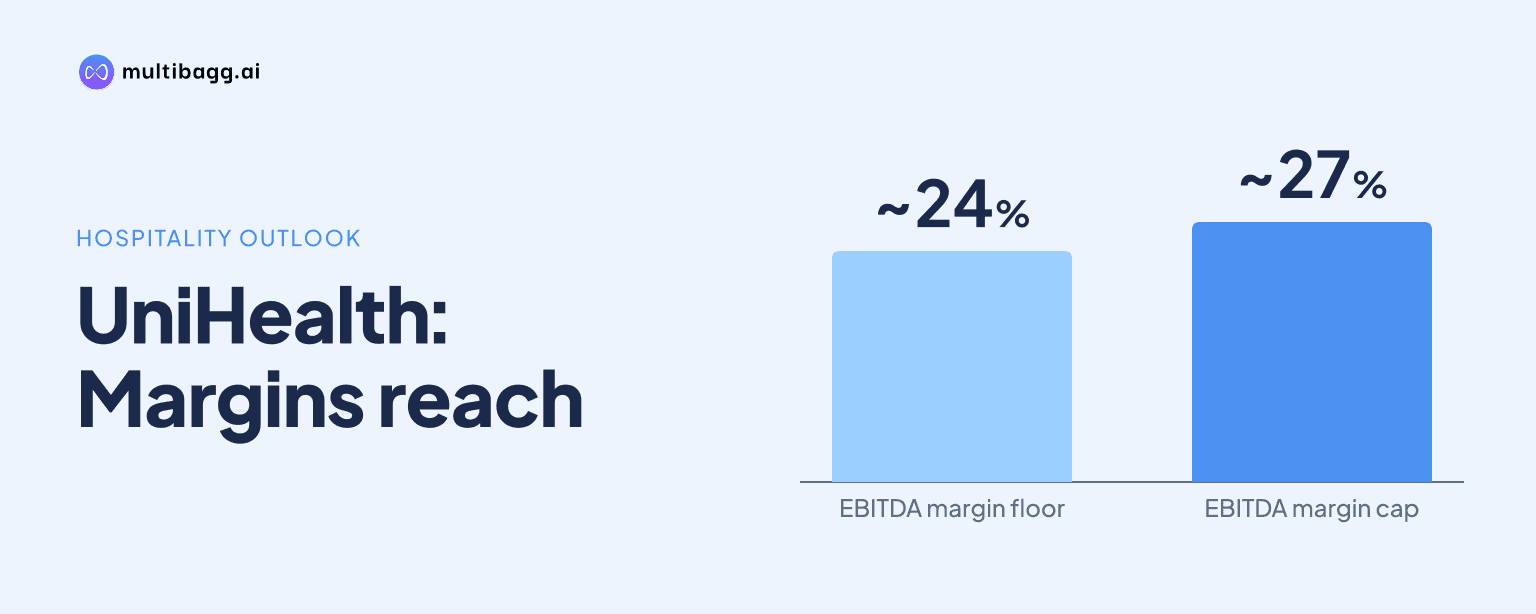
UniHealth Hospitals Limited said mature Indian hospitals can generate earnings before interest, tax, depreciation and amortisation (EBITDA) margins of 24% to 27% after ramp-up. Its Navi Mumbai hospital was not EBITDA-positive in H1 FY27, despite operational break-even in August when occupancy exceeded 40%.
Know Unihealth Hospitals inside out
Results, valuation, peers and who's buying, in one view.
What margin does UniHealth expect from mature Indian hospitals?
UniHealth expects an individual mature Indian hospital to report EBITDA margins of about 24% to 26%, or 27%, management said. That steady-state profile assumes occupancy of 65% to 70% and average revenue per occupied bed (ARPOB) of Rs 40,000 to Rs 50,000 a day. Management presented the range as a mature-facility outcome, rather than current performance from its newly opened Indian hospitals.
For Navi Mumbai and Nashik, UniHealth said the intended ramp-up profile is occupancy of 65% to 67%, potentially reaching 70%, ARPOB of Rs 40,000 to Rs 50,000 a day, and EBITDA margins of around 25% to 26%. This target is below its mature Uganda facility's reported EBITDA margin of above 40%, reflecting the distinction management made between its established African operations and newer Indian assets.
On a consolidated basis, management expects EBITDA margins to be just above 30%, in the initial 30s. It attributed margin volatility during the past 18 months to expansion, as the group combines higher-margin established African facilities with Indian hospitals that are still adding occupancy and revenue.
Why is UniHealth's Navi Mumbai hospital still EBITDA-negative?
Navi Mumbai was not EBITDA-positive in H1 FY27 because its occupancy was only just above 20% for the six-month period. It did reach operational break-even in August, its best month, after occupancy crossed 40%, but that single month did not offset the losses recorded during the first half.
September and October did not repeat the August break-even because Navratri and Diwali reduced elective procedures, management said. Occupancy of roughly 20% to 22% was expected for the first six to nine months, and UniHealth said quarterly performance was increasing even though those two months fell below August's level.
Navi Mumbai's ARPOB was above Rs 35,000 in H1 FY27, ahead of UniHealth's initial Rs 32,500 to Rs 33,000 target. Management said ARPOB was moving towards Rs 37,000 to Rs 37,500 in November. The reported combination of above-plan ARPOB and lower initial occupancy indicates that filling beds and absorbing fixed hospital costs, rather than pricing per occupied bed, remains the main ramp-up issue.
Got a follow-up? Ask IRIS
How has UniHealth's India revenue mix changed?
India revenue was about Rs 15 crore in both H2 FY26 and H1 FY27, but hospital activity became a much larger contributor in the latter period. Hospitals supplied just above Rs 3 crore in H2 FY26 and more than Rs 8 crore to Rs 8.5 crore in H1 FY27, while consultancy and pharmaceutical export and distribution contributed less proportionately.
UniHealth identified hospitals, consultancy services, and pharmaceutical export and distribution as its three India revenue streams. Consultancy and export and distribution were the principal contributors in H2 FY26, whereas hospitals, led mainly by Navi Mumbai, became the principal source in H1 FY27. Management did not provide an exact segmental split for either Rs 15 crore total.
Nashik had no meaningful H1 FY27 revenue contribution because it had operated for only one month, September, and focused mainly on promotional activity. Management expects its revenue base to increase considerably from January to March, but did not give a numerical H2 FY27 target for the facility.
What could improve UniHealth's new-hospital performance in H2 FY27?
Insurance empanelment is the main near-term mechanism that could improve Navi Mumbai occupancy, according to management. UniHealth was negotiating with insurers and anticipated concluding the process before the end of the financial year. Empanelment would enable cashless services and allow the hospital to pursue corporate clients in and around Navi Mumbai, where insurance access is a prerequisite.
Management expects Navi Mumbai's H2 FY27 hospital revenue to at least match its H1 contribution of about Rs 8 crore to Rs 8.5 crore, with additional revenue possible from rising occupancy, ARPOB and insurance agreements. This was a management expectation, not a formal revenue target. Nashik should add some H2 revenue because the second half includes at least one full quarter of operations absent from H1.
Other India businesses could also affect second-half results. UniHealth said consultancy revenue depends on project deliverables and invoicing milestones, while export revenue should improve from H1 after shipments delayed beyond September 30 by SGS and other global factors are booked. The export division sells medical consumables, dialysis consumables and pharmaceutical products.
Conclusion
UniHealth's stated India model requires materially higher occupancy than Navi Mumbai's just-above-20% H1 FY27 level to reach the 24% to 27% mature EBITDA range. The H1 comparison shows the group is shifting India revenue towards hospitals, with hospital revenue increasing from just above Rs 3 crore in H2 FY26 to more than Rs 8 crore to Rs 8.5 crore in H1 FY27, while the new facilities continue their ramp-up.
The next disclosed milestones are Navi Mumbai's insurance empanelment, anticipated before the financial year ends, and Nashik's expected revenue build from January to March. Management also expects Navi Mumbai to at least match its Rs 8 crore to Rs 8.5 crore H1 FY27 hospital contribution in H2, while the timing of consultancy invoices and delayed export shipments remains relevant to the outcome.

