








UniHealth sees ₹150-200 crore FY27 revenue after Tanzania delay
MAX Plan at ₹4,999/yr

Find your next multibaggerBe a Pro Investor
Research stocks and track your picks on the go. Download the app.
Key highlights
- UniHealth said FY27 revenue is likely to be ₹150 crore to ₹200 crore, versus an earlier ₹300 crore indication.
- UniHealth reported ₹77 crore of revenue in H1 FY27.
- Pending statutory approvals deferred the Tanzania hospital operating takeover anticipated in H1 FY27.
- Navi Mumbai ARPOB exceeded ₹38,000 in H1 FY27, while average occupancy was about 20%.
powered by IRIS
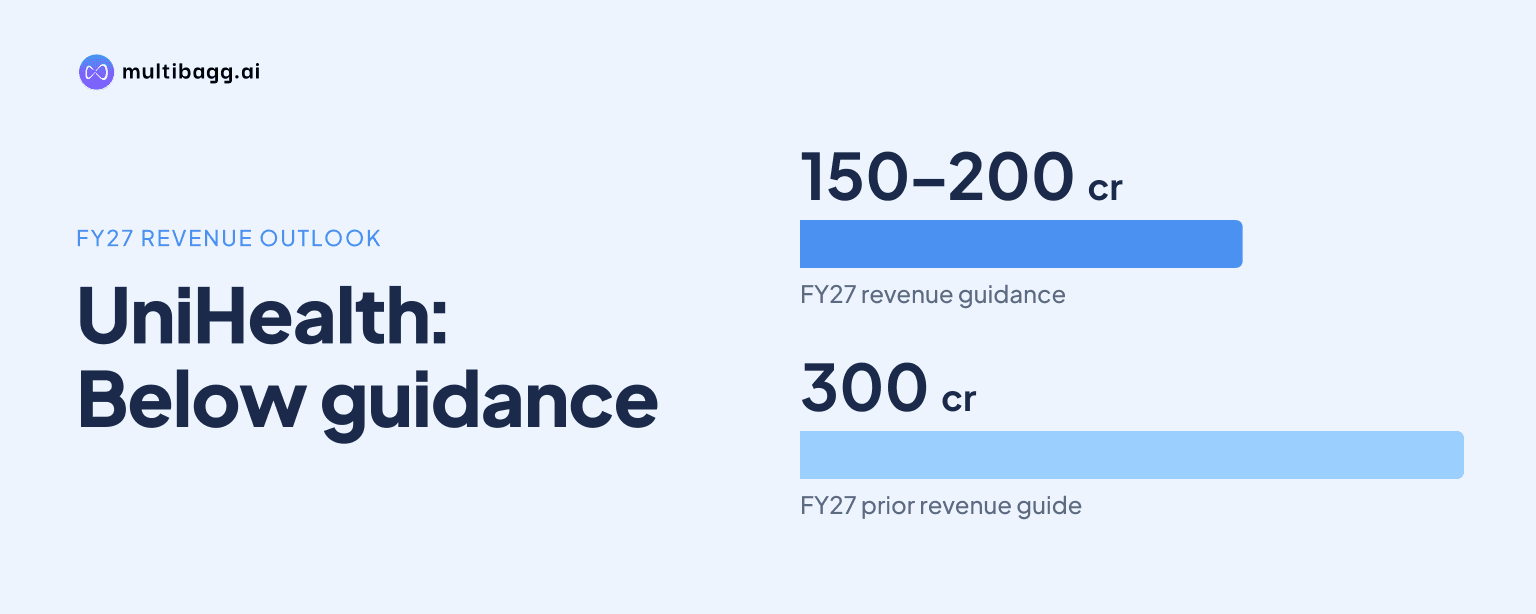
UniHealth said FY27 revenue is likely to be ₹150 crore to ₹200 crore, after statutory approvals delayed a Tanzania hospital operating takeover that management expected to make a significant top-line contribution. UniHealth reported ₹77 crore in H1 FY27 and said second-half growth will instead depend largely on its Indian operations.
Know Unihealth Hospitals inside out
Results, valuation, peers and who's buying, in one view.
Why has UniHealth lowered its implied FY27 revenue outlook?
UniHealth’s implied FY27 revenue outlook has fallen because its Tanzania operating takeover, anticipated during H1 FY27, was deferred while statutory approvals remained pending. Management said the proposed takeover was likely to make a significant addition to revenue, but described the permissions as still in process at the time of the call.
The current likely range of ₹150 crore to ₹200 crore compares with the ₹300 crore FY27 figure that an investor said had appeared in the previous investor presentation. Management acknowledged the concern that the current presentation did not provide a revised guidance figure and agreed that such information should be communicated to all stakeholders at the same time.
The source does not show that the Tanzania plan has been cancelled. Management described it as deferred because of approvals beyond its control, but did not disclose a replacement completion date, an expected revenue contribution or a timetable for including Tanzania operations in UniHealth’s reported revenue.
How does UniHealth expect to reach ₹150 crore to ₹200 crore?
UniHealth said H2 FY27 revenue was likely to match its ₹77 crore H1 FY27 result and add another 15% to 20%, or somewhat more. Management therefore placed the full-year outcome in the ₹150 crore to ₹200 crore range, depending on the revenue delivered by the Indian business.
That range remains below the earlier ₹300 crore indication even though management expects higher second-half revenue. The H2 plan depends on increased revenue from the Navi Mumbai hospital, an initial contribution from Nashik, consultancy milestones and export-and-distribution shipments that were delayed beyond September 30.
Management did not give separate numeric FY27 targets for those businesses. It said consultancy invoices depend on project deliverables, internal discussions and contractual milestones, while export revenue depends on completing and booking shipments of medical consumables, dialysis consumables and pharmaceutical products in H2.
What is changing in UniHealth’s Indian hospital business?
UniHealth expects the Navi Mumbai hospital to at least repeat its H1 FY27 hospital revenue contribution and increase it as occupancy rises. Hospitals contributed more than ₹8 crore to ₹8.5 crore of Indian revenue in H1 FY27, compared with just above ₹3 crore from hospitals in H2 FY26.
India revenue was about ₹15 crore in both H2 FY26 and H1 FY27, but its composition changed. H2 FY26 revenue came mainly from consultancy services and pharmaceutical export and distribution, while H1 FY27 revenue was mainly hospital-led after Navi Mumbai reached full commissioning on February 15, 2026.
Navi Mumbai’s average revenue per occupied bed, or ARPOB, exceeded ₹38,000 in H1 FY27, above management’s earlier target range of ₹35,000 to ₹37,500. Average occupancy from April 1 to September 30 was about 20%, while August occupancy exceeded 40% and the hospital achieved operational break-even for that month.
September and October did not repeat August’s operational break-even because elective procedures declined during Ganpati, Navratri and Diwali, management said. Navi Mumbai was not earnings before interest, tax, depreciation and amortisation, or EBITDA, positive for H1 FY27, and management identified insurance empanelment as necessary to widen cashless access and corporate patient coverage.
Got a follow-up? Ask IRIS
Can Nashik, consultancy and exports lift UniHealth’s second half?
UniHealth expects Nashik to contribute revenue in H2 FY27, although management did not quantify the amount because the facility began operations only on September 1. The hospital initially focused mainly on promotional activity, but management said it had started revenue-generating neurosurgical, joint-replacement, laparoscopic and intensive-care procedures.
Management’s initial ARPOB aim for Nashik is ₹27,500 to ₹30,000 per day for the current financial year. It said occupancy should be assessed from the start of the next financial year because marketing and insurance empanelments are still being developed, making Nashik an incremental rather than mature contributor in H2 FY27.
Consultancy may add to H2 revenue, but management said invoicing is conditional on project milestones and gave no forecast. It added that an extra ₹50 lakh to ₹2 crore of consultancy revenue has historically produced EBITDA margins above 50% for that revenue because fixed costs in the vertical are relatively small.
Export and distribution revenue is also expected to be higher in H2 than H1 after some shipments could not be completed before September 30 because of SGS-related and other global delays. Management said two shipments were expected to move during the relevant month, alongside regular quarterly exports, but did not disclose their value.
What operating milestones could affect UniHealth’s revenue path?
UniHealth’s Uganda facility is its mature-hospital comparison, recording ARPOB above ₹45,000 in H1 FY27 at occupancy slightly above 65%. Management intends to raise ARPOB through specialties including ophthalmology, introduced in July, and planned microscopic brain and spine procedures, while referrals from its clinic network are intended to support occupancy.
For Navi Mumbai, management is targeting ARPOB above ₹40,000 and occupancy beyond 40% to 45% as the route to EBITDA positivity. The hospital recently received an orthopaedic robot for robotic knee and hip replacements, and management expects insurance empanelments to conclude before the end of the financial year.
Management said a mature Indian facility could operate at 65% to 70% occupancy, with ARPOB of ₹40,000 to ₹50,000 per day and EBITDA margins of about 24% to 27%. It expects consolidated EBITDA margins in the low 30% range because UniHealth combines higher-margin African operations with expanding Indian facilities, though these are management expectations rather than FY27 commitments.
Conclusion
UniHealth’s likely FY27 revenue range of ₹150 crore to ₹200 crore represents a reset from the earlier ₹300 crore indication, as the delayed Tanzania operating takeover removes an anticipated significant revenue addition. The company is now relying on a higher H2 contribution from its ₹77 crore H1 FY27 base, led by Navi Mumbai, Nashik, consultancy and exports.
The next items to watch are statutory approvals for Tanzania, Navi Mumbai insurance empanelments that management expects before the financial year-end, and Nashik’s revenue build from January to March. Management has not supplied a revised Tanzania timetable or quantified segment forecasts, leaving the final H2 contribution from these initiatives unresolved.

