








United Heat shifts to standard products to shorten cycles
MAX Plan at ₹4,999/yr

Find your next multibaggerBe a Pro Investor
Research stocks and track your picks on the go. Download the app.
Key highlights
- United Heat said CDU piping and engine equipment take 3 to 4 weeks to manufacture, versus 3 to 4 months for customised project equipment.
- Management expects EBITDA margin to improve by 2% to 3% next financial year from the last full-year level.
- United Heat has dedicated Ambad to CDU piping and said the facility could support Rs 100 crore or more of revenue.
- Management expects at least Rs 50 crore from the data-centre vertical in the next full financial year.
powered by IRIS
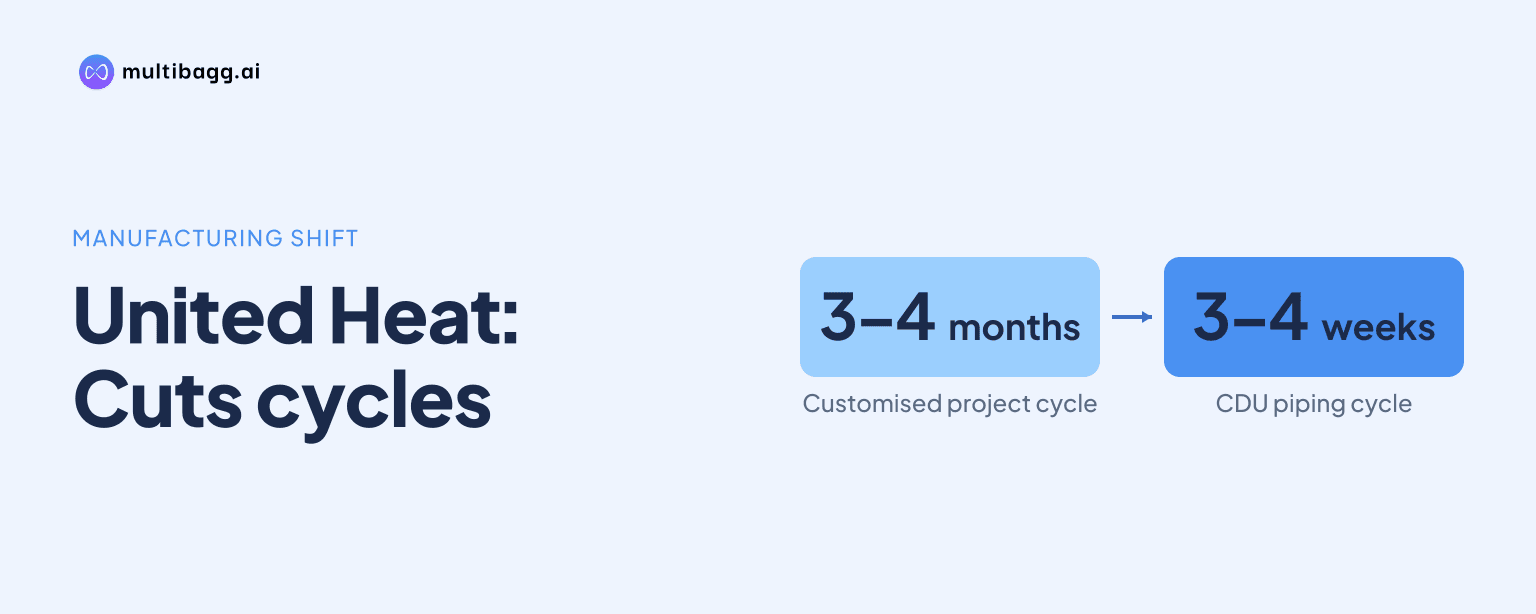
United Heat said its move toward standard CDU piping assemblies and original equipment manufacturer contracts can reduce end-to-end manufacturing time to three to four weeks, compared with three to four months for customised project equipment, while management expects EBITDA, or earnings before interest, taxes, depreciation and amortisation, margin to improve by 2% to 3% next financial year.
Know United Heat Transfer inside out
Results, valuation, peers and who's buying, in one view.
Why is United Heat changing its product mix?
United Heat is changing its mix because customer-specific equipment takes more time and management effort to scale than repeatable standard products. Management said that, over the past two years, it has systematically worked to add more standard-type business through customers including Vertiv and Hitachi, while maintaining a balance between customised and standard products.
Land is not the primary constraint, according to management. United Heat’s second plant has 13 acres, with only about one-third currently used, but customised production requires customer-specific planning, drawings and approvals before infrastructure can be deployed. Management said the company will develop capacity gradually against identified customer requirements rather than build without a production plan.
How much faster are United Heat’s standard products?
United Heat said CDU piping assemblies and engine-based equipment require three to four weeks of end-to-end manufacturing, against three to four months of actual factory work for project-based equipment. The shorter cycle allows CDU orders to be delivered weekly or monthly after production starts, while engine-manufacturer orders are supplied on monthly schedules.
The project timeline extends beyond factory work. Management said drawing approvals, material inspection by agencies, customers or end users, and stage-wise inspections lengthen customised orders to three to six months and sometimes eight months, even when manufacturing itself takes three to four months. For OEM products, actual production takes about eight to 10 weeks and typical order execution is one to three months.
This difference explains why United Heat is seeking more schedule-based demand. Standard CDU and engine-related products can be repeated to a defined design and supplied against recurring schedules, whereas bespoke engineering work can occupy capacity while approvals and inspections are completed. Management said its historical concentration in customised equipment made expansion of that activity more challenging.
How will automation improve United Heat’s production economics?
United Heat expects a 2% to 3% improvement in EBITDA margin next financial year from the last full-year level, driven partly by a higher share of CDU piping and greater automation. Management said CDU piping assemblies carry somewhat better margins than other current products, while customer-specific work is less suited to machine-based and automated operations.
At its Talegaon plant, United Heat is adding laser-cutting machines that management said can combine three separately performed processes into a single machine operation. It is also adding special-purpose machines, or SPMs, to reduce dependence on manual work, shorten processing time and allow equipment to operate for 24 hours.
The expected margin improvement is also tied to the contract structure. In scheduled CDU and engine-manufacturer orders, prices are fixed and reviewed quarterly, with the prior quarter’s raw-material movement passed through in the next quarter. In customised orders, the quoted price generally remains unchanged for six months, although United Heat said it typically books material immediately after receiving the order to limit exposure to price changes.
Got a follow-up? Ask IRIS
Which customers support United Heat’s repeat-order model?
United Heat said compressor manufacturers on its customer list are repeat buyers, with orders recurring monthly or quarterly. Management cited Burckhardt Compression as having one or two orders in production at a time and said IR issues orders every month; Atlas Copco, Kirloskar, Kirloskar Oil Engine, Pneumatics and Siemens were also named as customers with products in production.
National Compressor Canada illustrates the intended progression from a new relationship to repeat orders. Management said the customer began ordering in the current year, after which United Heat received three orders and had another in the pipeline. It did not disclose a revenue value or delivery schedule for that pipeline.
For Vertiv, United Heat is initially supplying pipe assemblies required for CDU systems rather than heat exchangers. Management said the samples had been physically approved, but written confirmation and order flow depended on compliance requirements, including ultrasonic cleaning equipment. It said it expected to be ready by the end of Q4, or earlier, for the next stage of engagement.
What revenue capacity does United Heat see from CDU production?
United Heat has vacated its Ambad facility for CDU piping production and said the site can generate revenue of Rs 100 crore or more. This is management’s capacity estimate rather than reported revenue or a confirmed order value. Management also said CDU piping assembly margins are somewhat better than those of other current products.
For the data-centre vertical, management conservatively expects at least Rs 50 crore of revenue in the next full financial year once operations are fully running. It linked this outlook to production beginning from April 2027 and said it expects the new vertical to support a further 2% to 3% EBITDA-margin improvement from the last full-year level.
The initial scope remains limited to CDU pipe assemblies. Vertiv currently sources heat exchangers separately, although management said United Heat may pursue heat-exchanger work after rolling out the current product. Separately, United Heat said it is targeting 35% to 40% growth next financial year and has a longer-term target of 30% compound annual growth for five years, while noting that growth beyond the next financial year is difficult to predict.
Conclusion
United Heat’s strategy is to reduce the share of production time tied up in bespoke project work by increasing repeatable CDU, engine-equipment and OEM business. The key operational contrast is three to four weeks for CDU and engine equipment against three to four months of actual manufacturing for customised projects, with automation at Talegaon intended to reduce manual processing further.
The next points to watch are United Heat’s readiness by the end of Q4 for Vertiv-related order bidding and the start of data-centre production from April 2027. Management has identified at least Rs 50 crore of data-centre revenue in the next full financial year and Rs 100 crore or more of potential revenue capacity at Ambad, but written Vertiv confirmation and the scale of additional CDU or heat-exchanger work remain unresolved.

