








United Heat Transfer Limited sees Rs 50 crore FY28 CDU revenue
MAX Plan at ₹4,999/yr

Find your next multibaggerBe a Pro Investor
Research stocks and track your picks on the go. Download the app.
Key highlights
- United Heat Transfer expects at least Rs 50 crore of FY28 revenue from its data-centre vertical.
- Ambad is planned to begin at 200 CDU sets a month by December-end 2026 or January 2027.
- United Heat Transfer said Ambad capacity could rise from 200 to 300 CDU sets a month with further improvement.
- Management estimated Rs 5 crore to Rs 6 crore of related CapEx had already been spent.
powered by IRIS
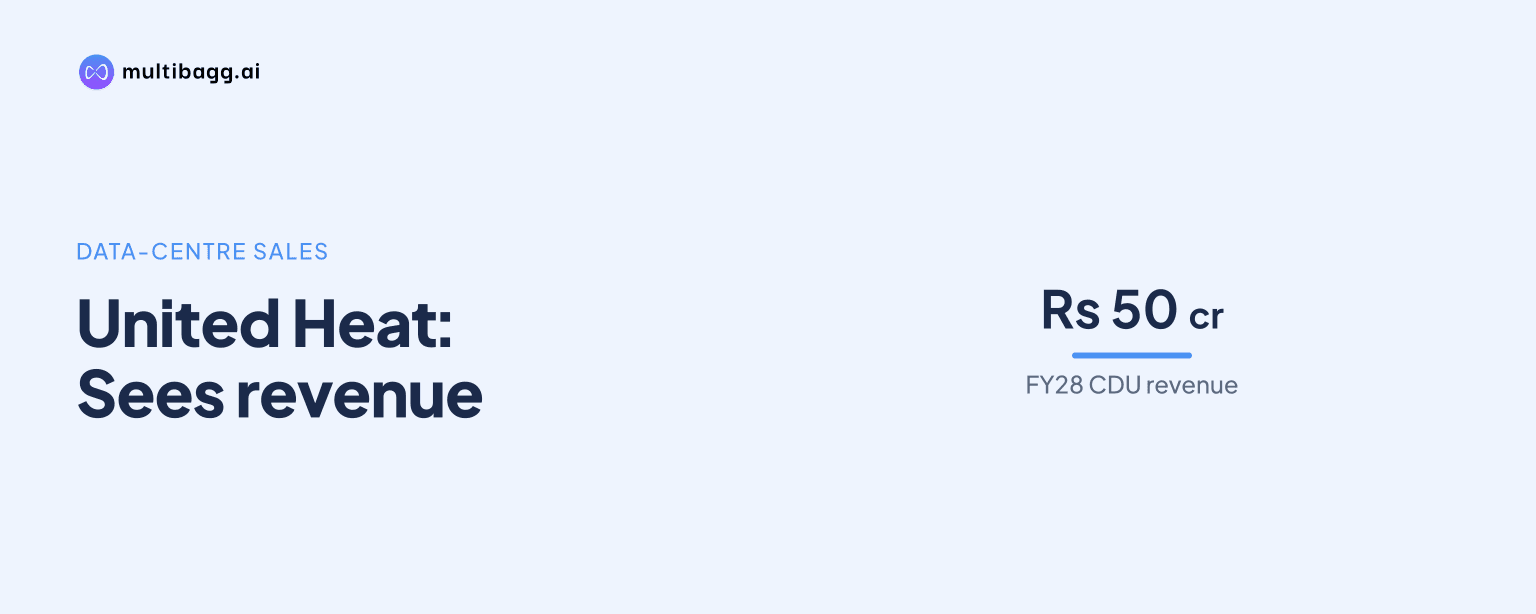
United Heat Transfer expects its data-centre vertical to add at least Rs 50 crore in FY28, assuming production begins in April 2027, after preparing its Ambad plant for 200 CDU sets a month by December-end 2026 or January 2027 and completing remaining Vertiv compliance requirements.
Know United Heat Transfer inside out
Results, valuation, peers and who's buying, in one view.
What revenue does United Heat Transfer expect from data centres in FY28?
United Heat Transfer expects, conservatively, at least Rs 50 crore from its data-centre vertical in FY28. Management gave the estimate in response to a question that assumed production would start in April 2027, so it is an expectation rather than reported revenue, a confirmed order book or formal guidance.
The projected FY28 contribution compares with about Rs 37 crore of revenue booked to date in FY27 and orders worth around Rs 50 crore that management said were yet to be executed in the current financial year. Management also said H1 FY27 revenue had grown 50% from the corresponding prior-year half and that it was targeting overall FY27 growth of 30% to 35%.
Management linked the proposed contribution to its CDU product line, with CDU being the term it used for the new product line. It said CDU orders, once started, would be supplied weekly or monthly, unlike engineering, procurement and construction, or EPC, projects, where delivery periods can range from three months to eight months.
When will United Heat Transfer's Ambad plant be ready for CDU production?
United Heat Transfer said Ambad should be ready for production by December-end 2026 or, at the latest, January 2027, with initial capacity of 200 CDU sets a month. Management said it had already shifted existing Ambad production to Talegaon, enabling Ambad to be prepared for Vertiv-related work.
The work includes epoxy coating of Ambad’s three workshops, cleaning, painting, plumbing and gas-line provisions. Management said the critical ultrasonic-cleaning machine had arrived the day before the November 19, 2026 call, that installation was expected to begin the following day and that the process could take about one week. It had also placed orders for further capacity-enhancement equipment expected on the shop floor within another month.
Management said the requirement is for a dust-free area, not a clean room. At Talegaon, ventilation-system installation was the remaining element of the dust-free-area work and was expected to take one to two weeks, while a newly received laser-cutting machine was under installation to improve processing efficiency and support approvals.
How much can United Heat Transfer make at Ambad?
United Heat Transfer plans to manufacture about 200 CDU sets a month at Ambad initially and said further improvement could add around 100 sets a month, taking potential capacity to 300 sets. Management did not give a date, capital cost or customer order volume for achieving the 300-set level.
The planned capacity supports a shift towards more standardised products. Management said it had spent the past one to two years seeking to balance customised work with standard products, including business with Vertiv, Hitachi and other customers. It said land was not the central constraint because its second plant has 13 acres, of which only about one-third is being used.
Manufacturing time also differs across product types. Management said CDU and engine-based equipment take three to four weeks from end to end, compared with about eight to 10 weeks for original equipment manufacturer, or OEM, products. EPC projects require about three to four months of actual manufacturing, although drawing approvals and material and stage-wise inspections can lengthen the overall delivery cycle.
Got a follow-up? Ask IRIS
What approvals and capital spending remain before orders can flow?
United Heat Transfer said its samples had received physical approval and that Vertiv had communicated approval verbally, but written confirmation and order flow depend on completing compliance requirements identified in a quality audit. The ultrasonic-cleaning machine forms part of that compliance work, and management said it had informed Vertiv that it would be ready for a visit any time after the 23rd, although Vertiv had not confirmed an inspection date.
Management said the production process at the new facility would not change. Vertiv had shared what management described as final drawings for the current series, with possible later changes limited to matters such as sizes or the positions of collars or joints. A change to a specific drawing could require United Heat Transfer to submit a new sample for that part.
Management estimated that it had spent around Rs 5 crore to Rs 6 crore on capital expenditure, or CapEx, for the facility and capacity work, while noting that the exact figure needed checking against its books. It did not disclose remaining CapEx, but said it expected to be ready to bid for orders by the end of Q4 and hoped order inflows could begin earlier after inspection and approval.
How could the new business affect margins and working capital?
United Heat Transfer expects earnings before interest, tax, depreciation and amortisation, or EBITDA, to improve by another 2% to 3% in the next financial year from the last full-year EBITDA margin. Management presented this as an expectation related to the prospective data-centre business, rather than disclosing a FY28 EBITDA margin target.
Management said it was negotiating working-capital arrangements for Vertiv business and had communicated its expectations on payment terms. It also said Vertiv has ties with financial institutions through which United Heat Transfer could discount bills, but did not disclose a committed facility amount, payment period or working-capital requirement for the expected Rs 50 crore of FY28 revenue.
For scheduled standard-product orders such as CDU products, management said prices are fixed and reviewed quarterly, with raw-material cost increases or declines reflected in the following quarter’s pricing. For customised orders, quoted prices generally remain fixed for six months, and management said it typically books material immediately after receiving an order.
Conclusion
United Heat Transfer’s plan is to convert Ambad into a production base for the Vertiv-related CDU opportunity, beginning with 200 sets a month and with scope for 300 sets. Management’s expectation of at least Rs 50 crore in FY28 data-centre revenue gives the new vertical a stated scale, but the outcome depends on production beginning from April 2027 and orders following compliance completion.
The next disclosed milestones are remaining equipment installation, plant readiness by December-end 2026 or January 2027, and Vertiv’s still-unscheduled facility visit after the company’s stated readiness date of the 23rd. Written approval, order inflows, remaining CapEx and working-capital arrangements will determine whether the planned FY28 ramp proceeds on schedule.

