










Usha Martin Limited sees Thailand margin rising to 14%-15%
Key highlights
- Usha Martin targets Thailand EBITDA margin of 14%-15%, up from 6%-7%, within 18 months.
- Thailand volume is expected to increase by 10%-15% over the next 18 months.
- Usha Martin reported Q2 FY27 operating EBITDA of Rs 202 crore and a 20.2% margin.
- H1 FY27 operating cash flow before tax was Rs 413 crore, equal to about 101% of operating EBITDA.
powered by IRIS
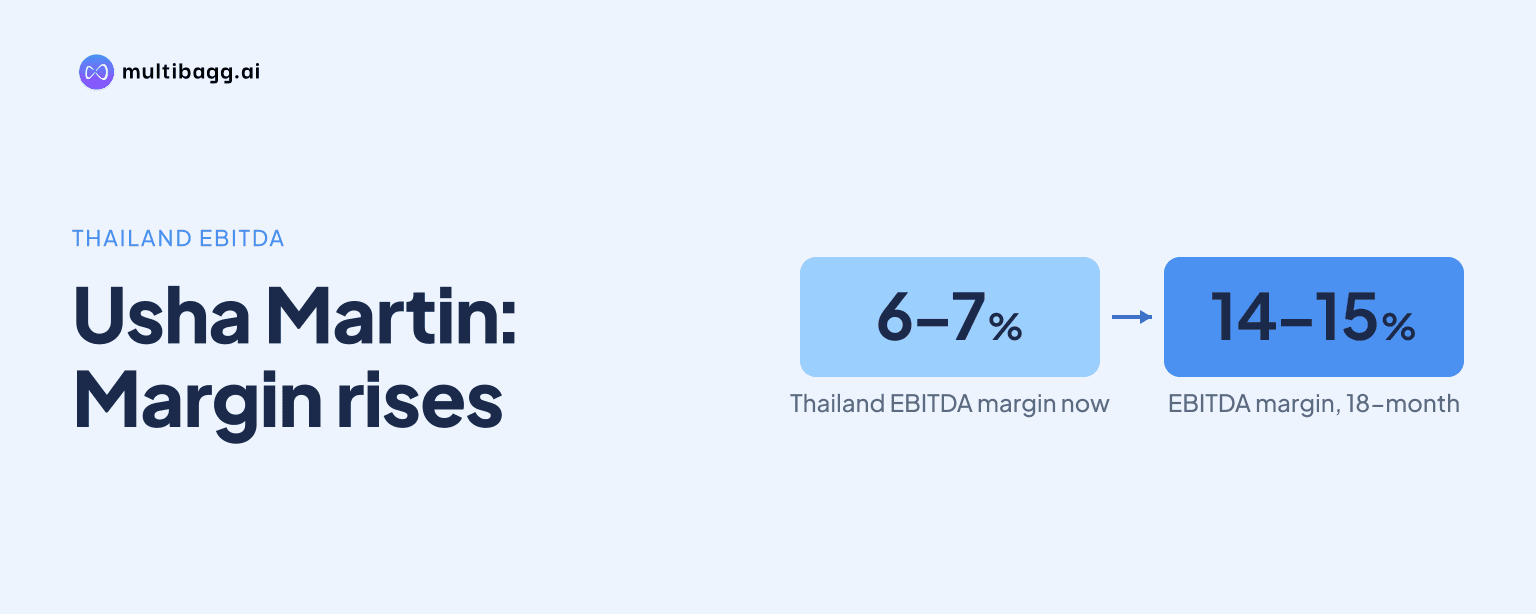
Usha Martin expects its Thailand operation’s earnings before interest, tax, depreciation and amortisation (EBITDA) margin to rise from 6%-7% to 14%-15% over the next 18 months, management said on November 13, 2026. The plan combines lower upstream costs through Ranchi integration, overhead reductions and a shift toward higher-value ropes for Southeast Asia.
Know Usha Martin inside out
Results, valuation, peers and who's buying, in one view.
What is Usha Martin targeting for its Thailand business?
Usha Martin is targeting a Thailand EBITDA margin of 14%-15%, compared with its current 6%-7%, alongside a 10%-15% increase in volume over the next 18 months. Managing Director Rajeev Jhawar presented the target as the expected result of a comprehensive review of the Thailand business model, which management has started after a similar exercise in Europe.
The target addresses an operation whose profitability is “significantly below” the group average. Usha Martin did not disclose Thailand’s revenue, current volume or capital spending for the programme, so the 14%-15% margin and 10%-15% volume increase are management expectations rather than reported financial results. Management said the change should improve both Thailand’s profitability and the wider group’s EBITDA margin.
The margin objective is separate from Usha Martin’s group-level FY27 outlook. For FY27, management said it remained confident of achieving 15% revenue growth, an operating EBITDA margin of around 20%, and cash conversion of approximately 100%. Thailand’s turnaround therefore seeks to lift an underperforming unit while the consolidated business maintains its existing profitability target.
How will Usha Martin lower Thailand’s operating costs?
Usha Martin plans to move certain upstream processes from Thailand to Ranchi, where management said costs are lower, while retaining significant manufacturing in Thailand to remain close to Southeast Asian customers during the 18-month programme. The arrangement is intended to reduce conversion and operating costs at the group level without moving all production away from Thailand.
The programme also includes rationalising manpower and overheads, modernising older machinery, and selectively adding rope-finishing equipment. Management linked the equipment investment to the higher-value rope applications it wants Thailand to make, rather than identifying a standalone Thailand capital-expenditure amount. The stated mechanisms are therefore both a cost-base reset and a production upgrade.
Ranchi is already receiving investment in other specialised rope categories. Usha Martin said its Ranchi elevator-rope expansion was being commissioned and that the full additional capacity of 500 metric tonnes a month should be operational by the first quarter of the next financial year. It also commissioned about 100 tonnes a month of higher-value mining-rope capacity, showing the Ranchi site’s broader role in specialised-rope production.
The group spent about Rs 143 crore on capital expenditure in H1 FY27. Management expects annual organic-growth capital expenditure of about Rs 200 crore to Rs 250 crore, covering completion of the elevator-rope project, specialised mining ropes, plasticated low-relaxation pre-stressed concrete steel (LRPC), and specialised wire capacity. It did not specify how much of that annual amount relates to Thailand.
Which Southeast Asian rope markets will Usha Martin pursue?
Usha Martin will focus Thailand on elevators, cranes, piling and port ropes over its 18-month turnaround programme, which management identified as higher-value applications with relatively strong Southeast Asian demand. The company has strengthened its commercial team for those segments and positioned Thailand as its primary manufacturing hub for the region.
This product focus is designed to improve mix as well as volume. Management said its global businesses have already progressed toward more specialised ropes, and it sees considerable room to develop the same approach in Southeast Asia. The Thailand plan is not based on selling more general-purpose rope alone, but on raising the share of applications that need tailored finishing and carry greater value addition.
A disclosed commercial development supports the regional emphasis: Usha Martin recently secured a three-year port contract with a large Southeast Asian port operator and increased its share of wallet. Management said such contracts and consignment arrangements, including those being developed in Southeast Asia and the United States, can create more recurring volume visibility.
Thailand’s role also sits alongside improved U.S. and European performance. In H1 FY27, Usha Martin’s U.S. entity recorded approximately 12% volume growth and 22% revenue growth, while combined European entities and direct exports to Europe increased sales by about 11%. Management attributed European value growth primarily to service activity and a better product mix, despite broadly flat volume.
Got a follow-up? Ask IRIS
Why is the Thailand plan important to Usha Martin’s group performance?
Usha Martin’s Thailand programme is important because international rope volumes were constrained in H1 FY27 even as group profitability increased. Management said Middle East demand weakened amid geopolitical uncertainty, higher freight costs and cautious distributor stocking, while the company protected regional profitability through its service model and improved mix.
Freight rates to key U.S., European and Middle Eastern markets rose by as much as four to six times at their September peak compared with February, management said. This affected order execution and general-purpose rope demand. In contrast, domestic wire-rope volume reached 12,700 metric tonnes in Q2 FY27, up 14% year on year, and realisations increased 12% as mix and market conditions improved.
At the consolidated level, Usha Martin reported Q2 FY27 revenue of Rs 1,000 crore, up 12.4% year on year, and operating EBITDA of Rs 202 crore, up 16.5%. Operating EBITDA margin rose to 20.2% from 19.5% in Q2 FY26. The Thailand margin target is material in this context because management said the unit’s improvement should contribute to group profitability rather than merely improve local results.
For H1 FY27, consolidated revenue rose 14.8% to Rs 2,021 crore and operating EBITDA rose to Rs 410 crore from Rs 319 crore, lifting the margin to 20.3% from 18.1%. Operating cash flow before income tax was Rs 413 crore, equal to about 101% of operating EBITDA, and the company ended September with net cash of Rs 415 crore after dividends and capital expenditure.
What could determine whether Usha Martin reaches the target?
Usha Martin’s ability to reach the 18-month Thailand target depends on completing cost integration and building sales in the intended specialised segments. Management has identified specific actions, including upstream transfer to Ranchi, workforce and overhead rationalisation, machinery modernisation, rope-finishing investment and expanded commercial coverage, but it did not provide interim Thailand milestones.
External logistics and regional demand remain relevant uncertainties. Management said Red Sea disruptions had begun easing more recently, offering some relief on freight costs to the U.S. and Europe for H2, but it also described the broader environment as uncertain. For Thailand, the volume objective of 10%-15% will depend on converting demand in ports, elevators, piling and construction into orders.
Management’s approach to volume elsewhere indicates its priorities. Group rope and wire volumes in H1 were flat at 101,000 metric tonnes, while LRPC volume fell about 17% to 19,000 tonnes from 23,000 tonnes. Usha Martin said it would not sell conventional black LRPC at a loss, preferring plasticated LRPC and higher-value ropes, a discipline that also underpins Thailand’s mix-led turnaround.
Conclusion
Usha Martin has set a defined operating objective for Thailand: lift EBITDA margin from 6%-7% to 14%-15% and increase volume by 10%-15% within 18 months. The plan connects lower-cost upstream work at Ranchi with Thailand-based manufacturing and a greater concentration on elevator, crane, piling and port ropes in Southeast Asia.
The next indicators will be execution of the Ranchi integration, modernisation and finishing-equipment steps, plus evidence of sales growth in Southeast Asian specialised ropes. Management’s FY27 targets remain 15% revenue growth, around 20% operating EBITDA margin and approximately 100% cash conversion, while its annual organic capital-expenditure plan is Rs 200 crore to Rs 250 crore.