










Usha Martin says freight surge cut Middle East rope volume 30%
Key highlights
- Usha Martin said Middle East rope volumes declined 30% in the quarter ended September 30, 2026.
- Freight rates to Usha Martin's U.S., Europe and Middle East markets rose four to six times from February to the September peak.
- Usha Martin's Q2 FY27 operating EBITDA rose 16.5% year on year to Rs 202 crore, with margin at 20.2%.
- Usha Martin generated Rs 413 crore of operating cash flow before tax in H1 FY27, equal to about 101% of operating EBITDA.
powered by IRIS
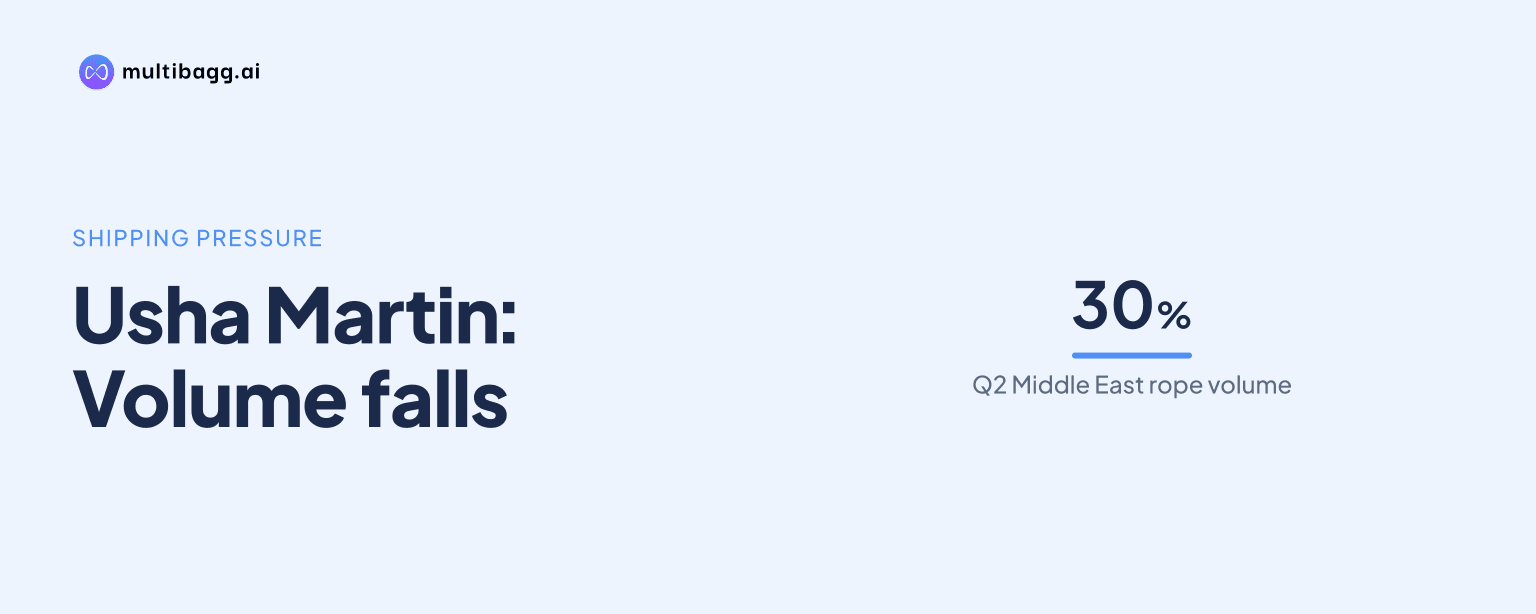
In the quarter ended September 30, 2026, Usha Martin said Middle East rope volumes fell 30% as freight rates to the U.S., Europe and Middle East rose four to six times from February at their September peak. Domestic growth and higher-value sales in other markets helped keep profitability intact despite broadly flat rope volumes in H1 FY27.
Know Usha Martin inside out
Results, valuation, peers and who's buying, in one view.
Why did Usha Martin's rope volumes remain flat?
Usha Martin's rope volumes remained broadly flat in H1 FY27 because a 30% decline in Middle East volume offset growth in domestic operations and the U.S. Management said geopolitical uncertainty, elevated freight costs and cautious distributor stocking reduced Middle East demand, particularly for general-purpose, or GP, ropes. The Middle East had been a significant market in Usha Martin's growth plans for the year.
Domestic wire-rope demand moved in the opposite direction. Usha Martin recorded domestic wire-rope volume of 12,700 metric tons in Q2 FY27, up 14% year on year despite the monsoon, while realizations increased 12%. Management said domestic performance supported revenue and profitability while international logistics disruptions delayed order execution.
Low-relaxation prestressed concrete, or LRPC, strand added to the first-half volume pressure. H1 LRPC volume declined to 19,000 metric tons from 23,000 metric tons, a fall of about 17%. Management said it would not sell conventional black LRPC at a loss and is instead quoting for plasticated LRPC projects in domestic and export markets that could convert into orders in Q4.
How much did freight disruption affect Usha Martin's overseas markets?
Freight rates to Usha Martin's U.S., European and Middle East markets rose by four to six times between February and the September peak, while transit times also increased. Management said those logistics disruptions slowed the pace of order execution and volume growth during the six months ended September 2026.
The effect varied across markets. Usha Martin's U.S. entity recorded about 12% H1 FY27 volume growth and 22% revenue growth, whereas European volumes were broadly flat. Combined European entity sales and direct exports from India to Europe nevertheless increased about 11%, supported by service activity and a better product mix.
In Europe, management said freight rates were almost four times February levels, prompting distributors to reduce GP-rope inventories. In the Middle East, Usha Martin said its rigging shops, service network and improved mix protected profitability at lower volume. Management said easing Red Sea disruptions since September could provide freight-cost relief for the U.S. and Europe in H2 FY27, although it also described the external environment as uncertain.
Did product mix protect Usha Martin's profitability?
Yes. Usha Martin reported operating earnings before interest, tax, depreciation and amortisation, or operating EBITDA, of Rs 202 crore in Q2 FY27, up 16.5% from Rs 173 crore in Q2 FY26. Revenue from operations increased 12.4% to Rs 1,000 crore, while the operating EBITDA margin rose to 20.2% from 19.5%.
Operating EBITDA per ton was Rs 40,680 in Q2 FY27, compared with Rs 40,580 in Q1 FY27 and Rs 34,915 in Q2 FY26. Management attributed the improvement in international rope markets to specialized, higher-value applications. In Europe, it specifically cited service work and product mix as the drivers of sales-value growth despite flat volume.
For H1 FY27, revenue increased 14.8% to Rs 2,021 crore and operating EBITDA rose to Rs 410 crore from Rs 319 crore. The operating EBITDA margin widened to 20.3% from 18.1%. Profit after tax from continuing operations was Rs 278 crore versus Rs 230 crore, although the prior-year figure included Rs 24 crore of one-time income and was restated to exclude UM Cables.
Got a follow-up? Ask IRIS
What is Usha Martin doing to restore volume growth?
Usha Martin is adding specialized rope capacity, expanding market coverage and running a turnaround programme at its Thailand facility. It spent about Rs 143 crore on capital expenditure in H1 FY27, and its Ranchi elevator-rope expansion is being commissioned. Management expects the full incremental capacity of 500 metric tons per month to be operational by Q1 of the next financial year.
Management said current domestic elevator-rope demand exceeds Usha Martin's ability to supply, and it expects the full new capacity to be saleable domestically, with additional international opportunity. It estimated that the capacity could add about Rs 130 crore to Rs 150 crore of revenue, at pricing of Rs 2.30 lakh to Rs 2.40 lakh per ton. Usha Martin has also commissioned 100 metric tons per month of higher-value mining-rope capacity.
In Thailand, management plans to focus on elevator, crane, piling and port ropes in Southeast Asia, integrate upstream processes with Ranchi, rationalise manpower and overheads, and modernise machinery. Management targets Thailand operating EBITDA margins of 14%-15%, compared with 6%-7%, alongside 10%-15% volume growth over 18 months. These are management expectations, not reported outcomes.
Usha Martin generated Rs 413 crore of operating cash flow before tax in H1 FY27, equivalent to about 101% conversion of operating EBITDA, and Rs 186 crore of free cash flow. Net working-capital days fell to 185 in September 2026 from 194 in March 2026, while inventory days declined to 166 from 176. It ended September with net cash of Rs 415 crore after dividends and capital expenditure.
Conclusion
Usha Martin's first-half results show how a 30% Middle East volume decline and sharply higher freight rates restrained rope volumes without preventing financial growth. Domestic rope demand, U.S. volume gains, European service revenue and specialized product mix contributed to H1 operating EBITDA of Rs 410 crore and a 20.3% margin, compared with Rs 319 crore and 18.1% a year earlier.
Next, the key issue is whether easing Red Sea disruption supports H2 FY27 volume recovery in Europe and the U.S. while Middle East conditions remain uncertain. Management is targeting FY27 revenue growth of 15%, an operating EBITDA margin of around 20% and cash conversion of about 100%, while the Ranchi elevator-rope expansion is scheduled to reach full capacity in Q1 of the next financial year.