










Utkarsh Small Finance Bank shifts to 52% secured lending
Key highlights
- JLG including BC JLG fell from 90% of Bank's loan book in Mar'20 to 26% in Sep'26.
- Secured loans increased from 8% in Mar'20 to 52% in Sep'26.
- Bank's total loan portfolio reached Rs 20,062 crore in Sep'26, with non-JLG loans accounting for 74%.
- Bank reported Rs 7,333 crore of micro-banking loans in Sep'26, including Rs 2,586 crore of MBBL.
powered by IRIS
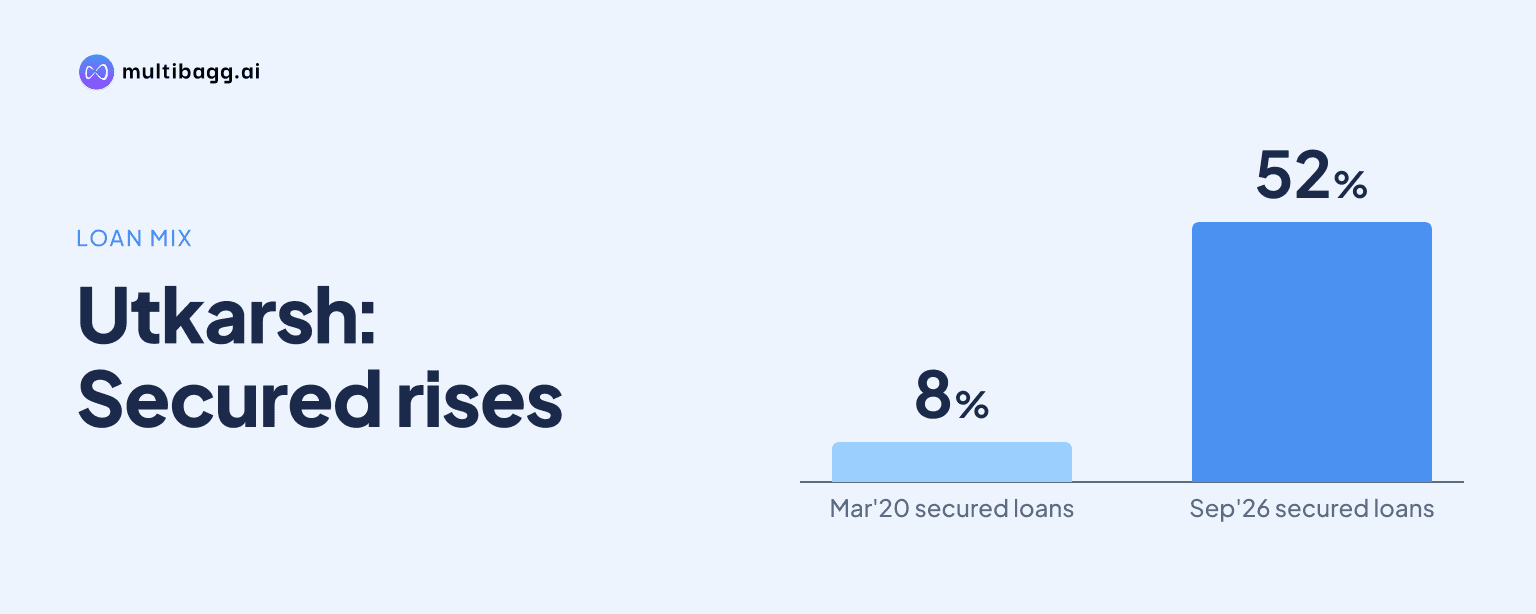
Utkarsh Small Finance Bank had shifted 52% of its loan book into secured lending by September 2026, as joint liability group, or JLG, loans including business correspondent, or BC, JLG fell to 26% from 90% in March 2020. The portfolio change accompanied Rs 20,062 crore in total loans, with non-JLG lending accounting for 74%.
Know Utkarsh Small Finance Bank inside out
Results, valuation, peers and who's buying, in one view.
How did Bank's loan mix change?
Bank's loan book moved from a JLG-led structure to a non-JLG majority between March 2020 and September 2026. JLG including BC JLG accounted for 26% of loans at September 2026, down 64 percentage points from 90% at March 2020, while non-JLG loans rose to 74% from 10%.
The secured share also crossed the unsecured share during this period. Secured lending increased from 8% at March 2020 to 52% at September 2026, while unsecured loans declined from 92% to 48%; secured loans had been 51% at March 2026. Bank attributed the rising secured share to the build-up of micro, small and medium enterprise, or MSME, housing and gold-loan products.
How did Bank's loan balances develop?
Bank's total loan portfolio reached Rs 20,062 crore at September 2026, compared with Rs 19,332 crore at March 2026 and Rs 6,661 crore at March 2020. Its JLG balance, excluding BC JLG, was Rs 4,747 crore at September 2026, down from Rs 5,386 crore at March 2026 and Rs 8,761 crore at March 2025.
Other lending categories increased as JLG reduced. Other retail loans rose from Rs 13 crore at March 2020 to Rs 2,586 crore at September 2026, while wholesale lending including the Trade Receivables Discounting System, or TReDS, increased from Rs 310 crore to Rs 3,513 crore. The presentation reported 35.1% year-on-year growth in the non-JLG portfolio.
Why did Bank reduce its JLG exposure?
Bank said market disruptions slowed the JLG segment and that it continued to focus on high-yield, low-risk products and productivity. During the second quarter of FY27, Bank said it slowed JLG disbursements and shifted its focus to collections, after the JLG portfolio declined from Rs 5,063 crore in June 2026 to Rs 4,747 crore in September 2026.
The presentation frames the development as a portfolio build-up across several products rather than solely a decline in JLG. It reported a 127% compound annual growth rate, or CAGR, for the category labelled Micro-Banking Business Loans, or MBBL, between FY20 and the first half of FY27, and a 57% CAGR for other retail loans over the same period.
At September 2026, Bank's product-share breakdown placed retail MSME loans at 22% of the total book and wholesale lending at 18%, compared with JLG at 24% excluding BC JLG. MBBL represented 13%, commercial equipment and commercial vehicle loans represented 5%, housing loans represented 5%, and other products represented 14%.
Got a follow-up? Ask IRIS
How is Bank changing micro-banking lending?
Bank reported a Rs 7,333 crore micro-banking portfolio at September 2026, comprising Rs 4,747 crore of JLG loans and Rs 2,586 crore of MBBL. On that measure, JLG represented 65% of micro-banking outstanding and MBBL represented 35%, compared with Rs 7,218 crore of JLG and Rs 1,052 crore of MBBL at September 2025.
The products had different customer and ticket-size profiles in the second quarter of FY27. JLG served more than 13 lakh customers, with an average portfolio ticket of about Rs 35,000, while MBBL served about 3.5 lakh customers, with an average portfolio ticket of about Rs 75,000. Bank put MBBL penetration at about 20% and disclosed potential for further growth.
Bank's distribution footprint was concentrated in its core rural and semi-urban markets at September 2026. Of its micro-banking outlets, 47% were in semi-urban locations and 41% were rural, taking the combined share to 88%; Bank also said it had opened savings accounts for more than 60% of micro-banking customers.
What happened to Bank's asset quality during the shift?
Bank reported a gross non-performing asset, or GNPA, ratio of 5.9% at September 2026, unchanged from June 2026 and lower than 12.2% at September 2025. Its net NPA ratio was 2.7% at September 2026, compared with 2.8% at June 2026 and 4.9% a year earlier, while JLG including BC JLG had declined to 26% of the portfolio.
Absolute GNPAs increased to Rs 1,189 crore at September 2026 from Rs 1,163 crore at June 2026. Additions during the second quarter of FY27 were Rs 239 crore, credit cost was Rs 166 crore or 3.3%, and special mention account, or SMA, categories 1 and 2 were 4.0%, compared with 3.6% at June 2026.
The presentation does not attribute the asset-quality movement to a specific product. It reported Rs 65 crore of upgrades and recoveries, Rs 98 crore of write-offs and Rs 51 crore of asset reconstruction company sales in the second quarter of FY27; total provisions were Rs 730 crore at September 2026, versus Rs 701 crore three months earlier.
Conclusion
Bank's figures show a multi-year change in portfolio composition, with JLG including BC JLG declining from 90% to 26% between March 2020 and September 2026 and secured loans rising from 8% to 52%. The Rs 20,062 crore portfolio at September 2026 included larger balances in other retail loans and wholesale lending, reducing the historical concentration in JLG.
The next disclosed measure to watch is Bank's plan to grow MBBL from approximately 20% penetration, alongside its continued focus on JLG collections and slower JLG disbursements in the second quarter of FY27. Later reporting will also show whether the September 2026 rise in absolute GNPAs to Rs 1,189 crore and SMA 1 and 2 to 4.0% persists.