










Vedant Fashions sees weddingwear rivals begin consolidating
Key highlights
- Vedant Fashions said internal data showed slight quarter-on-quarter competitor consolidation for the last two quarters.
- Management estimates the weddingwear market expanded sixfold to sevenfold over the preceding three to four years.
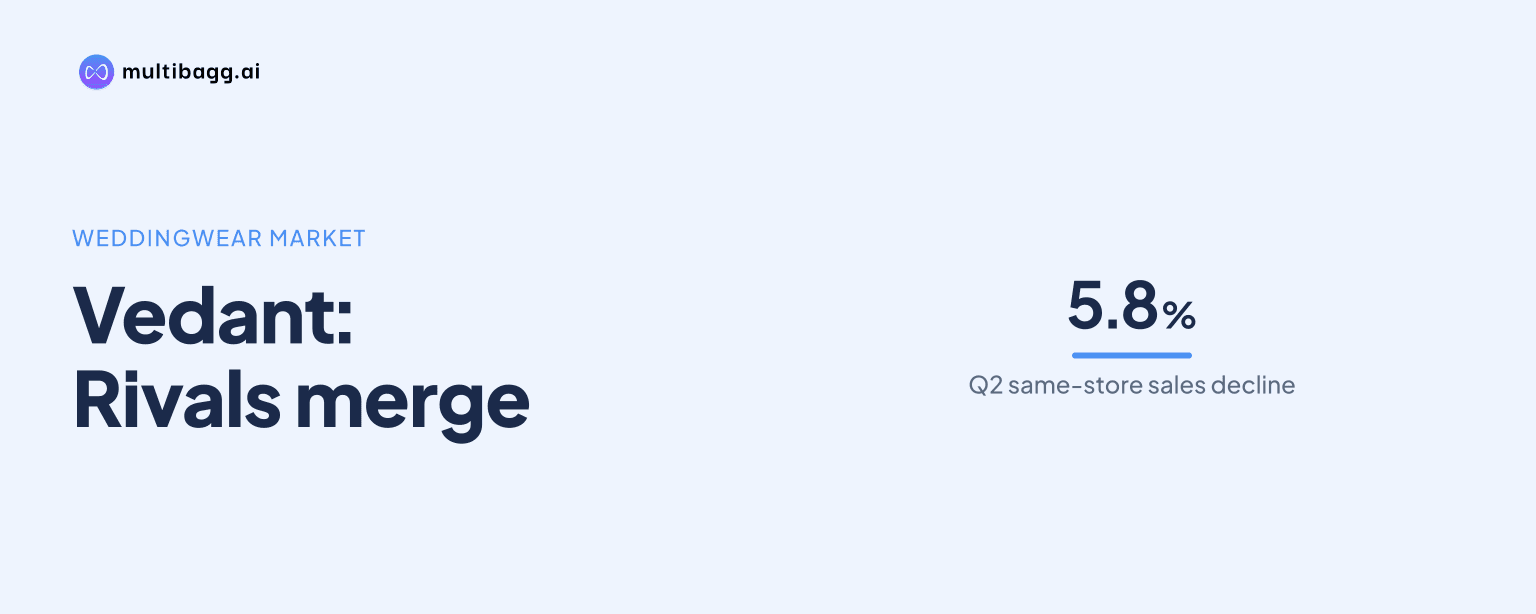
- Vedant Fashions reported a 5.8% same-store sales decline in Q2.
- Management aims for high-single-digit to double-digit same-store sales growth over the next three quarters.
powered by IRIS
Vedant Fashions said internal tracking showed slight quarter-on-quarter consolidation among weddingwear competitors for the last two quarters, following market expansion of an estimated sixfold to sevenfold over three to four years. Management attributed the shift to retailers encountering the dead-stock challenge of men’s celebration wear after rapid expansion.
Know Vedant Fashions inside out
Results, valuation, peers and who's buying, in one view.
Why does Vedant Fashions think weddingwear competition is consolidating?
Vedant Fashions said its teams collect competitor information every month and quarter, and their internal data has indicated “a little bit” of quarter-on-quarter consolidation for the past two quarters. Management did not disclose the number of rival stores closing, the cities affected, or a market-wide measure of net store closures.
Management contrasted that two-quarter trend with the preceding three to four years, when it estimated the market had expanded sixfold to sevenfold. In Vedant Fashions’ assessment, the market is now flat and slowly consolidating, marking a change from a period defined by substantial new retail entry.
What is pressuring weddingwear retailers?
Vedant Fashions said dead stock, or unsold inventory, is a material challenge in men’s celebration wear and may become clear only after two to three years of operations. Management described the category as one of the more difficult fashion verticals to operate because occasion-led merchandise can remain unsold when demand and wedding dates change.
The company did not provide competitors’ inventory balances, losses, margins or store-level economics. Its comments therefore represent management’s interpretation of its internal market monitoring, rather than independently reported evidence that named retailers have exited or incurred a specified financial loss.
Wedding-calendar timing illustrates the inventory-planning issue, although Vedant Fashions did not directly link this example to rival closures. Management said Andhra Pradesh and Telangana, a large region for the company, had a significant wedding-date period in the prior-year Q2, while the current-year Q2 had no wedding dates in that period.
How could consolidation help Vedant Fashions win customers?
Vedant Fashions said its major current challenge is gaining new customers, and management believes a consolidating competitive market could support that effort alongside its own initiatives. It did not give a market-share target or quantify how fewer competing stores might affect customer acquisition.
The company said it has taken measures in team building, marketing and product development. Vedant Fashions also said it has deployed multiple artificial-intelligence agents across multiple departments to handle internal functions, though management did not disclose agent numbers, costs, individual functions or a measured sales benefit.
Management said festive comparisons are monitored using Diwali minus 30 days against Diwali minus 30 days, and it sees “a lot of green shoots” in that comparison. It did not disclose the sales-growth percentage behind that observation, but said the goal is to deliver good growth in H2, the second half of the financial year.
Got a follow-up? Ask IRIS
What are Vedant Fashions' sales and expansion plans?
Vedant Fashions aims to achieve high-single-digit to double-digit same-store sales growth across the next three quarters, management said. Same-store sales growth measures sales change at comparable stores, and the aim follows a reported 5.8% decline in Q2.
Management said same-store sales were positive if the final 10 days of Q2 were excluded, but did not provide the adjusted percentage. It also said that, at an annual level, management would not be satisfied with growth below high double digits, distinguishing that longer-term ambition from the next-three-quarters aim.
On physical expansion, Vedant Fashions said it expects mid-single-digit area growth this year and next year, followed by double-digit growth as it moves into FY 2029. Management corrected an analyst who described the FY 2029 outlook as high double-digit growth, saying the company had referred to double-digit growth only.
Which businesses could determine Vedant Fashions' next growth phase?
Vedant Fashions identified its men’s celebration-wear portfolio and Mohey, its mid-premium women’s celebration-wear business, as key parts of its four- to five-year plan. Management said Mohey contributes just above double-digit revenue, with a slightly higher share of retail area, and has below 1% market share while being one of the larger players in its category.
Management plans to take another two to three quarters to establish a Mohey model that can provide future financial profitability before expanding more aggressively. It did not provide a Mohey revenue, margin, store-count or market-share target, but said the business could become the company’s next growth lever over the following three to four years.
Vedant Fashions also said its multi-brand outlet, or MBO, business reached 100% of budget in Q2. Management is seeking high-double-digit growth in that business and then aims to double it over two years; it stopped separately reporting shop-in-shop operations to allow teams to use either format at particular locations.
Conclusion
Vedant Fashions’ message is that rapid expansion in weddingwear retail may be moving into a more rational competitive phase. Its evidence is internal tracking showing slight consolidation for two quarters after estimated market growth of sixfold to sevenfold in three to four years, with management identifying dead-stock pressure as the principal operating mechanism.
The next indicators are H2 sales performance and the company’s high-single-digit to double-digit same-store sales aim over the next three quarters. Management also plans to refine Mohey’s profitability model within two to three quarters, pursue mid-single-digit area growth this year and next year, and target double-digit area growth as it moves into FY 2029.