










Vedant Fashions: Twamev and Diwas broaden market reach
Key highlights
- Vedant says Twamev can access an additional 20%-30% of the addressable market at the premium end of celebration wear.
- Vedant says Diwas can add 30%-35% to its addressable market and should exceed Rs 100 crore in sales this year.
- Twamev has a target of 30 stores in the top 30 markets, with 21 locations still to be opened.
- Vedant aims for high-single-digit to double-digit same-store sales growth over the next three quarters.
powered by IRIS
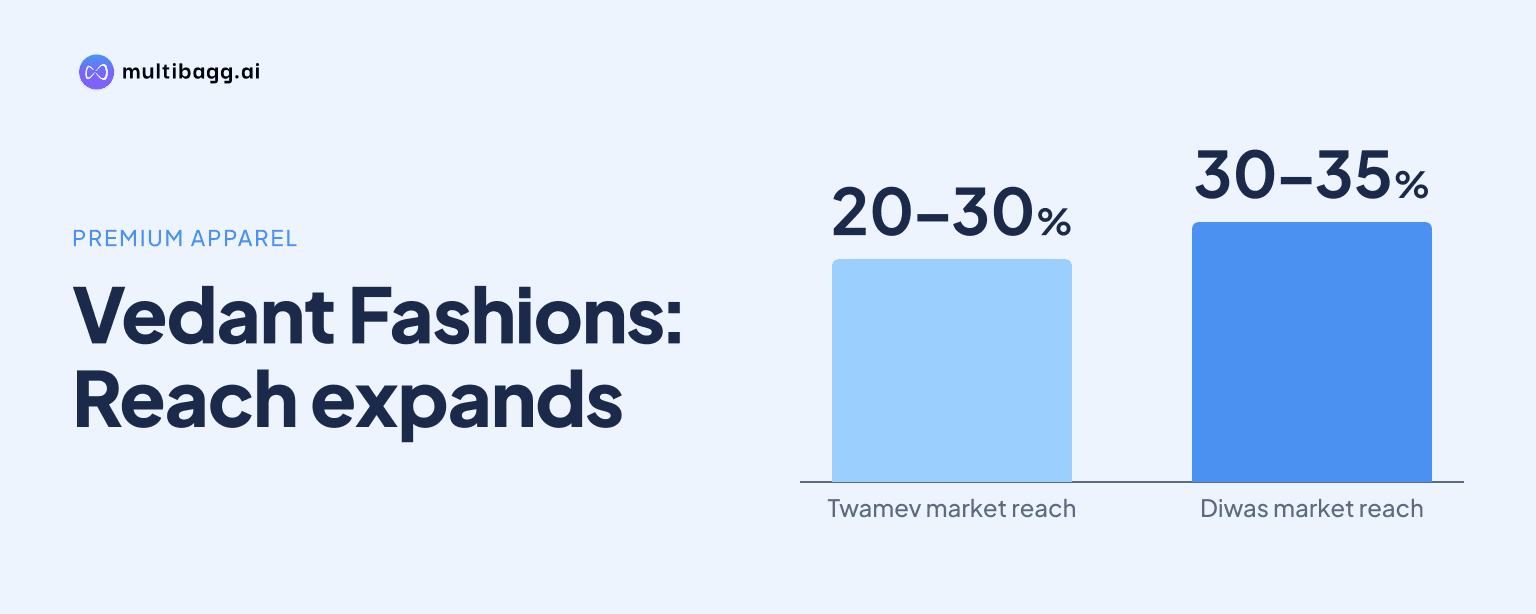
Vedant Fashions says premium Twamev can reach an additional 20%-30% of the addressable market and value-focused Diwas another 30%-35%, while Diwas is expected to exceed Rs 100 crore in sales this year. Management presented the labels as extensions of its celebration-wear portfolio rather than a move into regular apparel.
Know Vedant Fashions inside out
Results, valuation, peers and who's buying, in one view.
How are Twamev and Diwas expanding Vedant’s market?
Vedant says Twamev and Diwas expand its reach across two price points within festive and celebration wear. Management described Twamev as the company’s higher-end label, with access to an additional 20%-30% addressable market, while Diwas targets value-priced festive kurtas and could add 30%-35% to the addressable market.
The company said it has not moved into regular wear. Instead, its newer additions have primarily been Twamev and Diwas, which are intended to broaden participation in Indian celebration wear beyond Manyavar’s established positioning. Twamev addresses higher-end demand, while Diwas is aimed at a large, mass-market volume opportunity in festive kurtas.
Management did not state that the two percentage ranges can simply be added together. The figures describe separate opportunities at premium and value price points, and the company has not disclosed the current revenue contribution of either Twamev or Diwas. Its disclosed measures are instead store rollout for Twamev and the Rs 100 crore sales threshold for Diwas.
What is Vedant’s rollout plan for Twamev?
Vedant’s stated Twamev model is 30 stores across India’s top 30 markets, with 21 stores still to be opened. Management said Twamev is already on a path to becoming a large brand based on its internal key performance indicators, or KPIs, but identified store openings as the main execution requirement.
The limiting factor is the time required to develop suitable locations. Management said it is signing build-to-suit properties for Twamev and that these can take two years to open. It said it would open the 21 remaining stores immediately if sites were ready, making real-estate development the disclosed constraint on the premium label’s expansion.
Twamev also has a different marketing task from Manyavar. Management said Manyavar has 99% awareness in India, whereas Twamev’s awareness was low. A campaign featuring Orry was designed to increase awareness and make consumers consider Twamev fashionable, with management seeking virality at a controlled budget rather than a high-cost celebrity campaign.
Manyavar’s marketing is instead focused on consideration among a well-aware audience. Vedant said its third-quarter strategy included making 150 short videos and testing what performs on Meta and Google, supported by internally built artificial-intelligence-based campaign-optimisation systems. The contrast shows Twamev’s immediate need for awareness and physical availability, compared with Manyavar’s focus on conversion and consideration.
Why is Diwas important to Vedant’s growth plan?
Diwas matters because management expects the value-led festive-kurta label to exceed Rs 100 crore in sales this year. Vedant said Diwas had grown well internally during the past two years, while acknowledging that newer labels began from a low revenue base.
Management’s next step for Diwas is to scale it into a larger online and multi-brand-outlet, or MBO, business. It described Diwas as a one- to two-year journey, rather than providing a longer-term revenue target. The model differs from Twamev because Diwas is intended to use online and MBO distribution, while Twamev needs premium store locations in major markets.
The value proposition is central to Diwas’s role. Management said the mass side of festive kurtas is a large market and a substantial volume play, supporting its estimate of a further 30%-35% addressable-market opportunity. This gives Vedant a route to serve festive-wear customers at lower price points without describing the initiative as an entry into everyday apparel.
Diwas also forms part of a broader channel shift at Vedant. Management said approximately 90% of company sales now come from exclusive brand outlets, or EBOs, down from about 92% three years earlier, mainly because of e-commerce. That movement provides context for Diwas’s stated plan to expand online and through MBOs rather than rely exclusively on a dedicated physical-store network.
Got a follow-up? Ask IRIS
How do Twamev and Diwas fit with Manyavar and Mohey?
Vedant says Twamev and Diwas support its four- to five-year aim to serve men’s celebration wear at premium, mid-premium and value price points. Twamev represents the higher end and Diwas the value end, while Manyavar remains the established brand in the company’s men’s celebration-wear portfolio.
The existing retail base remains substantial. Vedant reported around 497 EBOs as of September 30, 2026, compared with 508 EBOs and 1.67 million square feet in Q2 FY 2026. Management said about 90% of sales came through EBOs, underscoring that the rollout of Twamev stores and the channel development of Diwas will occur alongside a large physical retail network.
Mohey is a separate growth platform in women’s mid-premium celebration wear. Management said Mohey’s revenue contribution had just moved above double digits, its area contribution was slightly higher, and it had six or seven dedicated stores. Most new Manyavar stores also carry Mohey, giving it a different distribution model from Twamev’s planned network of 30 dedicated stores.
Management said it needs another two to three quarters to determine a financially sustainable model for Mohey before expanding it more aggressively. Twamev has a defined store target, while Diwas has a stated Rs 100 crore sales marker and a one- to two-year scaling plan. The three brands are therefore at different stages of development within Vedant’s wider Indian-wear strategy.
What should investors monitor after Vedant’s expansion plans?
The principal measures to monitor are Twamev’s progress toward its 30-store target and Diwas’s sales after it crosses Rs 100 crore, as management expects. For Twamev, the key disclosed issue is whether build-to-suit properties can be completed fast enough to address the 21-store gap. For Diwas, management’s stated test is its ability to scale online and through MBOs over one to two years.
The broader trading backdrop will also affect the brands’ contribution. Management said it aims for high-single-digit to double-digit same-store sales growth, or SSG, over the next three quarters, after a reported 5.8% SSG decline in Q2. It said SSG would have been positive excluding the final 10 days of Q2, but did not provide an adjusted growth figure.
Store expansion remains measured in the near term. Vedant expects mid-single-digit fleet growth in the current financial year and said the rate could improve somewhat next year, with double-digit store openings expected in FY 2029. That timetable means the company’s stated market-expansion opportunity will depend on execution across stores, online sales and MBO distribution rather than a rapid network increase alone.
Conclusion
Vedant’s strategy is to broaden price-point coverage in celebration wear, not to enter regular apparel. Management sees Twamev opening a 20%-30% higher-end opportunity and Diwas a 30%-35% value-market opportunity, with Diwas expected to exceed Rs 100 crore in sales this year. Manyavar remains the established platform, while Mohey provides a separate women’s celebration-wear growth route.
The next disclosed milestones are Twamev’s 21 remaining targeted stores, Diwas’s scale-up through online and MBO channels over one to two years, and Mohey’s financially sustainable model within two to three quarters. Management is also aiming for high-single-digit to double-digit SSG over the next three quarters and expects double-digit store openings in FY 2029.