










Vimta Labs Limited Reaffirms FY28 Rs 700 Crore Target Amid Lull
Key highlights
- Vimta Labs reaffirmed its FY28 revenue target of Rs 700 crore and its 20%-25% medium-term CAGR ambition.
- Q2 FY27 total income rose 9.9% year on year to Rs 114.9 crore, while EBITDA increased 10.5% to Rs 40.8 crore.
- Food-related sample volumes recovered to about 60%-70% of normal levels from roughly 30%-40% in April-July.
- Vimta Labs invested about Rs 25 crore in biologics and expects the business to take a couple of years to become substantial.
powered by IRIS
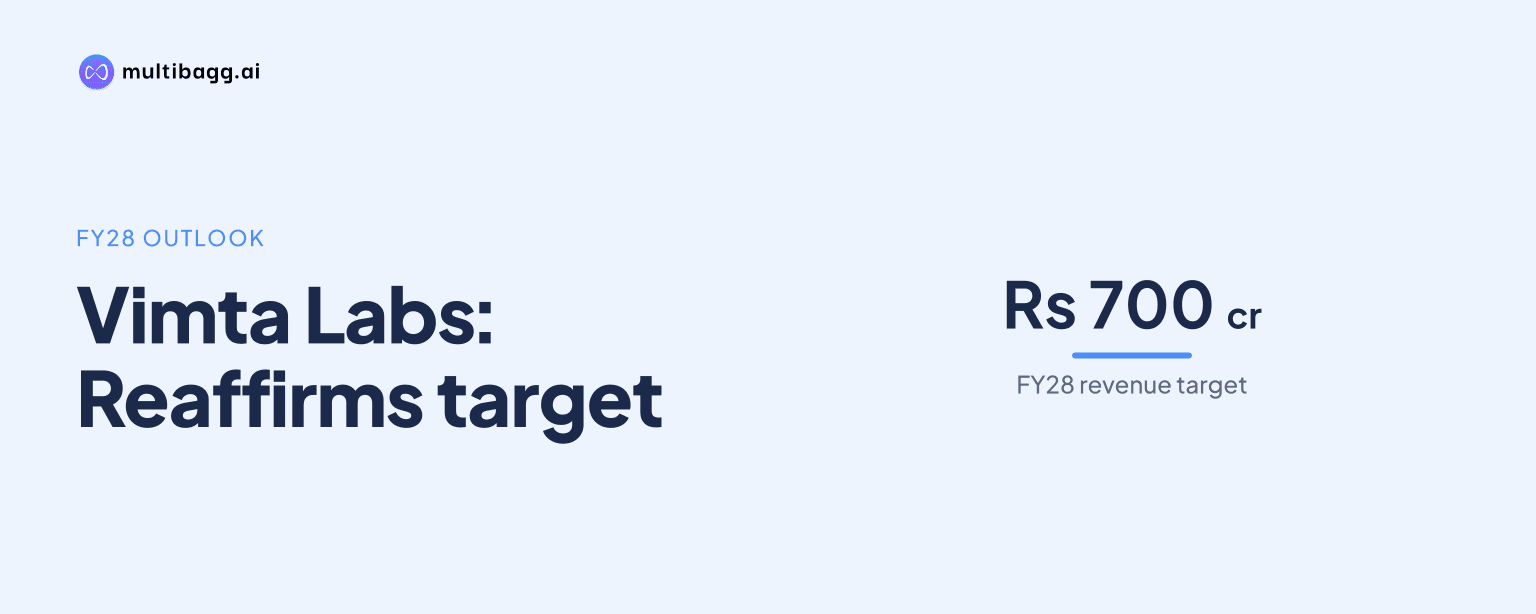
Vimta Labs Limited reaffirmed its FY28 revenue target of Rs 700 crore on October 30, 2026, although Q2 FY27 total income increased 9.9% year on year to Rs 114.9 crore, as management expects pharmaceutical proposals and food-testing sample flows to recover.
Know Vimta Labs inside out
Results, valuation, peers and who's buying, in one view.
Why is Vimta Labs retaining its FY28 revenue target?
Vimta Labs is retaining its FY28 Rs 700 crore revenue target and the 20%-25% medium-term compound annual growth rate, or CAGR, discussed on the call because management views the present slowdown as temporary. Managing Director Harita Vasireddi said the company remained confident about the medium term, while identifying slower pharmaceutical research-and-development, or R&D, pipelines and food-testing disruption as near-term constraints.
The target stands against H1 FY27 total income of Rs 227.8 crore, up 11.8% from Rs 203.8 crore in H1 FY26. Management expects Contract Research and Development Services, or CRADS, for large molecules, clinical research and biologics to improve during Q3 and Q4, subject to active customer proposals becoming executable projects.
Vimta Labs reported EBITDA growth of 10.5%, faster than the 9.9% increase in Q2 FY27 income, while PAT rose 3.5%. EBITDA margin was 35.5% and PAT margin was 17.9%; management said revenue was broadly stable from Q1 FY27 because customer decision cycles had lengthened.
What slowed Vimta Labs' Q2 FY27 growth?
Vimta Labs said a lull in pharmaceutical R&D activity and reduced export- and import-linked food samples slowed Q2 FY27 growth. Management said the pharma slowdown had appeared in Q1 FY27 as well, but requests for proposals had increased in recent months and could convert into projects in the quarters ahead.
Management linked the pharma pause partly to peptide-related work in the prior year. It said many related filings had been completed and major Indian pharmaceutical companies were waiting for regulatory approvals, reducing immediate R&D activity; it did not provide quarterly guidance but said H2 has typically performed better than H1.
Food testing faced a sharper operational change. Vimta Labs said it previously collected about 20 to 25 samples from a shipment but was collecting only about two or three as exporters changed shipping practices amid higher shipment and insurance costs. Export- and import-linked sample volumes had risen from about 30%-40% of normal levels in April-July to roughly 60%-70% by the call, but remained below earlier volumes.
Can Vimta Labs' recent capacity spending support growth?
Vimta Labs said its Rs 100-odd crore infrastructure investment was designed to support growth for five to seven years rather than reach immediate full utilisation. Management defines capacity through laboratory infrastructure, equipment and people, adding equipment and employees as business requirements and technology needs develop.
The company invested about Rs 25 crore in CRADS biologics services, which began generating revenue in Q2 FY27 but remained a very modest contributor. Vimta Labs had booked an initial order, was speaking with multiple clients and hoped to onboard at least a couple more during the quarter, although management said the business could take a couple of years to become substantial.
Management said it generally seeks a 1:1 return ratio for equipment investment, while new capabilities need an incubation period. It expects biologics to reach a 1:1 return by its third year, with a possible second-year outcome if ramp-up is faster; separately, it said its large-animal preclinical facilities reached capacity in H1 FY27 and were being expanded.
Got a follow-up? Ask IRIS
Which businesses could change Vimta Labs' revenue mix?
Vimta Labs identified preclinical services, clinical research, biologics and food-sample recovery as the principal areas that could improve growth. Preclinical has recorded an almost 30% CAGR over the past four years, according to management, although Vimta Labs does not disclose segment-level revenue figures.
Clinical research is rebuilding after the loss of several major customers in the previous year. Vimta Labs has a 180-bed bioavailability and bioequivalence facility and does not intend to increase beds; management said it has since signed contracts with many multiples of customers, but lead times of 12 to 18 months delay the revenue effect.
Biologics projects can be larger than small-molecule assignments, according to management. Work limited to yield realisation or process improvement can range from Rs 1 crore to Rs 1.25 crore, while full biosimilar development to laboratory scale can range from Rs 4 crore to Rs 7 crore and above; Vimta Labs is pursuing cross-selling to existing customers.
Electronics testing remains a smaller business, but Vimta Labs doubled its electromagnetic interference and electromagnetic compatibility, or EMI/EMC, chamber capacity after reaching full utilisation. Management said defence original-equipment manufacturers use about 70%-80% of Hyderabad capacity, while noting that this testing is usually required at development and procurement stages rather than for every production batch.
What is Vimta Labs' margin and capital-spending outlook?
Vimta Labs reported EBITDA margins of 35.5% in Q2 FY27 and 36.0% in H1 FY27. Management said it did not expect a significant near-term change, but envisaged a medium-term correction of around 100 to 200 basis points because biologics could alter service mix; one basis point equals one-hundredth of a percentage point.
The company budgeted about Rs 80 crore of capital expenditure for FY27, including around Rs 45 crore to Rs 50 crore of maintenance capital expenditure. Management said spending on analytical capabilities and self-service offerings would be phased according to business visibility, customer demand and budget requirements, while smaller additions in high-growth services would generally be funded within normal depreciation-linked spending.
Conclusion
Vimta Labs has maintained its FY28 Rs 700 crore revenue goal despite Q2 FY27 income growth of 9.9%, which is below the 20%-25% medium-term CAGR management confirmed. Its case depends on a recovery in pharmaceutical project decisions and food-related sample flows, alongside conversion of customer discussions in preclinical, clinical and biologics services.
The next disclosed milestones are management's expected improvement in CRADS and clinical research in Q3 and Q4, and its hope that food-testing samples return to normal levels by Q4. Investors can also watch whether the Rs 25 crore biologics capability adds customers, as management expects that business to take about two years to become substantial and potentially reach a 1:1 return by its third year.