










Visaka non-asbestos businesses reach a 47% revenue share
Key highlights
- Visaka reports 47% revenue contribution from non-asbestos sheet businesses and 53% from cement roofing sheets.
- Cement fibre boards and panels contribute 30% of revenue, compared with 15% for synthetic yarn and 2% for ATUM.
- Visaka operates 14 plants, including 7 cement-roofing plants and 5 boards-and-panels plants.
- Visaka reported FY26 revenue of Rs 1,678 crore, up 9% year on year.
powered by IRIS
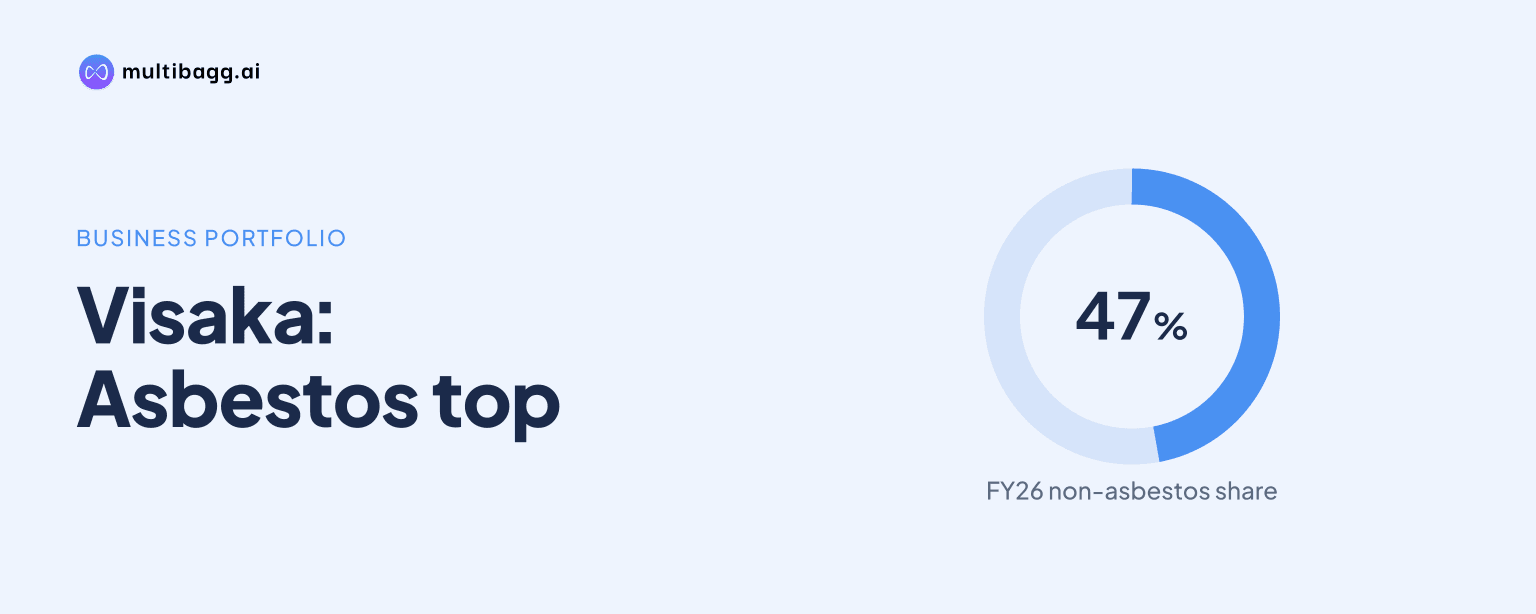
Visaka Industries Ltd reports that non-asbestos sheet businesses contributed 47% of revenue, compared with 53% from cement roofing sheets, in its Q2 and H1 FY27 investor presentation. Cement fibre boards and panels supplied the largest 30% share outside roofing, while synthetic yarn contributed 15% and ATUM integrated solar roofing 2%.
Know Visaka Industries inside out
Results, valuation, peers and who's buying, in one view.
What makes up Visaka’s 47% non-asbestos revenue share?
Visaka’s presentation shows that the 47% contribution outside cement roofing comprises 30% from cement fibre boards and panels, 15% from synthetic yarn, and 2% from ATUM integrated solar roofing. Cement roofing remains the largest individual product category at 53%, but it exceeds the combined contribution of the other three categories by only 6 percentage points.
Boards and panels are therefore the principal component of the 47% mix, at twice the synthetic-yarn contribution and 15 times the ATUM contribution. The presentation identifies prefabricated and modular construction, renovation and retrofitting, and substitution of plywood and brick-and-mortar construction as demand drivers for this 30% category.
ATUM accounts for 2% of revenue, making it the smallest disclosed product category in the chart. Visaka links the integrated solar-roofing product to rooftop-solar adoption across large built-up spaces, demand for combined roofing and power-generation systems, and rising electricity costs that can encourage on-site generation.
How has Visaka moved beyond cement roofing?
Visaka moved beyond its original roofing base by entering synthetic yarn in 1992, launching V-Next fibre cement boards and panels in 2008, and launching ATUM in 2018. The company was incorporated in 1981 and began producing corrugated cement fibre sheets in 1985 with capacity of 36,000 tonnes per annum, or TPA.
The 1992 yarn entry at Nagpur used twin air-jet spinning technology and began with 2,000 TPA of capacity. By 2017, the presentation says synthetic-yarn capacity had increased to 12,000 TPA, a sixfold rise from the initial level, before the 2023 addition of 288 spinning positions took the total to 3,040 positions.
V-Next added boards and panels to the building-materials portfolio in 2008, while ATUM added an integrated solar-roofing solution in 2018. Visaka describes 2018 to 2026 as a period of technology-led innovation, scale-up and portfolio transformation, and the disclosed 47% contribution provides the presentation’s numerical evidence of that change.
The shift does not mean cement roofing has ceased to be Visaka’s largest business. Its 53% share remains 23 percentage points higher than the 30% boards-and-panels share, while the combined 47% contribution indicates that revenue is no longer concentrated solely in the original roofing category.
Got a follow-up? Ask IRIS
Which facilities and capacities support Visaka’s product mix?
Visaka operates 14 plants across India: 7 cement-roofing plants, 5 cement fibre boards-and-panels plants, 1 synthetic-yarn plant and 1 ATUM plant. Of the five facilities serving boards and panels, three are panel plants, supporting the category that accounts for 30% of revenue.
The presentation lists installed capacity as of Q1 FY27 at 8.48 lakh TPA for cement roofing sheets, 3.56 lakh TPA for cement fibre boards, and 12,000 TPA for synthetic yarn. Its 2026 portfolio timeline separately describes 3.56 lakh TPA of capacity for fibre cement boards and panels, alongside 8.48 lakh TPA for cement roofing and 3,040 twin air-jet spinning positions.
Roofing capacity increased by 100,000 TPA in 2022 when Visaka added a second manufacturing line at Raebareli. That expansion followed the development of the core roofing business from 36,000 TPA in 1985 to 8.48 lakh TPA in the capacity figures disclosed for 2026 and Q1 FY27.
The different capacity measures limit direct comparison across all businesses: roofing, boards and yarn are reported in TPA, while the 2026 yarn timeline also uses 3,040 spinning positions. Still, the 14-plant footprint and 5 boards-and-panels facilities provide the operating base for a segment with a 30% revenue contribution.
How does the portfolio shift coincide with Visaka’s FY26 financial recovery?
Visaka reported FY26 revenue of Rs 1,678 crore, up 9% year on year, and disclosed a five-year average gross margin of 47% and a five-year average EBITDA margin of 9%. It also reported net debt-to-equity of 0.3, cash flow from operations to EBITDA of 131%, and return on capital employed, or ROCE, of 17% for FY26.
Gross margin was 47.5% in FY26, compared with 45.2% in FY25 and 46.4% in FY23. Management attributes the gross-margin movement to product-mix transition and input-cost normalisation, but the presentation does not quantify the margin earned by cement roofing, boards and panels, yarn, or ATUM individually.
The presentation’s adjusted profitability series shows profit after tax, or PAT, margin of 2.3% in FY26, compared with negative 0.2% in FY25. ROCE increased to 16.8% from 9.2% over the same period, while return on equity rose to 9.1% from negative 0.8%; FY26 PAT and earnings before interest and tax figures exclude exceptional items less tax.
These figures show financial improvement alongside the 47% non-asbestos share, rather than proving that the mix shift caused the recovery. Visaka says near-term PAT margins were affected by higher operating costs and capacity investments, while its return ratios moderated during the investment phase before recovering with profitability and asset utilisation.
Conclusion
Visaka’s disclosed product mix shows a portfolio still led by cement roofing at 53% of revenue but materially broadened by boards and panels, synthetic yarn and ATUM at a combined 47%. The sequence from the 1992 yarn entry to the 2008 V-Next launch and 2018 ATUM launch is now reflected in a business with 14 plants, including 5 boards-and-panels facilities.
The next issue to watch is execution of Visaka’s stated FY29 agenda of accelerating value-added-product mix, scaling capacity in high-growth businesses, unlocking operating leverage and deleveraging. The presentation displays FY29F indicators including 10% to 15% CAGR, a 12% label and a 10% label, but does not clearly map every figure on the slide; future disclosures on revenue, EBITDA margin and mix will clarify progress.