










Visaka returns to profit as Q2 gross margin reaches 52.6%
Key highlights
- Visaka’s Q2 FY27 gross margin rose 344 basis points year on year to 52.6%.
- Visaka reported Q2 FY27 EBITDA of Rs 36.2 crore, up from Rs 11.7 crore in Q2 FY26.
- Visaka’s reported Q2 FY27 PAT was Rs 71.3 crore, including Rs 68.7 crore of exceptional items.
- Visaka’s total borrowings declined to Rs 237 crore at September 2026 from Rs 303 crore at March 2026.
powered by IRIS
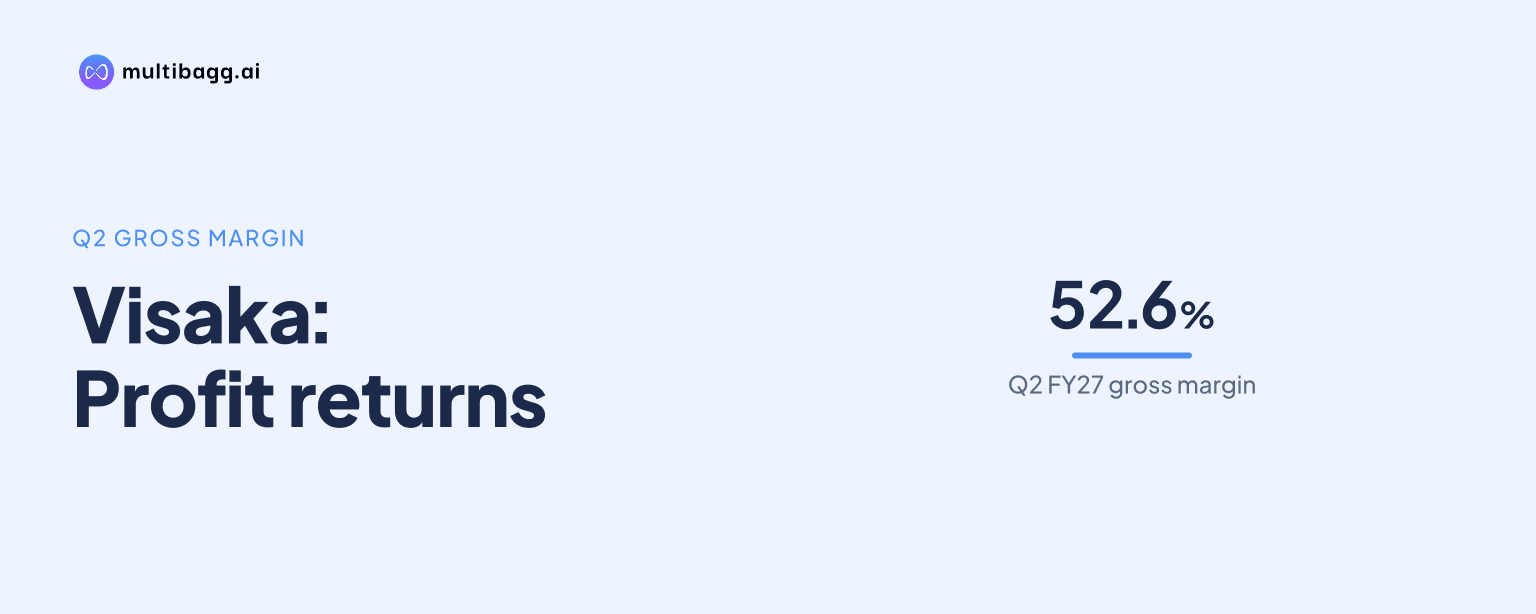
Visaka Industries Limited returned to reported profit in Q2 FY27, posting profit after tax of Rs 71.3 crore as gross profit margin rose 344 basis points year on year to 52.6%; before exceptional items, the presentation shows Rs 16 crore of profit after tax versus a Rs 9 crore loss.
Know Visaka Industries inside out
Results, valuation, peers and who's buying, in one view.
How did Visaka return to profit in Q2 FY27?
Visaka returned to profitability because revenue rose 22.8% to Rs 399.2 crore in Q2 FY27, while gross profit increased faster, by 31.4% to Rs 209.8 crore. Profit after tax was Rs 71.3 crore, against a Rs 8.7 crore loss in Q2 FY26, although the reported result included Rs 68.7 crore of exceptional items. Profit before tax was Rs 85.8 crore, compared with a Rs 11.3 crore loss a year earlier.
The turnaround was also visible before exceptional items. The presentation’s profit before tax, or PBT, before exceptional items was Rs 17 crore in Q2 FY27, compared with a Rs 11 crore loss in Q2 FY26. Its stated profit after tax, or PAT, measure before exceptional items and after a 20% tax charge was Rs 16 crore, compared with a Rs 9 crore loss. This separates the operating recovery from the exceptional gain included in reported PAT.
What drove Visaka’s gross-margin and EBITDA expansion?
Visaka’s main operating change was a 344-basis-point expansion in gross profit margin to 52.6% in Q2 FY27 from 49.1% in Q2 FY26. Basis points are one-hundredths of a percentage point. Revenue grew by Rs 74.2 crore, while raw-material cost rose by Rs 24.0 crore, or 14.5%, to Rs 189.4 crore. That gap enabled gross profit to grow Rs 50.2 crore, faster than sales.
Employee expense rose 16.0% to Rs 41.0 crore and other expenses increased 17.8% to Rs 132.6 crore in Q2 FY27. These cost increases were below gross-profit growth of 31.4%, resulting in earnings before interest, tax, depreciation and amortisation, or EBITDA, of Rs 36.2 crore against Rs 11.7 crore. EBITDA margin consequently increased 545 basis points to 9.1% from 3.6%.
The EBITDA bridge assigns a Rs 50.2 crore positive contribution to operating profit versus Q2 FY26, partly offset by Rs 5.6 crore higher employee cost and Rs 20.1 crore higher other expense. Depreciation was broadly stable at Rs 16.8 crore against Rs 16.2 crore, while finance cost fell 34.5% to Rs 5.3 crore from Rs 8.1 crore. Earnings before interest and tax, or EBIT, therefore moved from a Rs 3.2 crore loss to Rs 22.4 crore profit.
Which Visaka segments changed in Q2 FY27?
Visaka’s building-products segment supplied Rs 331 crore of Q2 FY27 revenue and Rs 30 crore of EBIT, compared with Rs 266 crore and Rs 8 crore respectively in Q2 FY26. Revenue increased Rs 65 crore year on year, while segment EBIT increased Rs 22 crore. The same segment had generated Rs 519 crore of revenue and Rs 86 crore of EBIT in Q1 FY27, making Q2 lower sequentially by Rs 188 crore in revenue and Rs 56 crore in EBIT.
The synthetic segment reported Q2 FY27 revenue of Rs 68 crore, up from Rs 59 crore in Q2 FY26, and EBIT of Rs 5 crore, compared with Rs 2 crore. Synthetic revenue was below the Rs 71 crore reported in Q1 FY27, while EBIT rose from Rs 3 crore. The two segment revenue figures, Rs 331 crore for building products and Rs 68 crore for synthetic products, add to the consolidated Q2 revenue of about Rs 399 crore.
Got a follow-up? Ask IRIS
How did Visaka’s H1 FY27 compare with H1 FY26?
Visaka reported H1 FY27 revenue of Rs 989.3 crore, up 19.1% from Rs 830.6 crore in H1 FY26, while gross profit rose 27.8% to Rs 495.8 crore. Gross margin expanded 342 basis points to 50.1% from 46.7%. This first-half margin improvement was close to the 344-basis-point Q2 expansion, indicating that the increase was present across the six-month period rather than only in the second quarter.
H1 EBITDA more than doubled to Rs 127.6 crore from Rs 62.9 crore, and EBITDA margin increased 533 basis points to 12.9%. PBT before exceptional items was Rs 88 crore against Rs 16 crore, while the presentation’s PAT before exceptional items less 20% tax was Rs 69 crore against Rs 14 crore. Reported H1 PAT was Rs 124.0 crore, versus Rs 43.4 crore, supported by Rs 68.7 crore of exceptional items in FY27 and Rs 36.7 crore in the prior-year half.
What do Visaka’s balance sheet and cash flow show?
Visaka’s total assets increased to Rs 1,411 crore at September 2026 from Rs 1,349 crore at March 2026, while total equity rose to Rs 931 crore from Rs 827 crore. Inventory increased to Rs 415 crore from Rs 352 crore and capital work in progress rose to Rs 28 crore from Rs 7 crore. Trade receivables declined to Rs 138 crore from Rs 163 crore over the same dates.
Total borrowings declined to Rs 237 crore at September 2026, comprising Rs 98 crore of non-current borrowings and Rs 139 crore of current borrowings, from Rs 303 crore at March 2026. H1 net cash from operating activities was Rs 49 crore, marginally below Rs 50 crore in H1 FY26, as a Rs 60 crore working-capital outflow followed Rs 10 crore a year earlier. Cash and cash equivalents ended the period at Rs 11 crore, compared with Rs 24 crore at the beginning of H1 FY27.
Conclusion
Visaka’s Q2 and H1 FY27 recovery was primarily an operating-margin story: gross profit grew faster than revenue, lifting EBITDA and moving pre-exceptional quarterly earnings into profit. The building-products segment produced Rs 30 crore of Q2 EBIT, while synthetic EBIT rose to Rs 5 crore, and lower finance cost further supported the move from a quarterly EBIT loss to Rs 22.4 crore of EBIT.
Management says it plans to strengthen core businesses while shifting toward value-added, non-asbestos and technology-led offerings. Its disclosed priorities include V-Next capacity expansion, innovation and deeper market penetration, development of ATUM as a rooftop energy-generating opportunity, and greater efficiency and specialisation in synthetic yarn. Progress in those initiatives, along with gross margin, working-capital movements and the level of exceptional items, are the disclosed areas to watch next.