










Vishnu Chemicals H1FY27 PAT rises 15.5% to Rs 75.2 crore
Key highlights
- Vishnu Chemicals reported H1FY27 PAT of Rs 75.2 crore, up 15.5% year on year.
- H1FY27 gross profit rose 21.4% to Rs 401.7 crore and gross margin increased to 46.6% from 44.3%.
- Q2FY27 shipping and forwarding expenses rose to 8.8% of revenue from 5.9% in Q1FY27.
- Vishnu Chemicals plans about 20 MW of additional solar capacity alongside its existing 4.3 MW.
powered by IRIS
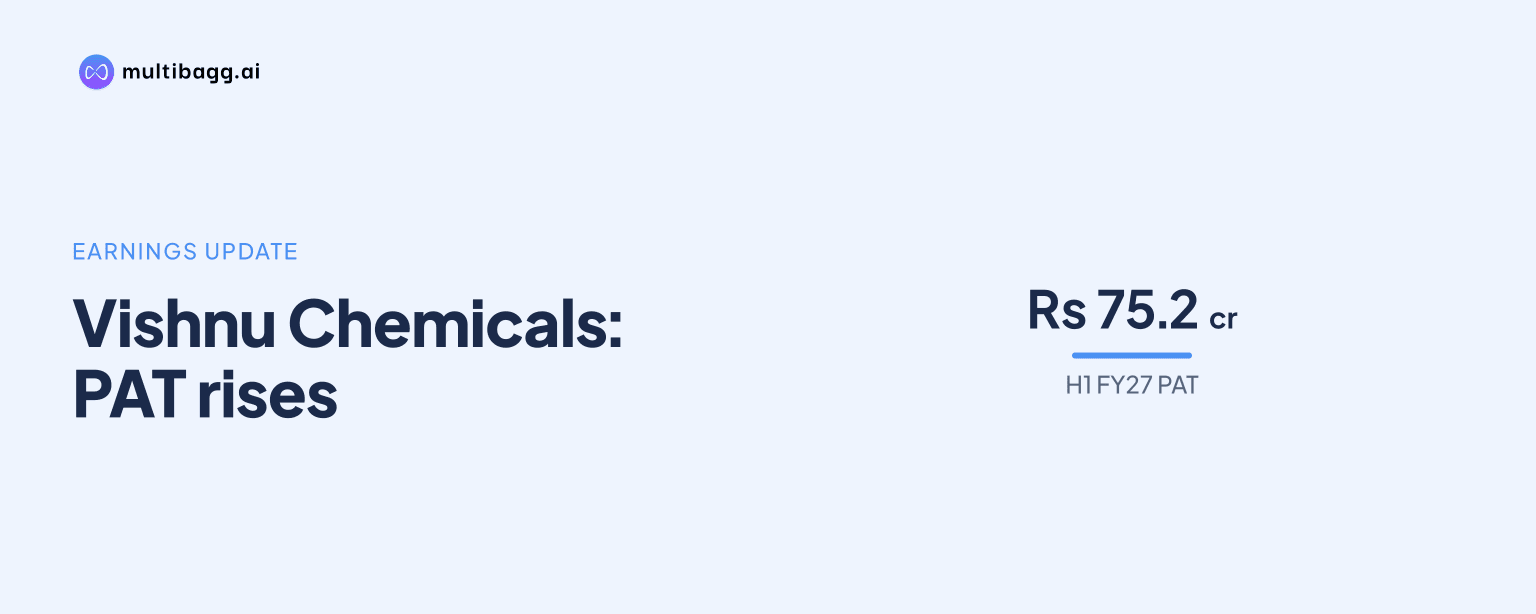
Vishnu Chemicals Limited reported H1FY27 profit after tax of Rs 75.2 crore, up 15.5% year on year, as gross profit increased 21.4% to Rs 401.7 crore and gross margin rose to 46.6%, even while shipping and forwarding costs reached 8.8% of Q2FY27 operating revenue.
Know Vishnu Chemicals inside out
Results, valuation, peers and who's buying, in one view.
How did Vishnu Chemicals perform in H1FY27?
Vishnu Chemicals recorded operating revenue of Rs 862.9 crore in H1FY27, a 15.3% increase from Rs 748.0 crore in H1FY26, while earnings before interest, tax, depreciation and amortisation, or EBITDA, rose 13.7% to Rs 129.4 crore. Profit after tax, or PAT, increased by 15.5% to Rs 75.2 crore from Rs 65.1 crore a year earlier.
The half-year result followed a Q2FY27 in which operating revenue grew 7.0% year on year to Rs 429.5 crore, EBITDA rose 10.0% to Rs 64.0 crore and PAT increased 8.1% to Rs 35.5 crore. Vishnu Chemicals reported the unaudited results for the quarter and half year ended September 30, 2026, after its board meeting on October 31, 2026.
What changed in Vishnu Chemicals' margins?
Vishnu Chemicals expanded its H1FY27 gross margin to 46.6% from 44.3% in H1FY26, a 2.3-percentage-point increase, as gross profit rose to Rs 401.7 crore from Rs 331.0 crore. The 21.4% gross-profit increase exceeded the 15.3% rise in operating revenue over the same half-year comparison.
The quarterly movement was also pronounced at the gross-profit level: Q2FY27 gross profit grew 20.2% to Rs 207.7 crore from Rs 172.8 crore, and gross margin reached 48.4% from 43.1%. EBITDA margin, however, was 15.0% in H1FY27 compared with 15.2% in H1FY26, while Q2FY27 EBITDA margin was 14.9%, up from 14.5% in Q2FY26.
PAT margin was unchanged at 8.7% across H1FY27 and H1FY26 despite the increase in half-year PAT to Rs 75.2 crore. In Q2FY27, PAT margin was 8.3%, compared with 8.2% a year earlier, alongside the 8.1% increase in quarterly PAT to Rs 35.5 crore.
How did freight costs affect Vishnu Chemicals in Q2FY27?
Vishnu Chemicals said shipping and forwarding expenses increased to 8.8% of operating revenue in Q2FY27 from 5.9% in Q1FY27, a 2.9-percentage-point sequential rise. The company attributed the higher freight costs to geopolitical tensions affecting logistics during the quarter ended September 30, 2026.
The release identified a 58% domestic and 42% export sales contribution as providing geographical diversification and partly mitigating exposure to elevated international freight costs. Q2FY27 gross margin nevertheless rose to 48.4% from 43.1% in Q2FY26, although Vishnu Chemicals did not quantify freight's separate effect on gross profit or EBITDA.
Management said it remained positive on medium-term prospects while maintaining a balanced domestic and export sales mix that it described as a natural hedge against rising input and logistics costs. Q2FY27 EBITDA of Rs 64.0 crore was 10.0% higher year on year, but its 14.9% margin was below the 15.0% reported for H1FY27 overall.
Got a follow-up? Ask IRIS
What growth projects has Vishnu Chemicals disclosed?
Vishnu Chemicals entered a 50:50 joint venture with DCX Chrome SAS of France to establish a high-purity chromium metal facility in India for niche aerospace and defence applications. The November 10, 2026 announcement did not disclose the facility's capital cost, capacity, commissioning date or expected revenue contribution.
In its barium business, Vishnu Chemicals reported stable performance and said its ongoing initiatives focus on operational efficiency and higher market share. Vishnu Chemicals manufactures chromium, barium and strontium chemicals and states that it serves customers in more than 50 countries, providing product context for the 42% export-sales contribution.
Vishnu Chemicals also plans to add about 20 megawatts, or MW, of solar capacity across its Visakhapatnam and Srikalahasti units, supplementing its existing 4.3 MW capacity. Management presented the solar expansion as a plan to improve energy-cost efficiency and sustainability, without a date, capital expenditure figure or quantified savings target.
What is the status of Vishnu Chemicals' South Africa operations and balance sheet?
Vishnu Chemicals said its South Africa operations progressed infrastructure refurbishment, engineering assessments, contractor mobilisation, recruitment and regulatory compliance work towards a safe and stable operational restart. The release did not provide a restart date, production estimate or financial contribution from the South Africa operations as of September 30, 2026.
Consolidated debt-to-equity, or D/E, stood at 0.67 times and debt-to-EBITDA stood at 2.8 times on September 30, 2026. Vishnu Chemicals also said ICRA assigned an A Stable rating to its long-term banking facilities, compared with the earlier CARE A- Stable rating.
For context, Vishnu Chemicals reported FY26 operating revenue of Rs 1,609.7 crore, EBITDA of Rs 252.4 crore and PAT of Rs 142.2 crore. Its FY26 gross margin was 45.1%, compared with the 46.6% reported for H1FY27, while FY26 EBITDA margin was 15.7% and PAT margin was 8.8%.
Conclusion
Vishnu Chemicals' H1FY27 outcome combined 15.3% operating-revenue growth with a 21.4% increase in gross profit, lifting gross margin by 2.3 percentage points to 46.6%. That operating performance supported a 15.5% increase in PAT to Rs 75.2 crore, while Q2FY27 logistics costs rose sharply to 8.8% of revenue from 5.9% in Q1FY27.
The next disclosed items to watch are progress on the approximately 20 MW solar plan, the high-purity chromium metal joint venture with DCX Chrome SAS, and the South Africa restart work. Vishnu Chemicals has not disclosed timing, spending, capacity or earnings targets for those projects, while management has indicated that domestic sales represented 58% of the mix used to partly mitigate elevated freight exposure.