










Vishnu Chemicals plans Rs 520 crore expansion and Rs 820 crore debt
Key highlights
- Vishnu Chemicals said about Rs 190 crore of its around Rs 520 crore programme had been spent, with around Rs 330 crore remaining.
- Management expects debt including working capital to peak at Rs 800-820 crore, from Rs 717 crore at the time of the call.
- The 10,000-tonne-per-annum DMSO plant is scheduled to commence operations in Q1 FY28.
- Management targets 17% to 18% consolidated EBITDA margin in FY28, after 15% in the first half of FY27.
powered by IRIS
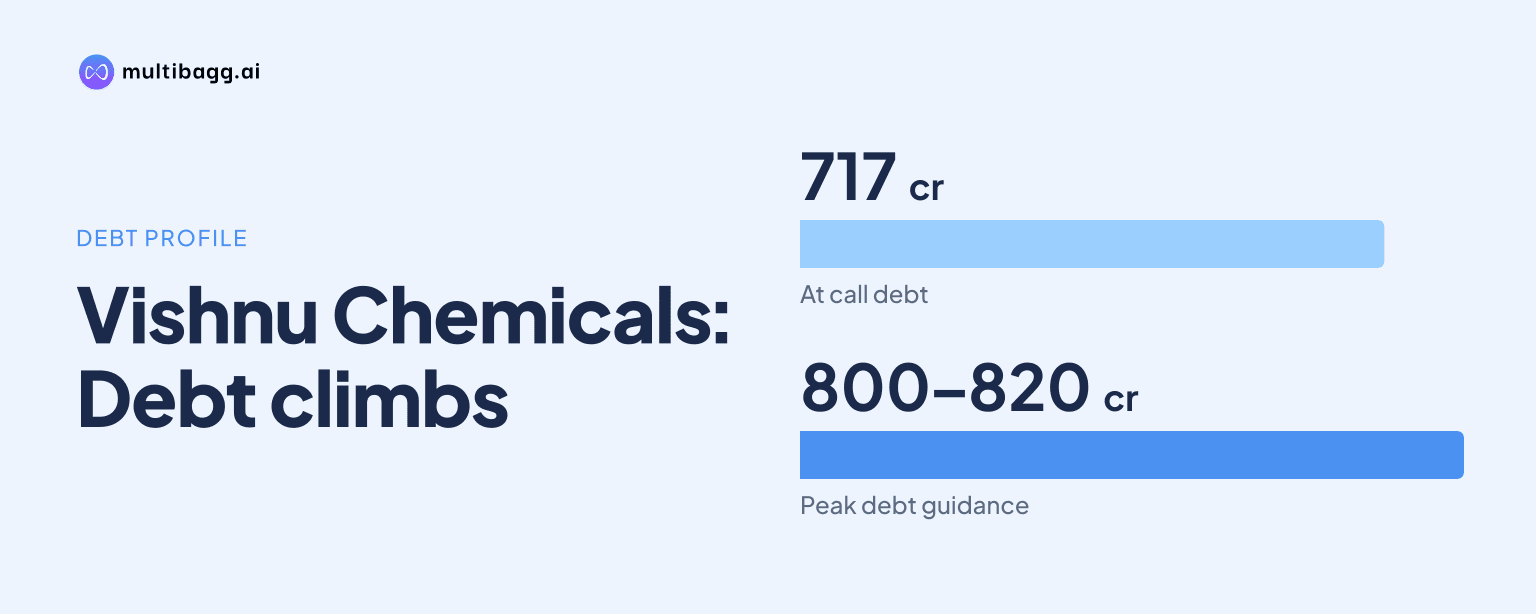
Vishnu Chemicals Limited said in the second quarter of financial year 2027 (Q2 FY27) that it was pursuing an around Rs 520 crore expansion programme, with management expecting debt including working capital to peak at Rs 800-820 crore from Rs 717 crore. The programme includes dimethyl sulfoxide (DMSO) and chrome-oxide capacity, with DMSO scheduled to start in Q1 FY28.
Know Vishnu Chemicals inside out
Results, valuation, peers and who's buying, in one view.
What does Vishnu Chemicals' Rs 520 crore expansion include?
Vishnu Chemicals said its around Rs 520 crore programme covers DMSO and chrome-oxide expansion, but excludes the chromium-metal venture because that project is in a separate 50:50 joint venture. Management said about Rs 190 crore had been incurred by the Q2 FY27 call, leaving around Rs 330 crore to be spent over the following 12 months.
Management allocated about Rs 250 crore to DMSO and about Rs 220 crore to the oxide expansion. The two disclosed allocations total Rs 470 crore, compared with the around Rs 520 crore programme cited by management, and no detailed allocation was provided for the difference. The chromium-metal project is separately planned as a 6,000-tonne greenfield plant in Vishakhapatnam.
When will Vishnu Chemicals' new plants begin operating?
Vishnu Chemicals expects its 10,000-tonne-per-annum DMSO plant to commence operations in Q1 FY28. Management described DMSO as its first venture into organic chemistry and expects two to three months of stabilisation, while customer approvals are pursued in parallel.
Vishnu Chemicals is targeting a 50% to 60% operating level for DMSO in its first year rather than immediate full utilisation. Management did not provide an earnings before interest, tax, depreciation and amortisation (EBITDA) margin target for DMSO, saying operating scale would determine the outcome. It said the business plan indicated raw-material costs of 35% to 40%.
Vishnu Chemicals has also installed 12,000 tonnes per annum of strontium-chemical capacity and targets 70% utilisation in that business's second year of operations. In chromium chemicals, management said sodium dichromate expansion had been completed, raising capacity to 90,000 tonnes, while chromium operations were running above 75% utilisation at the time of the call.
How will Vishnu Chemicals fund its projects and debt?
Vishnu Chemicals expects debt including working capital to rise from Rs 717 crore at the time of the call to Rs 800-820 crore at its peak. Management said the remaining spending would be funded through additional debt and internal accruals, with the projects capitalised over the next year.
Working-capital conditions had also changed by September 30, 2025. Receivable days rose to about 72-73 days from 62 days a year earlier, while management attributed higher inventory days mainly to elevated logistics costs and geopolitical uncertainty. Management expects those conditions to stabilise over the short to medium term.
Export logistics costs reached 20.9% of export sales in Q2 FY27, compared with 10.7% in Q1 FY27 on a consolidated basis. Vishnu Chemicals said it balanced that rise by focusing more on domestic sales, whose contribution increased to 58% in Q2 FY27 from 45% in Q1 FY27.
Got a follow-up? Ask IRIS
What specialty chrome capacity is Vishnu Chemicals adding?
Vishnu Chemicals is adding about 30,000 tonnes of specialty chrome derivatives, comprising roughly 20,000 tonnes of incremental chrome oxide green capacity and 5,000 to 6,000 tonnes of chromic acid capacity. These additions follow the completed sodium dichromate expansion to 90,000 tonnes.
The separate chromium-metal joint venture is planned to produce 6,000 tonnes of high-purity chrome metal for aerospace, defence, nuclear-power and welding-electrode applications. Management said India imported about 1,700 to 1,800 tonnes of chrome metal annually over the previous two years, with imports growing by about 12% to 13% year on year. The venture targets exports for 60% to 70% of its production.
Management said it selected an aluminothermic process because the electrolytic route is more energy intensive. It said a further processing step, potentially in one to two years, could produce quality similar to electrolytic chrome metal. Management cited an indicative global chrome-metal price of about Rs 1,000 per kilogram but did not disclose expected project realisations or a formal margin forecast.
Can Vishnu Chemicals raise EBITDA margin in FY28?
Management expects Vishnu Chemicals' consolidated EBITDA margin to move towards 17% to 18% in FY28, after the company reported 15% in the first half of FY27. Management linked the expected improvement to a potential easing of logistics costs, backward integration and forward integration through a higher-value product mix.
Management said logistics costs had increased by nearly 3 percentage points on a quarterly basis and expected that pressure to subside in subsequent quarters. It also said a consolidated EBITDA margin near 20% was possible if several conditions were met, including South African chrome-ore output meeting 80% to 90% of Vishnu Chemicals' requirement, DMSO stabilising within about a quarter, the oxide plant starting up and European shipments improving.
The South African operation is part of the proposed backward-integration plan. Mining had already started, while the beneficiation plant was in final commissioning, and management targeted shipments from South Africa to India from Q4. Management said FY28 should see a significant contribution from South African operations but did not disclose shipment volumes or financial contribution.
Conclusion
Vishnu Chemicals is pursuing an around Rs 520 crore programme intended to broaden its product mix through a 10,000-tonne DMSO plant and specialty chrome capacity, while separately developing a 6,000-tonne chromium-metal joint venture. The funding trade-off is management's expected increase in debt, including working capital, from Rs 717 crore to a peak of Rs 800-820 crore.
The next disclosed markers are DMSO commissioning in Q1 FY28, its targeted 50% to 60% first-year operating level, and planned South African shipments from Q4. Management's FY28 EBITDA margin expectation of 17% to 18% also depends on logistics costs easing from 20.9% of export sales in Q2 FY27 and on execution of the new capacity plans.