










Vishnu Chemicals targets exports for 6,000-tonne chrome metal
Key highlights
- Vishnu Chemicals plans a 6,000-tonne-per-annum high-purity chrome-metal joint venture in Vishakhapatnam.
- Vishnu Chemicals targets exports of 60% to 70% of chrome-metal output.
- Management estimates Indian chrome-metal demand at around 2,000 tonnes after import growth of about 12% to 13% annually.
- The call did not disclose a commissioning date, capex amount or revenue forecast for the chrome-metal venture.
powered by IRIS
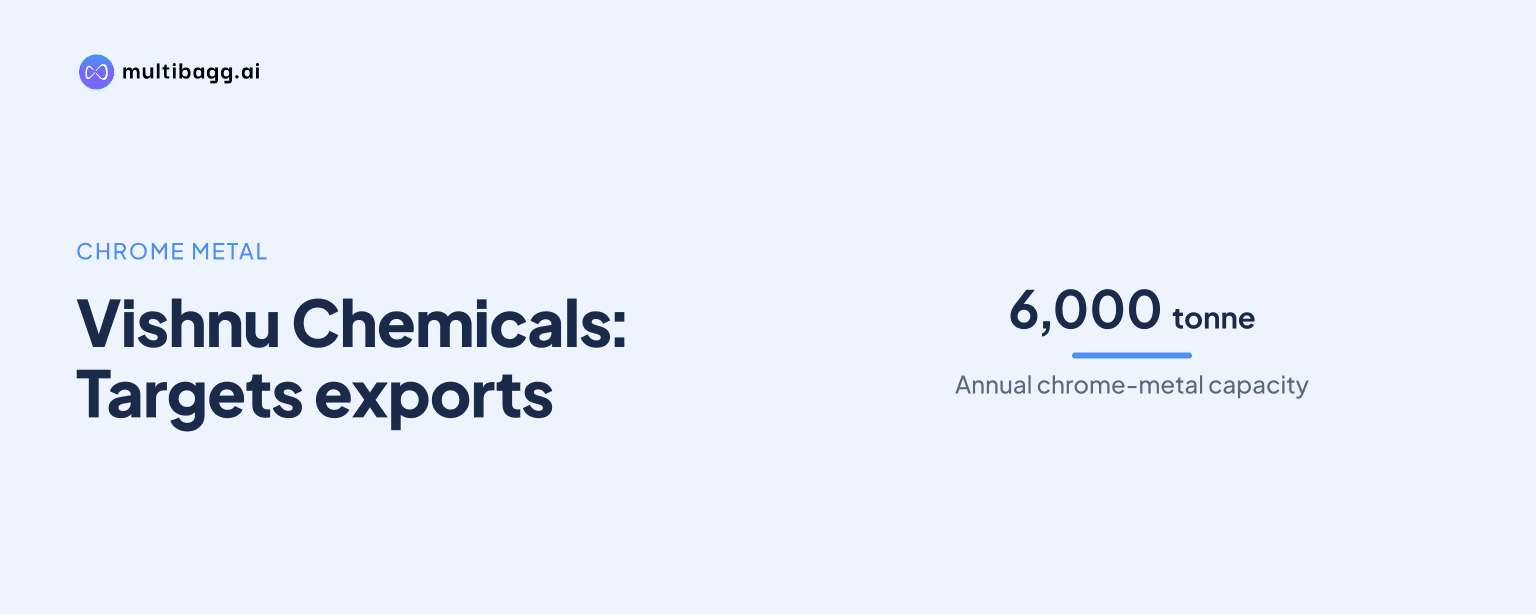
Vishnu Chemicals plans a 6,000-tonne high-purity chrome-metal joint venture in Vishakhapatnam and targets 60% to 70% of production for exports, compared with management’s estimate of about 2,000 tonnes of Indian demand. Management did not disclose a Q4 FY28 commissioning date, project capex or revenue forecast on the call.
Know Vishnu Chemicals inside out
Results, valuation, peers and who's buying, in one view.
What is Vishnu Chemicals building in chrome metal?
Vishnu Chemicals is setting up a 6,000-tonne-per-annum greenfield plant in Vishakhapatnam to make high-purity chrome metal and related grades. Management said the products are intended for aerospace, defence, nuclear-power and welding-electrode applications, and that India currently has no domestic manufacturer of chrome metal.
The call did not provide an operating-start date for the chrome-metal venture, including a Q4 FY28 date. Management separately said its 10,000-tonne-per-annum dimethyl sulfoxide plant was expected to commence operations in Q1 FY28, making that timeline inapplicable to the 6,000-tonne chrome-metal project.
Management said it selected an aluminothermic process because it is more energy-efficient than an electrolytic process. It plans initially to make air-melt grade, while a vacuum-furnace step could produce quality similar to electrolytic chrome metal; management said further development over one to two years could seek comparable quality through its chosen route.
How much chrome metal will Vishnu Chemicals export?
Vishnu Chemicals and its partner target exports of 60% to 70% of chrome-metal production. At the proposed 6,000-tonne capacity, that would imply 3,600 to 4,200 tonnes for export at full utilisation, while management did not disclose a utilisation ramp-up or annual sales forecast.
Management said India imported about 1,700 to 1,800 tonnes of chrome metal in each of the past two years, with imports growing about 12% to 13% year on year. It estimated Indian demand at around 2,000 tonnes, meaning the proposed export allocation is larger than its stated estimate of the domestic market.
Vishnu Chemicals said Indian supplies currently come from Europe and China. Management described the venture as a prospective Tier 2 supplier to aerospace and defence customers, where chrome metal is used as an anti-corrosive material in components exposed to high thermal conditions; it said an Airbus A320 engine uses around 220 kilograms of chrome metal.
What margins and pricing has Vishnu Chemicals indicated?
Vishnu Chemicals has not issued formal project-level margin guidance, although management said it was looking at EBITDA, or earnings before interest, tax, depreciation and amortisation, margin of above 20% for the higher-value product. Management also said the outcome would be volume-driven and that the difference between gross margin and EBITDA should not be significant.
Management said a global chrome-metal index was around Rs 1,000 per kilogram, but it did not disclose the venture’s expected selling realisation. It said the business plan reviewed with its partner showed promising gross and EBITDA margins at 60% operating levels, without disclosing the partner’s name, investment amount, purchase-order quantity or contract duration.
Export freight is a material consideration in the existing business. Logistics cost equalled 20.9% of export sales in Q2 FY27, compared with 10.7% in Q1 FY27 on a consolidated basis, while domestic-market contribution rose to 58% from 45% as management shifted focus toward local sales.
Got a follow-up? Ask IRIS
How does chrome metal fit Vishnu Chemicals’ wider expansion?
Vishnu Chemicals is expanding chromium derivatives alongside the chrome-metal venture, with about 20,000 tonnes of incremental chrome oxide green capacity and 5,000 to 6,000 tonnes of incremental chromic-acid capacity. Its sodium dichromate expansion has been completed, taking capacity to 90,000 tonnes, while chromium-side utilisation was above 75%.
Management said barium utilisation was close to 70%, compared with chromium utilisation above 75%, and that it had no further barium capex plans. It is focusing on oxide and acid products, and said a clear purchase order from its European partner for oxide business should add revenue visibility; the call did not identify that order as a chrome-metal order.
The company expects Europe to account for a larger share of revenue as chrome-oxide shipments to its European partner increase in coming months. Management said the United States remained promising after customer wins in recent quarters, while sulfuric acid, sulfur and energy costs had created more volatility than end-user demand.
What could affect Vishnu Chemicals’ chrome-metal rollout?
Vishnu Chemicals’ project economics will depend on operating volumes, energy costs, raw-material costs and export logistics, based on management’s comments. The company did not provide project revenue, asset-turn or capex guidance, so management’s observation of EBITDA margin above 20% remains preliminary rather than a financial target.
Raw-material integration is another disclosed development. Management said mining operations in South Africa had begun and were producing good output, while the processing plant was being prepared for commissioning; it targeted shipments to India from Q4 onwards and said FY28 should see significant contribution from those operations.
Management did not specify whether South African material would supply the chrome-metal joint venture. It said teams in India, South Africa and the United Kingdom were working on processing-plant readiness, with operational safety, reliability and consistency of output identified as priorities before regular shipments begin.
Conclusion
Vishnu Chemicals is building a 6,000-tonne chrome-metal venture around overseas sales, with 60% to 70% of output targeted for exports despite an Indian market management estimates at around 2,000 tonnes. The project extends its chromium portfolio alongside expansion in chrome oxide green and chromic acid, but its commercial contribution remains undisclosed.
The next points to watch are a commissioning date, project investment, customer contracts and the path to the 60% operating level cited by management. Management expects its dimethyl sulfoxide plant to start in Q1 FY28 and targets South African shipments to India from Q4 onwards, but it has not set out an equivalent timeline for the chrome-metal facility.