










VST Cuts FY27 Tractor Outlook to Flat Amid Maharashtra Drought
Key highlights
- VST expects FY27 domestic and export tractor sales to be flat after domestic tractor sales fell 4% in H1.
- Maharashtra accounts for almost 40% of VST’s compact-tractor business, and the state’s tractor industry had fallen more than 20%, management said.
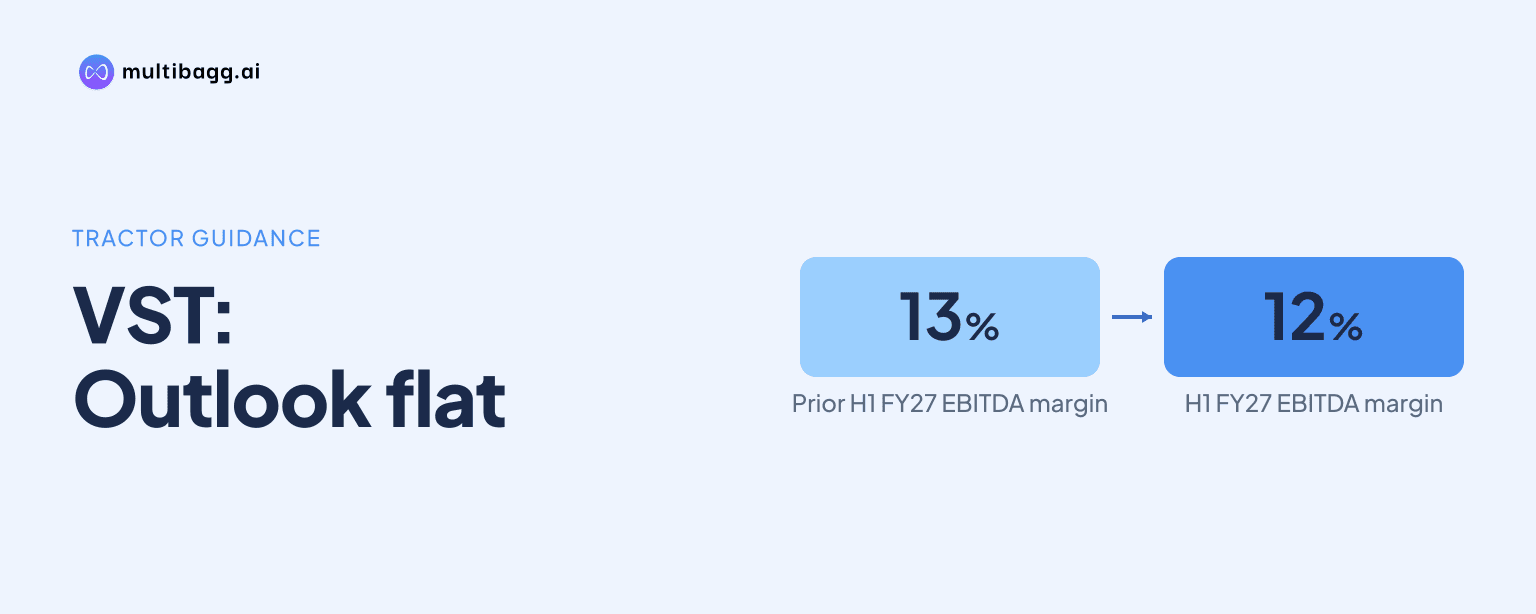
- H1 FY27 revenue rose 6% to Rs 635 crore, while operational EBITDA margin declined to 12% from 13%.
- VST targets about 40% FY27 power-weeder growth after H1 volume increased 22% to 6,076 units.
powered by IRIS
VST Tillers Tractors Limited cut its FY27 domestic and export tractor outlook to flat on November 5, 2026, after domestic tractor sales fell 4% in H1 and drought hit Maharashtra, which contributes almost 40% of its compact-tractor business. Management said growth in other regions would not fully offset the state’s decline.
Know VST Tillers Tractors inside out
Results, valuation, peers and who's buying, in one view.
Why did VST cut its FY27 tractor outlook?
VST expects domestic tractor sales to be flat in FY27 because severe drought in Maharashtra and northern Karnataka has outweighed growth in northern India and other markets. Management said the Maharashtra tractor industry had declined by more than 20% and expected a further drop in Q3, based on October industry figures discussed during the call.
The pressure is concentrated in compact tractors, for which Maharashtra supplies almost 40% of VST’s business. Management identified vineyards and orchards, particularly pomegranate orchards, as important compact-tractor applications, and said Solapur had been badly affected by weak rainfall. Western Maharashtra was relatively better, management said, but compact-tractor usage there is lower.
Management also cited a competitor’s lower pricing in Gujarat over the preceding two to three months as a factor affecting tractor sales. It expected that pricing action to stop, but did not provide a timetable or quantify its effect. VST said domestic tractor sales were down 4% in H1 FY27 and expected a flat full-year result rather than the growth anticipated at the start of the year.
How did VST’s H1 FY27 sales and earnings change?
VST reported H1 FY27 revenue of Rs 635 crore, up 6% from Rs 597 crore in the prior-year period, while operational earnings before interest, tax, depreciation and amortisation, or operational EBITDA, margin declined to 12% from 13%. Management attributed the 100-basis-point margin reduction to higher raw-material costs.
Profit after tax increased to Rs 71.5 crore in H1 FY27 from Rs 69.9 crore a year earlier. The revenue increase occurred despite lower domestic tractor sales, as power tillers and power weeders recorded higher volumes. VST sold 27,158 power tillers, up 9%, and 6,076 power weeders, up 22%, during the first half.
In Q2 FY27, revenue rose 2% to Rs 321.6 crore from Rs 315 crore in Q2 FY26, but operational EBITDA fell to Rs 35.1 crore from Rs 40.9 crore. The quarterly operational EBITDA margin was 11%, compared with the 12% H1 margin, reflecting the commodity-cost pressure management said had affected the industry for two quarters.
What could help VST offset the tractor decline?
VST said growth in northern markets, the VST Zetor full-sized range and the Phantom series could partly cover the 4% to 5% first-half tractor decline. Management said markets other than Maharashtra and northern Karnataka had grown, with Phantom sales performing particularly in areas not affected by drought.
Management expects VST Zetor to grow about 40% to 50% from the prior year, although it did not disclose either the prior-year volume or a FY27 unit target. It said that growth would not be sufficient by itself to compensate for Maharashtra, because the state remains a large compact-tractor market for VST.
New tractor launches are not expected to contribute significant FY27 volume. Management plans a four-wheel-drive higher-horsepower tractor toward the end of FY27 and a global platform for India, Europe and the United States in Q4. It said these products should have a larger role in the following financial year rather than alter the current flat tractor outlook.
Got a follow-up? Ask IRIS
Can VST’s Netherlands warehouse improve tractor exports?
VST expects export tractor sales to be flat in FY27, although management said its Netherlands warehouse should begin full operations in Q4 and address a logistics constraint. The company planned to ship its first tractor lot to the warehouse by the end of Q3, with the operation intended to support European distribution from Q4.
Management said the warehouse could reduce delivery time to European distributors from 60 to 90 days to a target of two weeks from order. Faster availability is intended to improve distributors’ working-capital rotation and allow VST to fulfil smaller initial trial orders from other parts of Europe that had been difficult to serve from India.
Those delivery and rotation improvements are management targets rather than reported outcomes. The warehouse’s effect on export volume will depend on distributor orders after Q4, while management’s stated FY27 export outlook remains flat. VST sold 501 export tractors in H1 FY27, but did not disclose the comparable prior-year volume on the call.
Why is VST still targeting small-farm-machine growth?
VST continues to target double-digit FY27 growth in small farm machinery, or SFM, after power-tiller volume rose 9% to 27,158 units and power-weeder volume rose 22% to 6,076 units in H1. Management said paddy-growing markets including Odisha, Assam, Tamil Nadu and Andhra Pradesh had received reasonably good rainfall.
Management expects power-weeder sales to grow about 40% in FY27 after VST sold close to 10,000 units in the prior year. It also said a delayed monsoon had pushed power-reaper demand into Q3. Power tillers, weeders and reapers have their strongest markets in paddy-producing regions, which management said differed from the compact-tractor markets affected by drought.
VST had appointed more than 800 dealerships and more than 1,000 counters, and management wants to exceed 2,000 counters by FY27 year-end. It is also building a physical and digital, or phygital, sales network to generate customer inquiries online and use physical outlets for product delivery.
The company plans to launch the score platform and rear-rotary power weeders in November and December. Management expects only 500 score units to enter the market in H2 FY27, with larger volumes expected in the following financial year. The score platform is aimed at small and marginal farmers in dry areas, sugarcane and orchard applications rather than VST’s core paddy-tiller markets.
Conclusion
VST’s FY27 outlook now separates tractors from small farm machinery. Drought in Maharashtra and northern Karnataka, combined with lower competitor pricing in Gujarat, has shifted domestic and export tractor expectations to flat. Maharashtra’s almost 40% share of VST’s compact-tractor business means growth in VST Zetor, Phantom and northern markets has not yet fully compensated for the affected regions.
The next developments to watch are the Q4 start of the Netherlands warehouse, the November and December product launches, and whether VST Zetor and Phantom sales can offset the H1 tractor decline. Management is also evaluating a further price increase after taking two price hikes each for tractors and power tillers in FY27, while targeting retail-finance penetration of about 15% by year-end from 11% to 12% at the time of the call.