








Waaree Energies Limited: Tax Timing Hinges on 12 Months
Max Plan at ₹4,999/yr₹8,999

Find your next multibaggerBe a Pro Investor
Research stocks and track your picks on the go. Download the app.
Key highlights
- Waaree Energies' disclosure uses a holding period of more than 12 months for its long-term capital-gains discussion.
- Short-term gains are disclosed as taxable at 15%, subject to prescribed conditions.
- Institutional investors subscribed 76.4 times in Waaree Energies' October 2024 IPO.
- Operating margin was 18% in September 2026, versus 25% in December 2025.
powered by IRIS
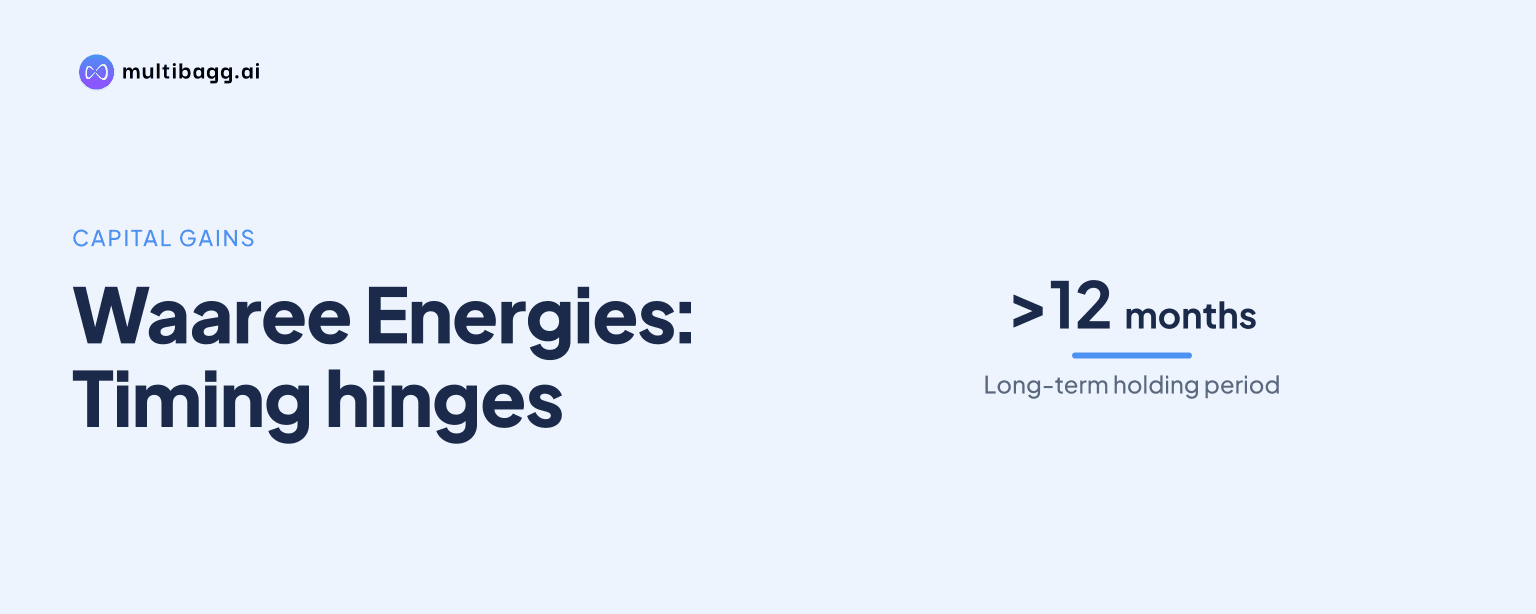
Waaree Energies Limited's disclosed capital-gains framework distinguishes holdings by a 12-month period, with short-term gains stated as taxable at 15% subject to prescribed conditions. The company-specific material does not identify any new capital-gains tax policy change, while institutional investors subscribed 76.4 times to its October 2024 IPO.
How are Waaree Energies share gains classified for tax?
Waaree Energies classifies the tax discussion around whether shares are held for more than 12 months. Its disclosures state that gains from selling equity shares in an Indian company are generally taxable in India unless a specific exemption applies. This makes the purchase and sale dates important reference points for investors reviewing their own holding period.
For a sale after more than 12 months, the disclosure says an investor may be subject to long-term capital gains tax in India, alongside securities transaction tax, or STT. For short-term gains, the disclosed rate is 15%, subject to prescribed conditions. The supplied material describes this treatment but does not provide a broader calculation, exemption amount or investor-specific tax outcome.
Has Waaree Energies disclosed a new capital-gains tax change?
No, Waaree Energies has not disclosed a capital-gains tax change unique to its shares in the material provided. The social-media discussion links the company with tax policy concerns, but the cited disclosure explains the holding-period treatment rather than announcing a new Waaree-specific rule.
That distinction matters because investors may confuse a company disclosure with a change in tax policy. The stated 12-month threshold is the central item in the supplied tax language, not a newly announced rate or concession. Investors considering a sale would need to assess the applicable prescribed conditions and their own circumstances rather than assume that the disclosure changes the tax position.
What did the Waaree Energies IPO offer retail investors?
Waaree Energies' IPO lot size was nine shares, and a retail individual investor could apply for up to 14 lots. That maximum amounted to 126 shares and ₹1,89,378, according to the supplied IPO details. The red herring prospectus also stated that not less than 35% of the net offer size would be allocated to retail individual investors.
The October 2024 IPO received strong interest across investor categories. Institutional investors subscribed 76.4 times, based on the supplied context. For investors who acquired shares through the IPO or later in the market, the relevant tax holding period remains a separate issue from the subscription response or the original retail application limit.
Got a follow-up? Ask IRIS
What operating trends are investors tracking at Waaree Energies?
Investors are tracking a decline in operating margin from 25% in December 2025 to 18% in September 2026, alongside the company's export exposure and policy sensitivity. The broader market discussion has moved from concern over execution across multiple growth projects towards closer scrutiny of whether policy developments, currency movements and margin compression limit the benefit of capital expenditure and diversification.
The quarterly figures supplied for September 2026 show sales of 7,518, operating profit of 1,335 and net profit of 754. These compare with sales of 8,480, operating profit of 1,577 and net profit of 1,126 in March 2026. The data gives investors a recent operating backdrop to monitor alongside tax timing, but it does not establish a direct link between tax treatment and financial performance.
Conclusion
The available information puts the 12-month holding test at the centre of the Waaree tax discussion. Its disclosures describe short-term gains as taxable at 15% subject to prescribed conditions and note potential long-term capital gains tax and STT after a holding period of more than 12 months. They do not indicate a newly disclosed capital-gains change specific to Waaree.
Investors will continue to watch policy developments, currency movements, interest-rate conditions and export exposure, which the supplied discussion identifies as relevant to share-value monitoring. On operations, the next important comparison will be whether sales, profit and the 18% operating margin reported for September 2026 stabilise or change as Waaree pursues its capital-expenditure and diversification plans.

