










WABAG order book reaches Rs 20,207 crore in H1 FY2027 results
Key highlights
- WABAG closed H1 FY2027 with a record Rs 20,207 crore order book after more than Rs 5,200 crore of intake.
- WABAG’s Kuwait contract covers a 272 MLD seawater desalination facility and five years of post-completion O&M.
- WABAG’s Reliance order includes a 201 MLD Jamnagar desalination plant expandable to 302 MLD.
- WABAG reported H1 FY2027 consolidated revenue of Rs 1,887 crore, up 20.3% year on year.
powered by IRIS
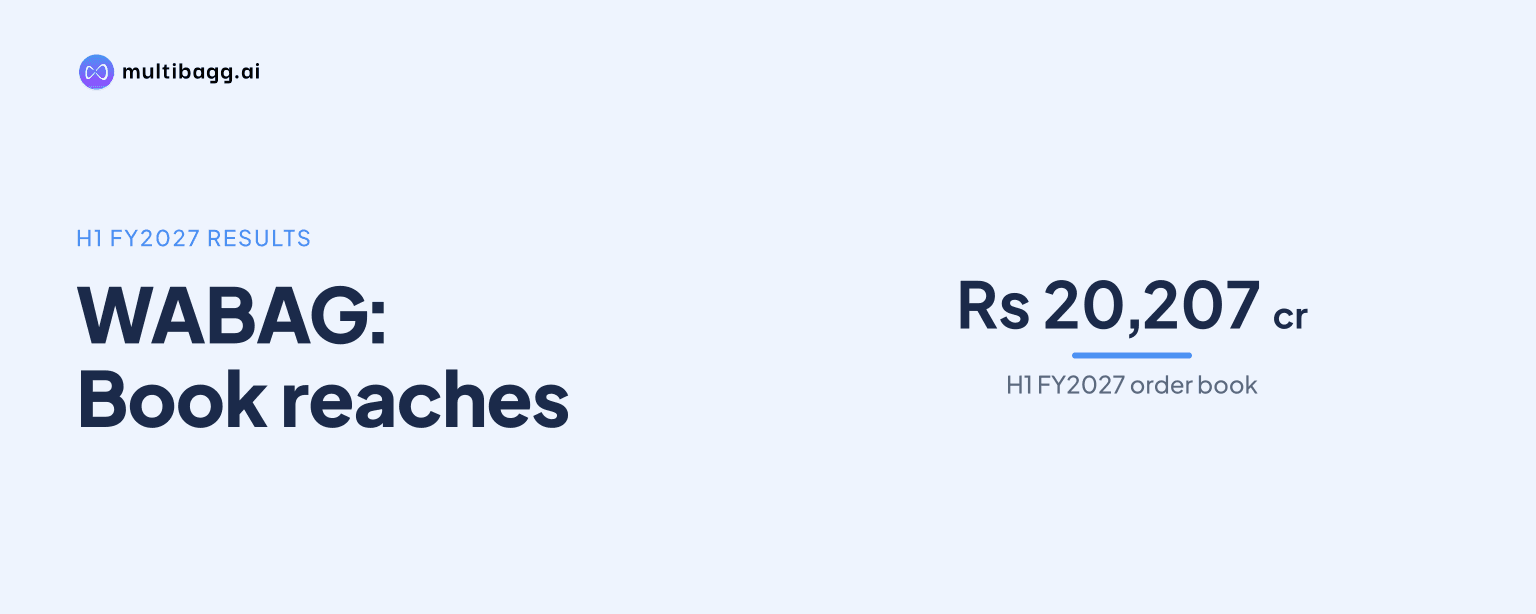
VA TECH WABAG LIMITED ended H1 FY2027 with a record Rs 20,207 crore order book, supported by more than Rs 5,200 crore of order intake. WABAG’s Kuwait desalination entry, Reliance Industries Limited work in Jamnagar, a UAE project and orders in India and Europe expanded the backlog, which management said was more than four times annual revenue.
Know Va Tech Wabag inside out
Results, valuation, peers and who's buying, in one view.
How did WABAG’s order book reach Rs 20,207 crore?
WABAG reached the Rs 20,207 crore threshold through more than Rs 5,200 crore of order intake during H1 FY2027. Management described the closing backlog as a lifetime high, comprising medium-term engineering, procurement and construction, or EPC, opportunities and longer-duration operations and maintenance, or O&M, revenue.
The order-book milestone coincided with record net cash. Net cash excluding hybrid annuity model, or HAM, assets exceeded Rs 1,100 crore at the end of H1 FY2027, compared with Rs 950 crore at the end of FY2026. Including HAM, net cash stood at Rs 1,036 crore, the 15th consecutive quarter of positive net cash, according to management.
WABAG’s cash conversion also improved during the half year. Consolidated operating cash flow was Rs 225 crore, more than 1.1 times profit after tax, or PAT, while net working capital improved to 101 days from 104 days at March 2026. Management said the order backlog and cash position provided a base for disciplined project execution.
Which orders drove WABAG’s H1 FY2027 intake?
WABAG’s disclosed H1 FY2027 wins included a 272 million litres per day, or MLD, seawater reverse-osmosis desalination project in Kuwait and a Reliance Industries Limited desalination project in Jamnagar. The Kuwait contract was signed and commenced with Kuwait’s Ministry of Electricity, Water and Renewable Energy in partnership with HEISCO and includes five years of O&M after the EPC phase.
The Kuwait award marked WABAG’s first project in that market. In Jamnagar, the Reliance project covers a desalination plant with capacity of about 201 MLD, expandable to about 302 MLD, and a 72 MLD remineralisation plant. WABAG also received a repeat medium order from Reliance in September for an effluent treatment plant at the Dhirubhai Ambani Green Energy Giga Complex in Jamnagar.
WABAG also entered the United Arab Emirates through the Ajman wastewater treatment project in the current financial year. Other disclosed orders included two Bangalore Water Supply and Sewerage Board projects, a medium order from Delhi Jal Board and a large order for expansion of waterworks in Vienna, Austria. Management said these wins spread its activity across municipal, industrial and technology-led water applications.
What does WABAG’s backlog say about revenue mix?
WABAG’s Rs 20,207 crore backlog combines EPC project work with recurring O&M contracts. O&M backlog was Rs 6,500 crore in H1 FY2027, while O&M accounted for 18% of H1 revenue and EPC accounted for 82%. Management has set an objective for O&M to reach 20% of revenue over the medium term.
The geographical revenue split was 54% international and 46% India in H1 FY2027. Consolidated revenue from operations rose 20.3% year on year to Rs 1,887 crore, while earnings before interest, tax, depreciation and amortisation, or EBITDA, increased about 21% to Rs 261 crore. PAT grew about 30% to Rs 195 crore.
Profit growth exceeded revenue growth in the half year. PAT margin rose to 10.3% in H1 FY2027 from 9.6% in the same period a year earlier, while EBITDA margin was 13.8%. Management reiterated medium-term objectives of 15% to 20% revenue compound annual growth, EBITDA margin in a 13% to 15% range, return on capital employed above 20% and a sustained positive net-cash position.
Got a follow-up? Ask IRIS
Which projects must WABAG execute to convert its backlog?
WABAG must execute several large projects already under way, including Chennai Metro’s 400 MLD Perur desalination plant. Management said about 90% of concreting had been completed, nearly 1 lakh cubic metres of concrete had been poured, and the site had recorded 7 million safe man-hours. Mechanical-equipment erection was progressing, with completion expected in the coming year.
In the Middle East, management targeted commissioning of the Al Haer sewage treatment plant in the fourth quarter of FY2027. At Ras Tanura, mechanical construction had been completed and pre-commissioning was under way, with hydro testing targeted by November-end. For Yanbu, basic engineering was substantially ready and procurement of long-lead equipment had begun before formal project commencement.
WABAG also reported progress on projects in India, Africa and Nepal. At Bangalore Water Supply and Sewerage Board’s Bommanahalli project, engineering and procurement were at an advanced stage, while civil work was progressing. In Zambia, civil work was under way at the Ngwerere and Chunga sewage treatment plants, and management said major equipment orders had been finalised.
What could affect WABAG’s project delivery and margins?
Management said commodity-price pressure and regional disruption in the Middle East were causing shipment delays, though they had not made a material impact on execution timelines or margins as of the November 6, 2026 call. Clients had recognised the shipping constraints and allowed longer routes, while WABAG said critical components could be moved by air freight if required.
The immediate exposure varies by project stage. Management said Al Haer was at final mechanical-completion stages, Ras Tanura was awaiting pre-commissioning, and newer projects were still at engineering or procurement stages. If conditions did not improve in the following three to six months, management said it would need a strategy to deliver equipment to sites.
Management said project sites themselves had not been affected and work was continuing normally. Its stated priority was to manage delivery of materials to site, particularly as new Middle East projects begin physical execution. The company also said it remained selective on projects based on technology differentiation, margins, payment security and execution risk.
Conclusion
WABAG’s Rs 20,207 crore H1 FY2027 order book brings together first-time work in Kuwait, a UAE wastewater project, expanded Reliance assignments and orders in India and Europe. More than Rs 5,200 crore of half-year intake, a Rs 6,500 crore O&M backlog and a 54% international revenue share show that the backlog spans geographies and contract types, while PAT margin increased to 10.3% from 9.6% a year earlier.
The next disclosed strategic event is WABAG’s annual investor meet in May 2027, when management plans to unveil Wriddhi 2.0, its next five-year plan. Before that, investors can monitor progress on the 400 MLD Perur plant, Al Haer commissioning targeted for Q4 FY2027, and management’s response to Middle East shipment delays as indicators of backlog conversion.