










WABAG Q2 PAT tops Rs 100 crore as net cash reaches Rs 1,036 crore
Key highlights
- WABAG’s Q2 FY2027 revenue exceeded Rs 1,000 crore and PAT exceeded Rs 100 crore, with PAT up 23% year on year.
- WABAG ended H1 FY2027 with net cash of Rs 1,036 crore including HAM and more than Rs 1,100 crore excluding HAM.
- H1 FY2027 consolidated revenue rose 20.3% to Rs 1,887 crore and PAT increased almost 30% to Rs 195 crore.
- WABAG’s H1 FY2027 order book reached Rs 20,207 crore and its O&M backlog reached Rs 6,500 crore.
powered by IRIS
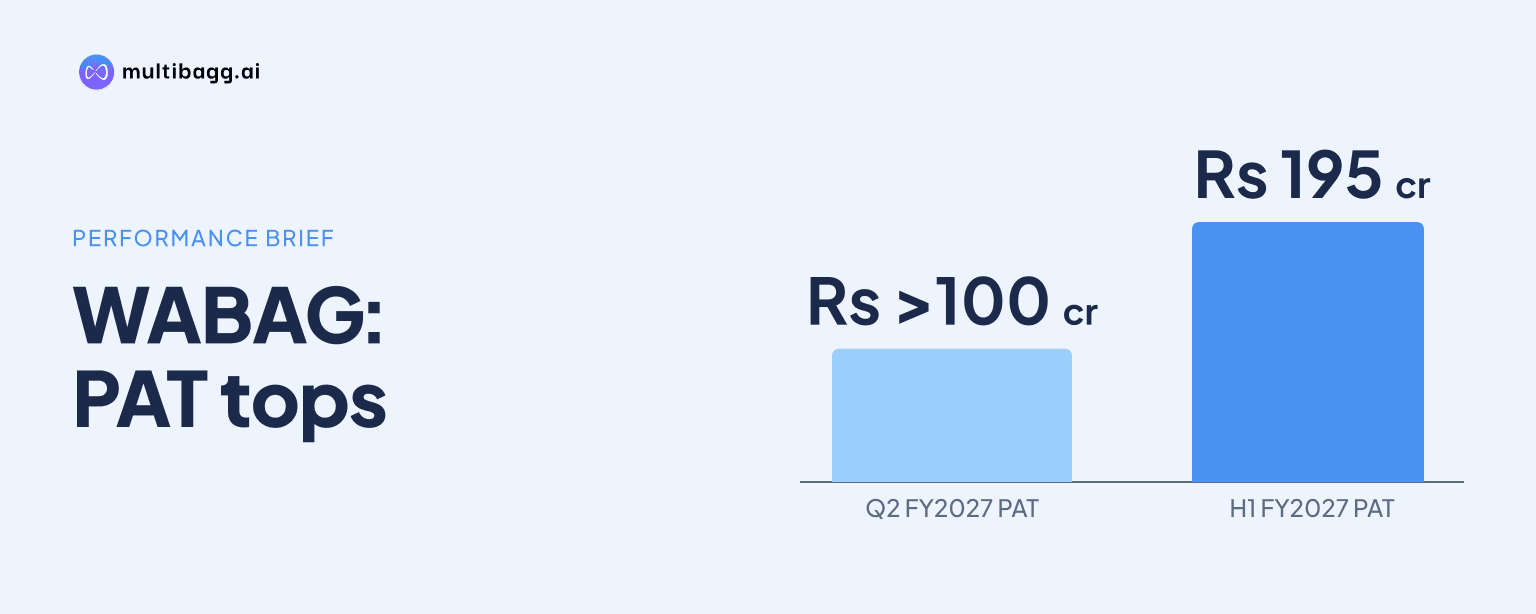
VA TECH WABAG LIMITED reported its highest-ever second-quarter profit after tax, above Rs 100 crore, in Q2 FY2027 and ended H1 with Rs 1,036 crore of net cash including the hybrid annuity model, or HAM. WABAG said Q2 revenue rose 20% year on year while profit after tax rose 23%, and H1 operating cash flow reached Rs 225 crore.
Know Va Tech Wabag inside out
Results, valuation, peers and who's buying, in one view.
How did WABAG perform in Q2 FY2027?
WABAG recorded revenue from operations above Rs 1,000 crore and profit after tax, or PAT, above Rs 100 crore in Q2 FY2027, its highest reported second-quarter figures. Management said quarterly revenue increased 20% year on year and PAT increased 23%, meaning profit rose faster than revenue in the period.
Earnings before interest, tax, depreciation and amortisation, or EBITDA, was Rs 145 crore in Q2 FY2027 at a margin of about 14.5%, management said. The call did not disclose precise Q2 revenue or PAT amounts beyond the Rs 1,000 crore and Rs 100 crore thresholds, respectively.
The half-year figures showed the same direction of change. Consolidated revenue from operations increased 20.3% year on year to Rs 1,887 crore in H1 FY2027, while EBITDA rose about 21% to Rs 261 crore and PAT increased almost 30% to Rs 195 crore. PAT margin expanded to 10.3% from 9.6% in the corresponding prior-year period.
Why did WABAG’s net cash exceed Rs 1,000 crore?
WABAG ended H1 FY2027 with net cash of Rs 1,036 crore including HAM and more than Rs 1,100 crore excluding HAM. Excluding-HAM net cash was Rs 950 crore at the end of FY2026, so this measure increased by more than Rs 150 crore during the first half.
Consolidated operating cash flow was Rs 225 crore in H1 FY2027, compared with PAT of Rs 195 crore for the same period. Management said operating cash flow was more than 1.1 times PAT, linking the cash outcome to collection and working-capital management as well as reported earnings.
Net working capital improved to 101 days in H1 FY2027 from 104 days as of March 2026. Management said the company had delivered positive net cash for 15 consecutive quarters and had maintained a positive net-cash position for seven consecutive years.
How did WABAG’s returns and revenue mix change?
WABAG’s return on capital employed, or ROCE, rose to 20.5% in H1 FY2027 from 19.5% in March 2026, while return on equity, or ROE, increased to 16.3% from 15.7%. Management attributed the improvement to profitability, its asset-light model and execution efficiency.
At the standalone level, H1 FY2027 revenue increased 19% to Rs 1,587 crore, EBITDA rose 20% to Rs 227 crore and PAT increased almost 29% to Rs 169 crore. Consolidated PAT was Rs 195 crore, Rs 26 crore above the standalone figure for the half year.
International markets accounted for 54% of H1 revenue and India accounted for 46%. Engineering, procurement and construction, or EPC, contributed 82% of revenue, while operations and maintenance, or O&M, supplied 18%; management has set an objective of taking O&M to 20% of revenue.
Got a follow-up? Ask IRIS
Does WABAG have enough orders to support execution?
WABAG closed H1 FY2027 with a record order book of Rs 20,207 crore after securing more than Rs 5,200 crore of orders during the half year. Management said the backlog was more than four times annual revenue and included medium-term EPC work as well as longer-duration O&M contracts.
The Kuwait order, signed with HEISCO, covers a 60 million imperial gallons per day seawater reverse-osmosis desalination facility, equivalent to about 272 million litres per day, plus five years of O&M after the EPC phase. The project marked WABAG’s entry into Kuwait during FY2027.
In India, WABAG secured a Reliance Industries Limited desalination project at Jamnagar with capacity of about 201 million litres per day, expandable to about 302 million litres per day, alongside a remineralisation plant of about 72 million litres per day. O&M backlog reached Rs 6,500 crore, supporting management’s stated plan to increase the business’s revenue share from 18% toward 20%.
What execution issues and targets should WABAG be judged against?
WABAG said commodity-price pressures and shipping delays in the Middle East were creating supply-chain headwinds, but management said these had not made a major dent in execution timelines or margins at the time of the call. Clients had accepted longer shipping routes, and management said air freight could be used for critical components where required.
The Al Haer sewage-treatment plant was targeted for commissioning in Q4 FY2027. Mechanical construction at Ras Tanura had been completed, with pre-commissioning underway and hydro testing targeted by the end of November; management said it may need a revised delivery strategy for new projects if regional conditions did not improve within three to six months.
Management reiterated medium-term objectives of revenue compound annual growth of 15% to 20%, EBITDA margin of 13% to 15%, ROCE above 20%, ROE above 15%, O&M at 20% of revenue and sustained positive net cash. In H1 FY2027, EBITDA margin was 13.8%, ROCE was 20.5% and ROE was 16.3%, while O&M revenue share remained at 18%.
Conclusion
WABAG’s H1 FY2027 results combined faster profit growth with cash generation and a larger backlog. PAT increased almost 30% to Rs 195 crore against 20.3% revenue growth to Rs 1,887 crore, while operating cash flow reached Rs 225 crore, net cash including HAM was Rs 1,036 crore and working-capital days declined to 101 from 104 in March 2026.
The next disclosed strategic event is management’s planned unveiling of its five-year Wriddhi 2.0 plan at the annual investor meet in May 2027. Before then, the relevant operational markers are Al Haer’s Q4 FY2027 commissioning target, Ras Tanura’s planned hydro test by the end of November, and whether Middle East shipment delays require a new equipment-delivery approach.