










Wealth First H1 profit falls 40% as expansion costs rise
Key highlights
- Wealth First's H1 FY27 profit after tax was Rs 16.3 crore, down 39.6% from Rs 27.0 crore.
- Total operating costs rose 51.4% year on year to Rs 13.2 crore in H1 FY27.
- The H1 FY27 cost-to-income ratio including AMC costs rose to 46.3% from 26.4%.
- Employee strength increased to 105 in H1 FY27 from about 80 in H1 FY26.
powered by IRIS
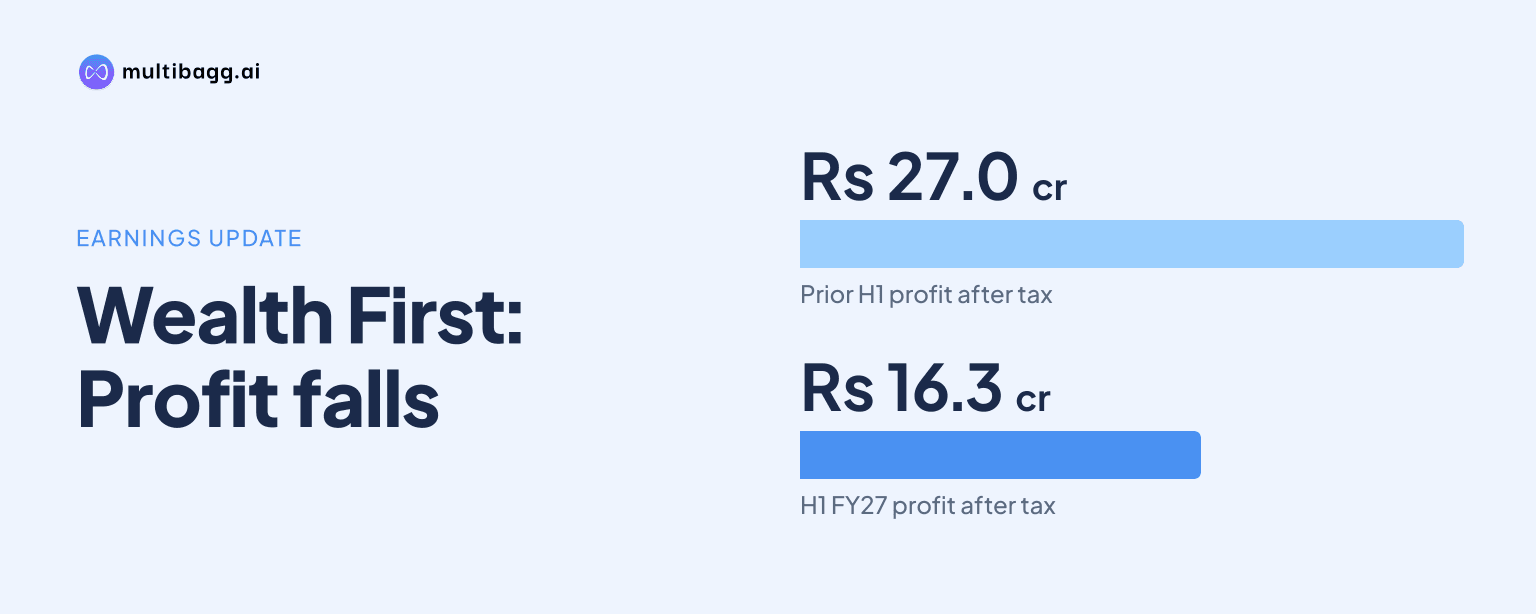
Wealth First Portfolio Managers reported profit after tax of Rs 16.3 crore in H1 FY27, down 39.6% from Rs 27.0 crore a year earlier, as total revenue fell 20.7% to Rs 36.2 crore while operating costs rose 51.4% to Rs 13.2 crore during investment in its new businesses.
Know Wealth First Portfolio Managers inside out
Results, valuation, peers and who's buying, in one view.
Why did Wealth First's H1 FY27 profit decline?
Wealth First's H1 FY27 profit declined because lower transactional revenue coincided with increased spending to establish its asset-management company (AMC) and insurance operations. Revenue from operations fell to Rs 29.6 crore from Rs 45.4 crore in H1 FY26, while total revenue, including other income, decreased by Rs 9.5 crore to Rs 36.2 crore. The company attributed the reduction principally to the absence of certain one-time and transactional income recorded in the previous year's first half, particularly from insurance and secondary-market brokerage.
The fall in revenue was not described by management as a decline in its recurring fee base. Wealth First said trail-based revenue increased in both Q2 FY27 and H1 FY27 compared with the respective prior-year periods, supported by growth in underlying assets under management, despite equity markets being broadly similar or marginally lower. Other income rose to Rs 6.6 crore in H1 FY27 from Rs 0.3 crore in H1 FY26, primarily due to investment profit booking and mark-to-market gains, but this did not offset the reduction in operating revenue.
How much did Wealth First's margins and quarterly earnings change?
Wealth First's H1 FY27 profit before tax after exceptional items was Rs 22.5 crore, 38.8% below Rs 36.8 crore in H1 FY26, and its profit-before-tax margin declined to 62.1% from 80.5%. Profit-after-tax margin similarly narrowed to 45.1% from 59.2%. Earnings per share fell to Rs 15.32 in H1 FY27 from Rs 25.37 a year earlier, following the decline in both revenue from operations and margins.
The second quarter showed a sharper sequential reduction in earnings. Q2 FY27 profit after tax was Rs 5.9 crore, compared with Rs 10.4 crore in Q1 FY27 and Rs 11.1 crore in Q2 FY26, while total revenue was Rs 17.2 crore against Rs 19.0 crore in the preceding quarter. Q2 profit before tax after exceptional items was Rs 8.8 crore, down from Rs 13.7 crore in Q1 FY27, and its margin was 50.9%, compared with 72.4% in the first quarter.
What costs are Wealth First incurring for its new businesses?
Wealth First's operating costs rose to Rs 13.2 crore in H1 FY27 from Rs 8.7 crore in H1 FY26, driven by employee hiring and AMC setup expenditure. Employee benefit expense increased to Rs 8.2 crore from Rs 6.1 crore, while other expenses nearly doubled to Rs 5.0 crore from Rs 2.6 crore. Employee strength rose from about 80 in H1 FY26 to 105 in H1 FY27 as the group added talent across Wealth First, the AMC and insurance broking businesses.
Management said other expenses included technology infrastructure, team building, regulatory licensing and operational arrangements for Lakshya AMC, as well as spending to strengthen insurance distribution through Wealth Shield Insurance Business. It also said employee expense is generally higher in the second quarter because appraisal and incentive payouts occur in that period under company policy. On a standalone basis, management said the incremental rise in employee costs remained relatively limited, without providing a separate standalone cost figure.
Got a follow-up? Ask IRIS
How has the investment phase affected Wealth First's cost-to-income ratio?
Wealth First's H1 FY27 cost-to-income ratio including AMC costs increased to 46.3% from 26.4% in H1 FY26, reflecting expenditure incurred before the new operations contribute revenue. Excluding AMC costs, the ratio was 35.4% in H1 FY27, still above the 26.4% reported a year earlier. This indicates that the rise was linked both to the new AMC investment and to broader employee and operating expenditure.
The quarterly movement was more pronounced in Q2 FY27, when the cost-to-income ratio including AMC costs reached 55.4%, compared with 36.6% in Q1 FY27 and 30.7% in Q2 FY26. Excluding AMC costs, Q2 FY27's ratio was 41.5%, against 28.8% in Q1 FY27. Management characterized the spending as an investment and setup phase, rather than a fixed long-term cost structure, and expects operating leverage to improve the cost-to-income ratio over the medium term as the businesses mature and scale.
What operating indicators support Wealth First's recurring business?
Wealth First's disclosed equity-flow data show positive net inflows from systematic investment plan (SIP) purchases of Rs 184 crore for April 2026 to September 2026, compared with Rs 222 crore for the year ended March 2026. In the same six-month period, growth and equity-oriented scheme flows were Rs 105 crore and SIP purchases were Rs 289 crore. These are company metrics and differ from industry flows, which were Rs 1,82,654 crore and Rs 1,90,598 crore, respectively, for April 2026 to September 2026.
Client relationships remained long dated as of September 2026, with 65% of client families associated with Wealth First for more than 10 years and 80% of clients associated for more than five years. Total client families increased to 7,039 from 6,717 in September 2025, a 4.8% increase. The company also said 64% of relationship managers had more than five years of industry experience as of September 2026, while 45% had been with Wealth First for zero to three years.
Conclusion
Wealth First's H1 FY27 result combines a Rs 9.5 crore fall in total revenue with a Rs 4.5 crore increase in operating costs, producing a Rs 10.7 crore reduction in profit after tax. The company attributes the revenue decline to the prior year's non-recurring and transactional income, while presenting the higher cost base as expenditure to build Lakshya AMC and Wealth Shield Insurance Business ahead of revenue contribution.
The next development to watch is whether these businesses become operational, generate revenue and scale as management expects, allowing operating leverage to reduce the cost-to-income ratio over the medium term. Investors can also monitor whether recurring trail-based revenue continues to rise after H1 FY27, when it increased despite broadly similar or marginally lower equity-market levels.