








Welspun retains customers as H1 FY27 EBITDA margin hits 12.9%
Max Plan at ₹4,999/yr₹8,999

Find your next multibaggerBe a Pro Investor
Research stocks and track your picks on the go. Download the app.
Key highlights
- Welspun said it lost zero customers despite a stated 50% US tariff challenge.
- Welspun's EBITDA margin rose from 9.1% in FY26 to 12.9% in H1 FY27.
- The US represented 59% of Welspun's disclosed regional revenue mix, versus 18% for the UK and EU.
- Welspun reported on-time, in-full delivery above 98% after freight actions.
powered by IRIS
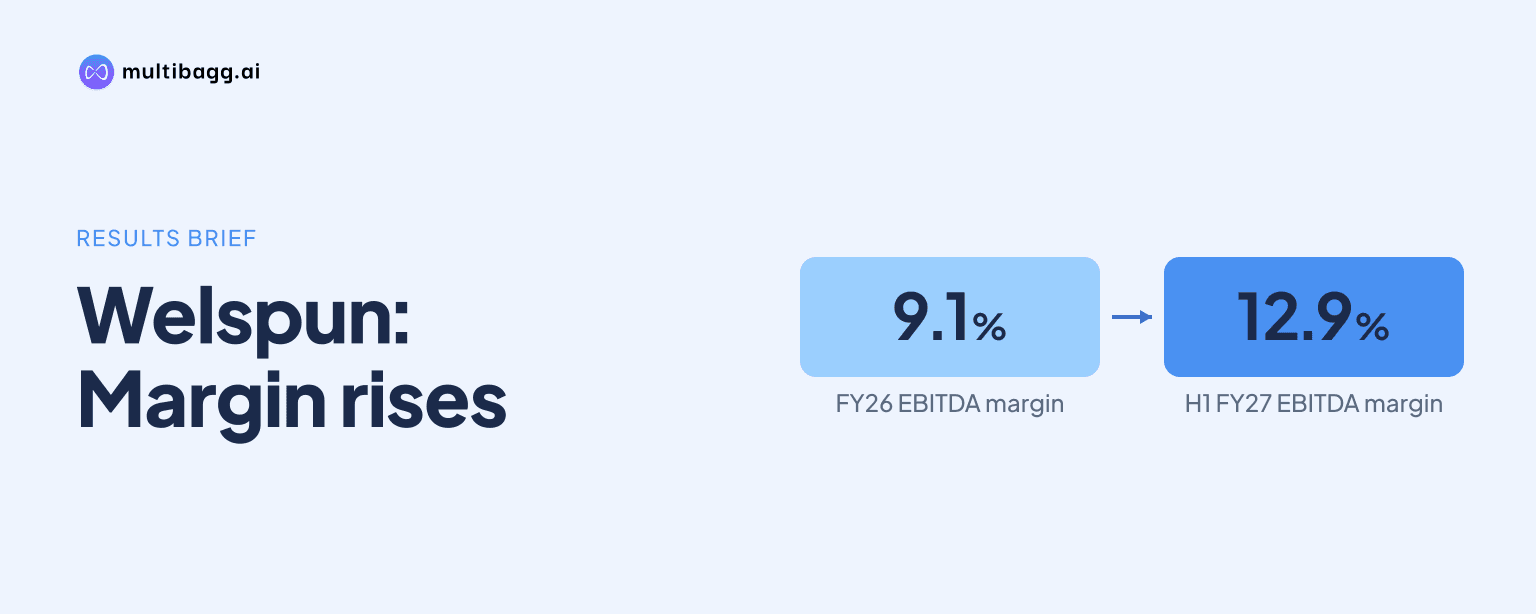
Welspun Living said it retained all customers during a stated 50% US tariff challenge, while earnings before interest, tax, depreciation and amortisation (EBITDA) margin rose 3.8 percentage points from 9.1% in FY26 to 12.9% in H1 FY27. Management attributed the outcome to tariff-sharing with customers, freight actions and procurement positions.
Know Welspun Corp inside out
Results, valuation, peers and who's buying, in one view.
Did Welspun lose customers during the US tariff disruption?
No, Welspun said it lost zero customers despite what it described as 50% US tariffs on its largest market. The company said long-standing retailer relationships allowed it to share the tariff burden with customers. Its Investor Day 2026 presentation does not disclose customer numbers, the proportion of tariffs borne by customers, contract terms or revenue retained through those arrangements.
The claim matters because the US represented 59% of Welspun revenue in the disclosed regional mix. The UK and European Union accounted for 18%, India contributed 13%, and the rest of the world represented 10%, leaving 41% of revenue outside the US. The presentation gives no US revenue amount for H1 FY27, but identifies the US as Welspun's largest individual market.
Welspun said it is the number-one supplier of towels and bath rugs in the US and that one in five towels imported into the country is its product. Its bath portfolio includes bath towels, fashion towels, bathrobes and bath rugs, while its bedding range includes flat sheets, fashion bedding, pillows and utility bedding. The company also identifies itself as the number-two exporter of bed sheets to the US.
How did Welspun manage freight and input-cost pressure?
Welspun said it rerouted shipments, built stock and locked in long-term freight contracts early to address volatile rates and disrupted routes. Those measures maintained on-time, in-full delivery above 98%, according to the presentation. The company did not disclose the freight-cost effect, volumes rerouted, inventory added or the duration of its freight contracts.
For rising cotton and crude-linked costs, Welspun cited long-term procurement positions and transparent customer pricing. It also identifies closer access to cotton as a sourcing advantage, noting that India is the world's number-two cotton producer. Welspun has five manufacturing locations, including three in India and two in the US, alongside sales spanning more than 50 countries.
The numerical result reported by Welspun was a 3.8-percentage-point increase in EBITDA margin, to 12.9% in H1 FY27 from 9.1% in FY26. This compares a six-month period with a full financial year, rather than like-for-like first-half periods. It therefore shows a higher reported first-half margin but does not establish the full-year FY27 result.
Got a follow-up? Ask IRIS
How concentrated is Welspun's US business?
Welspun is materially exposed to the US because the country generated 59% of its disclosed regional revenue mix, compared with 18% from the UK and EU combined. India contributed 13% and the rest of the world 10%. The 41% non-US share provides other sales channels, but no other individual region matched the US contribution in the presentation.
Welspun supports its US position with its bath and bedding manufacturing footprint. It said it has the world's largest terry-towel manufacturing capacity and onshore pillow capacity in Ohio and Nevada with about 5% market-share potential. That 5% figure is a potential market share, not a reported current share, and the presentation gives neither a capacity figure nor an operating date for the pillow facilities.
The company also operates flooring and advanced-textile businesses in addition to bath and bedding. Flooring includes carpet tiles, wall-to-wall products and area rugs, while advanced textiles include spunlace, wet wipes and needle-punch products for hygiene, healthcare and industrial uses. Management said flooring is focused on profitable growth with double-digit EBITDA margin, but did not provide segment revenue or margin data.
Which trade agreements could affect Welspun next?
Welspun said global trade realignment and free-trade agreements could expand its total addressable market, citing more than 50 agreements under discussion and mostly zero duty on home textiles. Its presentation lists the Association of Southeast Asian Nations agreement as live since 2010, Australia’s Economic Cooperation and Trade Agreement as in force since December 2022, and the UK agreement as in force from July 2026.
New Zealand's agreement was concluded in December 2025 and is now in force, according to Welspun. The European Union agreement is listed as concluded and expected to be live around early 2027. A US bilateral trade agreement remains under discussion, with India seeking tariff parity with peers, while Gulf Cooperation Council terms of reference were signed in February 2026.
The presentation contains two tariff references that it does not reconcile. Its resilience slide describes 50% US tariffs on Welspun's largest market, while its trade slide lists India, Pakistan and Bangladesh at 10%, and Vietnam, China and Turkey at 12.5%. Because the document does not explain the difference, those figures cannot be treated as directly comparable.
Conclusion
Welspun's presentation says retailer relationships, freight planning and procurement measures enabled it to preserve its US customer base during the stated 50% tariff challenge. The reported indicators are zero customers lost, on-time, in-full delivery above 98%, and EBITDA margin of 12.9% in H1 FY27, up from 9.1% in FY26, while the US remained 59% of revenue.
The next disclosed developments are the European Union agreement expected around early 2027 and unresolved US bilateral trade and Gulf Cooperation Council discussions. Welspun also plans about Rs 3,200 crore of investment over the next 18 to 24 months, including about Rs 1,600 crore each for terry-towel expansion and backward integration into spinning and weaving, with management targeting a 200-300 basis-point EBITDA uplift from the latter.

