








Welspun Enterprises Targets 15% Growth, Excludes AWEL from Outlook
Max Plan at ₹4,999/yr₹8,999

Find your next multibaggerBe a Pro Investor
Research stocks and track your picks on the go. Download the app.
Key highlights
- WEL targets revenue CAGR of about 15% and EBITDA margin above 18% in its medium-term outlook.
- WEL reported FY26 EBITDA of Rs 845 crore and EBITDA margin of 22.8%, versus Rs 730 crore and 19.3% in FY25.
- WEL’s order book was Rs 19,739 crore at March 2026, compared with Rs 14,354 crore a year earlier.
- AWEL’s expected FY29 production start is excluded from WEL’s current medium-term outlook.
powered by IRIS
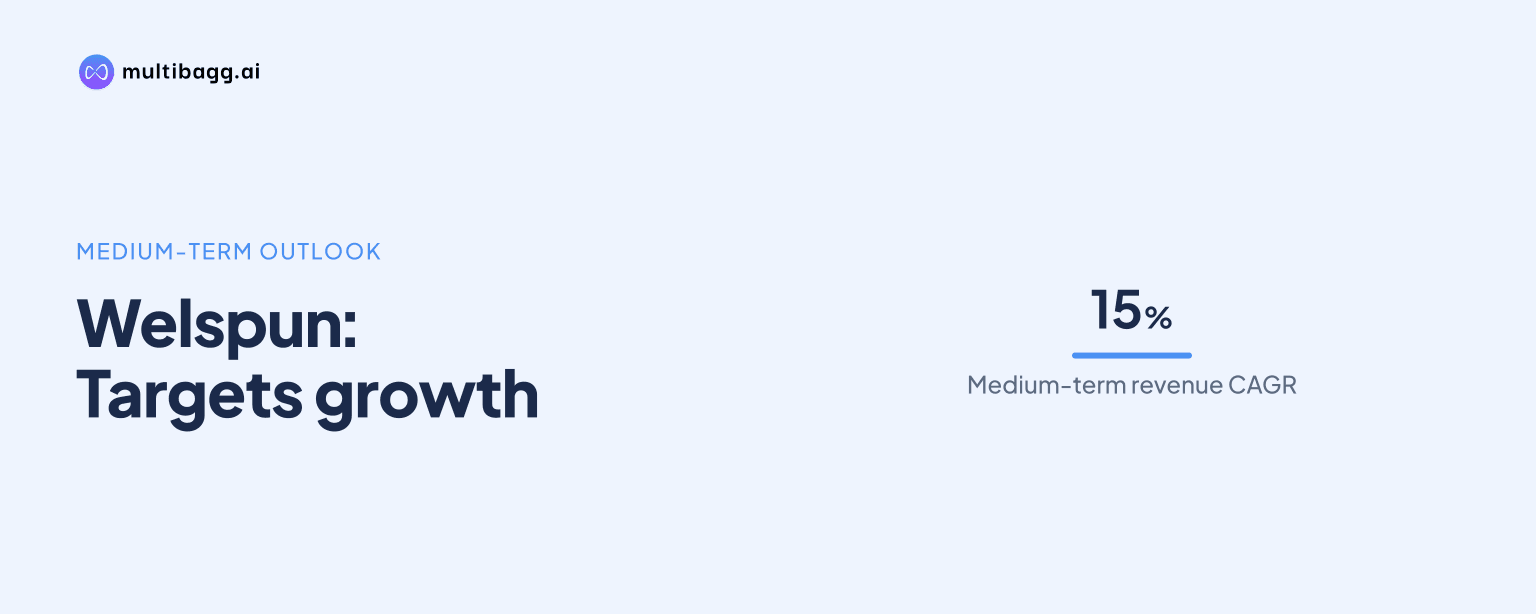
Welspun Enterprises targets about 15% compound annual revenue growth and EBITDA margin above 18% in its medium-term outlook, while excluding AWEL’s oil-and-gas operations; WEL reported a 22.8% EBITDA margin in FY26 and an order book of Rs 19,739 crore at March 2026.
Know Welspun Corp inside out
Results, valuation, peers and who's buying, in one view.
What is WEL’s medium-term financial outlook?
WEL’s medium-term outlook calls for revenue to grow at a compound annual growth rate (CAGR) of about 15%, with earnings before interest, tax, depreciation and amortisation (EBITDA) margin above 18%. Management also targets order-book CAGR of about 20%, average return on capital employed (RoCE) of about 18%, maintenance of a strong liquidity position and retention of its AA credit rating.
The targets follow FY26 revenue of Rs 3,615 crore and EBITDA of Rs 845 crore. The presentation does not state the duration of the medium-term outlook, a revenue base for the target or absolute future revenue and EBITDA figures. It therefore sets out management’s intended growth, margin, liquidity and capital-return parameters rather than a quantified annual forecast.
Order-book growth is a stated part of the plan because WEL reported an order book of Rs 19,739 crore at March 2026, compared with Rs 14,354 crore at March 2025. The Rs 5,385 crore increase came while FY26 revenue declined 2% year on year to Rs 3,615 crore, indicating that the reported project pipeline expanded even as revenue was lower than in FY25.
How did WEL perform against its previous guidance?
WEL reported an FY26 EBITDA margin of 22.8%, above its previous guided range of 18% to 20% and above its new medium-term threshold of more than 18%. FY26 EBITDA increased to Rs 845 crore from Rs 730 crore in FY25, even as revenue declined from Rs 3,695 crore to Rs 3,615 crore.
Across FY23 to FY26, EBITDA rose by Rs 454 crore while revenue increased by Rs 857 crore. EBITDA margin increased by 9.3 percentage points, from 13.5% to 22.8%, over those four reported years. RoCE, which WEL says factors in monetisation gains over a project’s lifecycle, was 19.1% in FY26, down from 20.4% in FY25 and 20.9% in FY24, but above 16.7% in FY23.
Management’s delivered-guidance scorecard separately states 20% order-book growth and an Rs 18,708 crore order book, with 55% in water, 30% in transportation and 15% in tunnelling, rehabilitation and storm-water management. The performance table lists Rs 19,739 crore at March 2026. The presentation does not explain the difference between these two order-book figures, so the disclosures cannot be treated as directly interchangeable.
Got a follow-up? Ask IRIS
What operating model does WEL say supports its targets?
WEL says selective bidding, strategic technical and execution alliances, project management, operation-and-maintenance capability and capital recycling support its operating model. Over five years, the company reports revenue CAGR of 19%, EBITDA CAGR of 22%, two capital-recycling instances at high-teen equity internal rates of return and average RoCE of 18%.
The approach is presented as a response to sector issues including aggressive bidding, sluggish order activity, counterparty risk, execution bottlenecks, cost overruns from delays, input-cost inflation and stretched receivables. WEL’s stated mechanism is bidding for selected projects and pairing execution capacity with operation-and-maintenance capabilities, rather than pursuing all available infrastructure opportunities.
Cash and working-capital measures provide additional context. Cash and cash equivalents rose from Rs 1,155 crore in March 2025 to Rs 1,728 crore in March 2026, while the cash-conversion cycle increased from 79 days to 80 days. The March 2026 cash balance was also above Rs 982 crore in March 2024, although the 80-day cycle was longer than the negative six days reported in FY23.
Why is AWEL excluded from WEL’s outlook?
WEL explicitly says that its medium-term outlook does not include AWEL’s oil-and-gas business operations. Adani Welspun Exploration Ltd is a 65:35 joint venture between the Adani Group and WEL, and its blocks have about 1.1 trillion cubic feet of collective gas initially in place, according to the presentation.
The exclusion separates WEL’s infrastructure targets from an oil-and-gas development with a later expected operating timeline. AWEL identifies FY29 as its expected start of production, after an April 2025 legislative change, a December 2025 Petroleum and Natural Gas Rules order, and a July 2026 Directorate General of Hydrocarbons order for the MB block.
AWEL has also entered a definitive agreement with Oil and Natural Gas Corporation for infrastructure sharing and plans to use that company’s network for evacuation and processing. However, the presentation gives no production volume, capital-expenditure, revenue, margin or cash-flow forecast for AWEL. The approximately 15% revenue CAGR and more-than-18% EBITDA-margin outlook therefore contain no disclosed assumed contribution from AWEL’s expected FY29 production start.
Conclusion
WEL’s plan combines about 20% order-book CAGR, about 15% revenue CAGR, EBITDA margin above 18% and average RoCE of about 18%, while keeping AWEL outside those measures. FY26 provides the operating context: revenue fell 2% to Rs 3,615 crore, whereas EBITDA increased to Rs 845 crore and margin reached 22.8%, with Rs 19,739 crore of orders reported at March 2026.
The next disclosed markers are progress in converting the March 2026 order book into revenue, the planned maintenance of liquidity and the AA rating, and AWEL’s expected FY29 production start. The separate Rs 18,708 crore delivered-guidance order-book figure and Rs 19,739 crore March 2026 performance-table figure also remain an unresolved disclosure difference in the presentation.

