








Welspun CORP maps 3 million tonnes of pipe capacity in four markets
Max Plan at ₹4,999/yr₹8,999

Find your next multibaggerBe a Pro Investor
Research stocks and track your picks on the go. Download the app.
Key highlights
- Welspun maps about 3 million metric tonnes of line-pipe capacity and 850,000 metric tonnes of DI-pipe capacity across four geographies.
- India is listed with about 1.30 MTPA of line-pipe capacity and 0.60 MTPA of DI-pipe capacity.
- Saudi Arabia has 0.50 MTPA of HSAW capacity at EPIC, plus marked 0.35 MTPA of LSAW capacity.
- Welspun has a firm contract for Jordan’s 450-kilometre Aqaba-Amman Water Desalination Project.
powered by IRIS
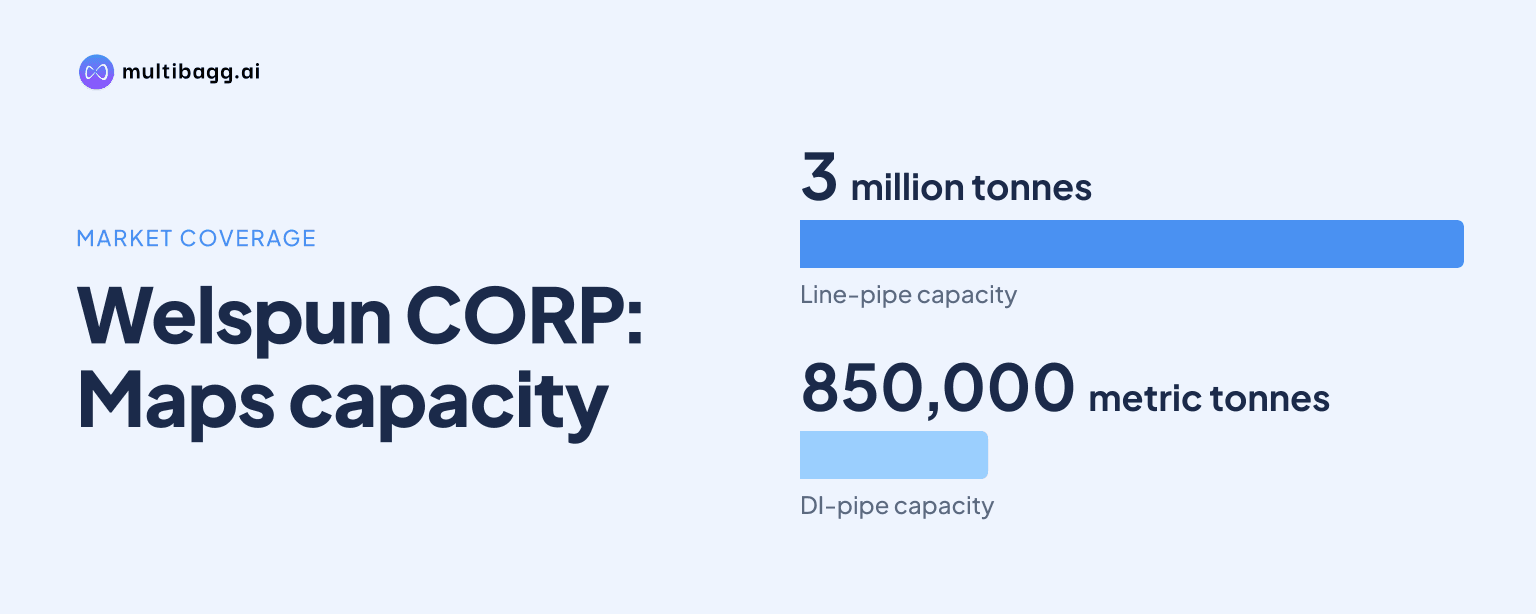
Welspun CORP maps about 3 million metric tonnes of line-pipe capacity and 850,000 metric tonnes of ductile-iron, or DI, pipe capacity across India, the United States, Saudi Arabia and Jordan, subject to announced-capex commissioning for several facilities. The presentation assigns each geography a distinct export, energy-infrastructure or water-infrastructure role.
Know Welspun Corp inside out
Results, valuation, peers and who's buying, in one view.
How is Welspun’s capacity distributed across four countries?
Welspun states a four-geography footprint of about 3 million metric tonnes of line-pipe capacity and 850,000 metric tonnes of DI-pipe capacity. India is listed with about 1.3 million metric tonnes per annum, or MTPA, of line pipes and 600,000 MTPA of DI pipes, while the United States is listed with about 1 million MTPA of line-pipe capacity. The presentation uses HSAW for helical submerged arc welded pipe, LSAW for longitudinal submerged arc welded pipe, ERW for electric resistance welded pipe and HFIW for high-frequency induction welded pipe.
Welspun identifies 0.50 MTPA of HSAW capacity in Saudi Arabia through East Pipes Integrated Company for Industry, or EPIC, plus 0.35 MTPA of LSAW capacity. Jordan is listed with about 0.35 MTPA of HSAW capacity. The asterisk denotes capacity after commissioning of announced capital expenditure, applying to the marked HSAW and LSAW facilities in the United States, the 0.35 MTPA Saudi LSAW facility, the 0.25 MTPA Saudi DI-pipe facility and Jordan’s HSAW facility.
The country-level line-pipe figures shown in the presentation total about 3.50 MTPA when added, compared with its headline of about 3 million metric tonnes. Welspun does not provide a reconciliation between the headline total and the individual country labels. The DI-pipe figures do reconcile: India’s 0.60 MTPA and Saudi Arabia’s 0.25 MTPA equal the stated 0.85 MTPA total.
What role does India play in Welspun’s network?
India is positioned as Welspun’s base for export value in line pipes and domestic volume in water-related products. Its stated line-pipe range runs from 1.25 inches to 144 inches with all types of coatings, while its DI-pipe range spans 80 millimetres to 1,200 millimetres. India’s 1.30 MTPA of line-pipe capacity is therefore combined with 0.60 MTPA of DI-pipe capacity across HSAW, LSAW, ERW and DI products.
Welspun links Indian pipeline demand to an expanding natural-gas grid and city gas distribution, or CGD, requirements. It links water-pipe demand to river interlinking, interstate water-sharing agreements, sewage networks and the Jal Jeevan Mission. The presentation calls the DI-pipe plant port based, describing exports as an advantage, while characterising India’s operating model as value from exports and volume from domestic markets.
The India map identifies Anjar, Bhopal and Mandya, although the presentation does not allocate its 1.30 MTPA of line-pipe or 0.60 MTPA of DI-pipe capacity among those locations. India has the widest stated product mix among the four geographies, whereas the United States is presented around energy pipelines and Saudi Arabia around energy and water infrastructure.
Got a follow-up? Ask IRIS
Why is Welspun positioning the United States around energy infrastructure?
Welspun describes the United States operation as its largest line-pipe manufacturing position and lists about 1 MTPA of HSAW, HFIW and LSAW capacity. Its stated demand drivers are liquefied natural gas, or LNG, exports, the Permian Basin, renewed oil-pipeline requirements and natural-gas power generation for artificial-intelligence data centres. The presentation specifically says the Permian Basin will require additional natural-gas evacuation pipelines.
The United States site is also positioned around logistics. Welspun cites about 800 acres of land, proximity to customers and raw-material suppliers, dedicated railroad links through BNSF and UP tie-ups, warehousing for steel and finished goods, and Arkansas-Mississippi River access for incoming material. Its stated pipe offering covers outside diameters from 6 inches to 60 inches, compared with India’s 1.25-inch-to-144-inch range.
Welspun identifies a brownfield opportunity in the United States, saying capacity can be added faster and cheaper than through a greenfield facility. This is a stated expansion mechanism rather than a disclosed volume target or commissioning date. The supply-chain map names United States Steel, ArcelorMittal and Nucor, but gives no purchase volume, contract value or customer order linked to those companies.
What do Saudi Arabia and Jordan add to Welspun’s strategy?
Saudi Arabia provides Welspun with 0.50 MTPA of HSAW capacity at EPIC, plus marked post-commissioning capacity of 0.35 MTPA of LSAW pipe and 0.25 MTPA of DI pipes. Welspun links this market to Vision 2030, oil-and-gas investment, regional exports, urban water infrastructure and DI-pipe import substitution. It also describes its Saudi LSAW plant as the only plant capable of supplying deep-offshore pipelines.
The Saudi infrastructure includes a highly automated DI-pipe plant capable of diameters up to 2,600 millimetres, compared with India’s 1,200-millimetre maximum. Welspun also cites proximity to Dammam Port and 500,000 square metres of land for storage. The presentation does not quantify the regional export opportunity, but identifies water infrastructure, urbanisation and potential post-war evacuation pipelines as demand areas.
Jordan is positioned as a manufacturing and coating hub through Welspun’s partnership with Perma-Pipe. The partnership covers integrated pipe manufacturing and anti-corrosion coating for products from 24 inches to 120 inches. Its most specific disclosed project is a firm contract for the 450-kilometre Aqaba-Amman Water Desalination Project, also called the National Water Carrier Project.
Welspun presents Jordan as a neutral regional base with proximity to Europe and the Levant, differentiating it from Saudi Arabia’s port-linked infrastructure proposition. The business is described as supplying high-grade steel pipes and coated tubular solutions for regional energy corridors and water networks. The presentation lists about 0.35 MTPA of HSAW capacity after the indicated commissioning, but gives no project value, delivery schedule or capacity split for the Perma-Pipe partnership.
Conclusion
Welspun’s presentation shows a geographically divided pipe strategy: India combines line-pipe exports with domestic water volumes, the United States targets LNG, Permian and power-related pipeline demand, Saudi Arabia combines oil-and-gas and water capacity, and Jordan provides a regional manufacturing and coating base. The stated DI-pipe network totals 0.85 MTPA, while the displayed line-pipe figures require clarification against the headline capacity of about 3 million metric tonnes.
The next point to watch is commissioning of the announced capital expenditure, because marked facilities include HSAW and LSAW capacity in the United States, 0.35 MTPA of Saudi LSAW capacity, 0.25 MTPA of Saudi DI-pipe capacity and about 0.35 MTPA of Jordan HSAW capacity. Progress on the 450-kilometre Aqaba-Amman project and on Saudi water and offshore-pipeline activity would show how the regional positions translate into execution.

