








Welspun Living plans ₹3,200 crore capex for 200-300 bps uplift
Max Plan at ₹4,999/yr₹8,999

Find your next multibaggerBe a Pro Investor
Research stocks and track your picks on the go. Download the app.
Key highlights
- Welspun plans approximately ₹3,200 crore of capital expenditure over the next 18-24 months.
- About ₹1,600 crore is allocated to increase towel capacity by roughly 30% to about 130,000 metric tonnes.
- Backward integration into spinning and weaving targets a 200-300-basis-point EBITDA uplift.
- Welspun reported net cash of ₹2 crore at September 2026 versus net debt of ₹1,534 crore at March 2026.
powered by IRIS
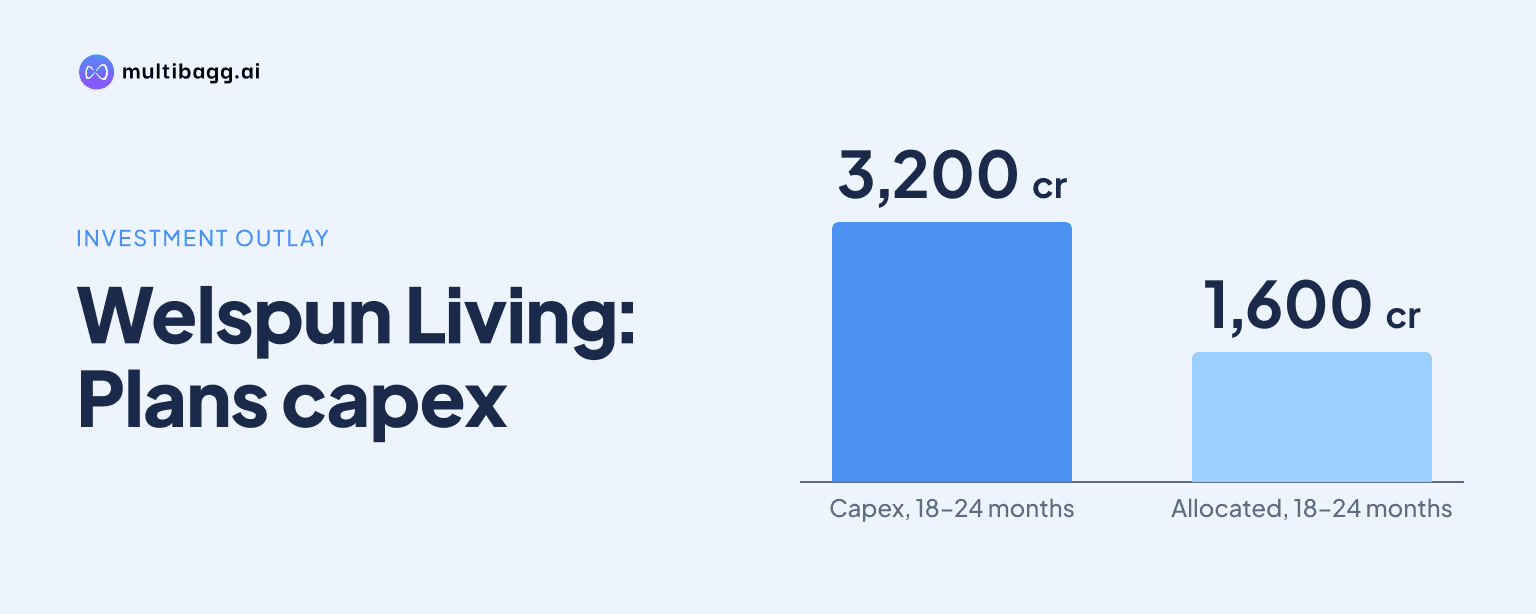
Welspun Living plans to invest about ₹3,200 crore over the next 18-24 months, splitting the outlay equally between terry-towel capacity and spinning and weaving, with management targeting a 200-300 basis-point EBITDA margin uplift from lower yarn costs through backward integration. The plan follows a 12.9% EBITDA margin in H1 FY27.
Know Welspun Corp inside out
Results, valuation, peers and who's buying, in one view.
What is Welspun investing ₹3,200 crore to achieve?
Welspun will use the approximately ₹3,200 crore programme to increase terry-towel production and bring more spinning and weaving in-house over the next 18-24 months. Half of the investment, about ₹1,600 crore, is earmarked for a terry-towel capacity increase of roughly 30%, taking capacity to about 130,000 metric tonnes, which management describes as the world’s largest capacity.
The other approximately ₹1,600 crore is intended for backward integration into spinning and weaving. Backward integration means producing more yarn and fabric inputs internally rather than relying to the same extent on outside suppliers. Welspun says this structure should lower input-yarn costs, reduce dependence on outsourcing partners and improve supply-chain reliability, lead times and compliance.
The investment programme also includes a research and development, or R&D, centre. Welspun says the centre is intended to support product innovation and value-added capabilities alongside the 130,000-metric-tonne towel expansion. The presentation does not give a separate rupee allocation, construction schedule or commissioning date for the R&D facility.
How will Welspun allocate the expansion spending?
Welspun has outlined an even allocation of about ₹1,600 crore each for towel capacity and integrated spinning and weaving. The allocation places 50% of the approximately ₹3,200 crore plan into expanding finished towel output and 50% into input production, rather than directing the entire programme toward additional towel capacity or external sourcing.
The towel investment is linked to demand that Welspun says is already available from existing retailers. Management’s stated rationale is to create headroom for incremental growth from current retail relationships while improving operational control through internally produced inputs.
The supply-chain objective sits alongside a broader manufacturing position presented by Welspun. It identifies integrated manufacturing and access to Indian cotton, with India described as the world’s number-two cotton producer, as competitive features. The planned spinning and weaving facilities would extend that integration into more stages before towel production, although the presentation does not quantify the planned internal yarn share.
How much margin improvement does backward integration target?
Welspun targets a 200-300 basis-point uplift in EBITDA, or earnings before interest, tax, depreciation and amortisation, from backward integration. A basis point is one-hundredth of a percentage point, so the indicated improvement equals 2-3 percentage points, and management attributes it specifically to lower input-yarn costs.
The target is separate from the company’s reported margin progression. Welspun’s EBITDA margin rose from 9.1% in FY26 to 12.9% in H1 FY27, a 3.8-percentage-point increase, in a period when it cited long-term procurement positions and transparent customer pricing amid rising cotton and crude-linked costs. The presentation does not state how much of that historical increase came from procurement, pricing or other factors.
For FY27E, the company forecasts EBITDA margin of about 13%, compared with 10.6% in FY23. The medium-term aspiration is a 15-16% margin, while the 200-300-basis-point integration objective provides a stated mechanism that could contribute to that direction. These are management targets, not reported results, and the presentation gives no year-by-year margin bridge for the 18-24-month investment period.
Got a follow-up? Ask IRIS
Does Welspun have balance-sheet capacity for the programme?
Welspun entered the proposed ₹3,200 crore programme with net cash of ₹2 crore at September 2026, compared with net debt of ₹1,534 crore at March 2026. The movement followed free cash flow of ₹1,059 crore in H1 FY27, above ₹784 crore in FY23, although the periods are not directly comparable because H1 FY27 covers only a half year.
Its cash conversion cycle, the days taken to turn working-capital investment into cash, decreased to 44 days in H1 FY27 from 93 days in FY23. Return on capital employed, or RoCE, increased to 12.7% in H1 FY27 from 5.7% in FY23. These reported measures show changed cash and capital metrics before the planned 18-24-month spending cycle.
Management’s medium-term financial framework is to maintain net debt to EBITDA at up to 1 time and keep the cash conversion cycle within 55-60 days. That framework matters because Welspun is proposing capital expenditure equal to more than three times its FY23 free cash flow of ₹784 crore; the presentation does not disclose a funding split among internal cash generation, debt or other sources.
What targets will the expansion support beyond towels?
Welspun projects FY27E revenue of approximately ₹11,000 crore, up from ₹8,215 crore in FY23. Beyond FY27E, management aspires to revenue growth at a 15% compound annual growth rate, or CAGR, while targeting EBITDA margin and RoCE of 15-16%. The capacity programme is presented as a source of incremental growth headroom and cost competitiveness within that wider plan.
The company’s strategic priorities include growing United States share in bath and bedding, using free-trade-agreement access in other geographies, and accelerating global brands and hospitality at more than 20% medium-term CAGR. The presentation also identifies automation and artificial-intelligence enablement as cost measures alongside backward integration, but does not assign a separate profit or capital-spending contribution to either initiative.
In India, Welspun targets ₹1,500 crore of revenue in the medium term through wider distribution, including e-commerce and quick commerce, plus an expanding GCC and hospitality segment. It also aims to expand flooring EBITDA to the low teens through recalibrated production. These targets cover businesses beyond the ₹1,600 crore towel expansion and ₹1,600 crore integration projects, so they should not be treated as direct outputs of the new textile capacity alone.
Conclusion
Welspun’s ₹3,200 crore plan combines a roughly 30% increase in terry-towel capacity with ₹1,600 crore of input integration. The central economic proposition is management’s 200-300-basis-point EBITDA uplift from lower yarn costs, supported by less outsourcing and faster, more controlled supply chains. Its reported 12.9% H1 FY27 EBITDA margin, ₹2 crore net-cash position and 44-day cash conversion cycle form the starting point.
The next measures to watch are execution over the stated 18-24 months, the progression toward about 130,000 metric tonnes of towel capacity, and whether integration contributes toward the 15-16% medium-term EBITDA-margin aspiration. Investors can also monitor management’s commitment to net debt-to-EBITDA of up to 1 time and a 55-60-day cash conversion cycle as capital expenditure advances.

