










West Coast Paper Mills Doubles Optical Fibre Cable Capacity
Key highlights
- WCPML’s new Fab City, Hyderabad cable plant started commercial production on February 14, 2024.
- The Hyderabad unit doubled WCPML’s optical fibre cable manufacturing capacity and was commissioned before the April 1, 2024 target.
- WCPML shares rose 2.5% to ₹638 on February 15, 2024 after the capacity announcement.
- WCPML’s paper division reported 318,590 tonnes of capacity and 99.6% utilisation in 2024-25.
powered by IRIS
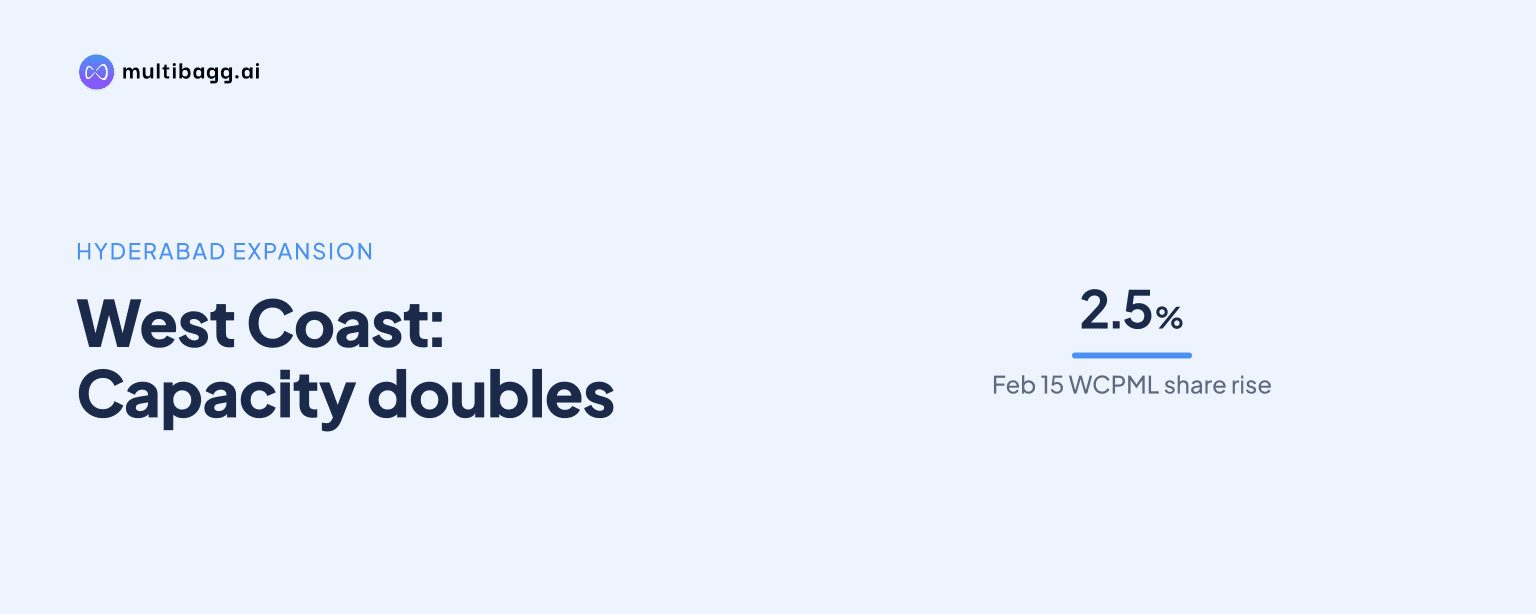
West Coast Paper Mills Limited doubled its optical fibre cable manufacturing capacity after its new Fab City plant in Hyderabad began commercial production on February 14, 2024, ahead of its April 1 commissioning target. The development added a second cable manufacturing location alongside Mysore and marked a further expansion of the company’s non-paper operations.
Know West Coast Paper Mills inside out
Results, valuation, peers and who's buying, in one view.
How did West Coast Paper Mills double its optical fibre cable capacity?
West Coast Paper Mills Limited, referred to as WCPML, doubled cable manufacturing capacity by commissioning a new optical fibre cable unit at Fab City, Hyderabad, Telangana. The facility started commercial production on February 14, 2024. The company had initially projected commissioning by April 1, 2024, making the operational start earlier than its stated schedule.
The Hyderabad site is WCPML’s second optical fibre cable manufacturing unit after its Mysore facility. Through its West Coast Optilinks division, the company manufactures a range of optical fibre cables for telecom and utility-sector demand. Its cable products also serve export markets in Europe and the Middle East and Africa region.
WCPML said the Fab City infrastructure has been designed to support quick future expansion, including the potential for another capacity doubling at Hyderabad. The company is also developing an Optical Fiber Draw Towers factory at the same site. That facility is intended to supply optical fibre to both cable units and support greater raw-material self-reliance.
Why was the Hyderabad cable plant important for WCPML?
The Hyderabad commissioning increased WCPML’s ability to address demand linked to telecom networks, utilities and data centres. The company connected the expansion with rising global 5G rollouts, while also referring to the Atmanirbhar Bharat and Digital India initiatives.
The cable expansion broadens WCPML’s manufacturing base beyond its established paper business. The paper division operates at Dandeli, Karnataka, while the cable operations have facilities in Mysore and Hyderabad. This division-level diversification is relevant because the company’s operations now span paper, captive pulp and power, and optical fibre cable manufacturing.
The market reacted positively immediately after the announcement. On February 15, 2024, WCPML shares rose 2.5% to ₹638, ending a six-session decline. The move reflected the reported commissioning update, though a one-day share-price movement does not establish a longer-term valuation impact.
What is the scale of WCPML’s paper business?
WCPML’s Dandeli paper facility has a stated production capacity of 320,000 metric tonnes a year, supported by self-sustained pulp capacity of 255,000 metric tonnes a year and captive power-generation capability of 74.8 MW. These in-house capabilities are central to the operating structure of the paper division.
For 2024-25, the paper division reported production capacity of 318,590 tonnes and sales of 313,823 tonnes. This represented capacity utilisation of 99.6%. The reported utilisation indicates that the division sold almost all of the volume it could produce during the period.
The company has continued phase-wise spending in the paper division to improve paper quality, develop specialty products, lower consumption of steam, power, chemicals and water, and reduce machine breakdowns. It has also replaced an older pulp unit with a 750 tonnes-per-day Metso fibre line using elemental chlorine-free bleaching.
Got a follow-up? Ask IRIS
How does the new project fit WCPML’s expansion history?
The Hyderabad cable project follows a long record of capacity additions at WCPML. In 2010, the company undertook a major ₹1,500 crore expansion that increased production capacity fivefold. A sixth paper machine with annual installed capacity of 135,000 tonnes was commissioned in May 2010, lifting paper production capacity from 500 tonnes per day to 900 tonnes per day.
WCPML said the 2010-11 expansion led to record revenue and profit for that year. It also described the programme as a step towards stronger global marketing exposure, supported by product quality intended to meet international standards. The company later completed an expansion that increased paper capacity from 180,000 tonnes a year to 320,000 tonnes a year and thermal power capacity from 40.3 MW to 70.3 MW.
The company has also disclosed expansion projects involving an additional half a million tonnes a year at an investment of ₹4,000 crore as being in the pipeline. The supplied information does not provide a completion date or confirm implementation status for those projects, so they should be treated as disclosed plans rather than completed capacity.
What does the capacity addition mean for investors and operations?
The cable expansion gives WCPML a larger manufacturing footprint in a segment tied to telecom infrastructure and utility networks. It also provides a second operating location for optical fibre cable production, while the planned draw-tower unit could strengthen supply integration if it begins commercial production as planned.
For investors, the February 2024 announcement was one of several corporate developments associated with short-term movements in the WCPML share price. The company’s acquisition of Andhra Paper and its earlier paper-capacity investments have also been cited among such developments. The information provided does not quantify the acquisition’s financial contribution or the new cable plant’s revenue potential.
The reported 99.6% paper capacity utilisation in 2024-25 highlights the importance of operating efficiency in WCPML’s core business. At the same time, ongoing investment in cable capacity and fibre production indicates that the company is building operational capability across both its paper and optical fibre divisions.
Conclusion
WCPML’s February 2024 commissioning at Fab City doubled its optical fibre cable capacity ahead of schedule and added Hyderabad as a second cable manufacturing base. The development sits alongside a large paper operation that reported 318,590 tonnes of production capacity and 99.6% utilisation in 2024-25, as well as a history of major capacity-led investment.
The next disclosed operational milestone is the Optical Fiber Draw Towers factory at Fab City, which WCPML said is under construction and intended to meet the fibre needs of both cable plants. Investors can also track progress on the company’s stated paper-efficiency programmes and any updates on the pipeline expansion projects.