










Intellect Design Arena Reports ₹13,125 Crore Pipeline in Q2 FY27
Key highlights
- Intellect reported a ₹13,125 crore pipeline in Q2 FY27, up 9% year-on-year.
- LTM total income rose 17% year-on-year to ₹3,388 crore.
- Q2 EBITDA was ₹199 crore, representing a 22.7% margin.
- LTM platform revenue increased 51% year-on-year to ₹591 crore.
powered by IRIS
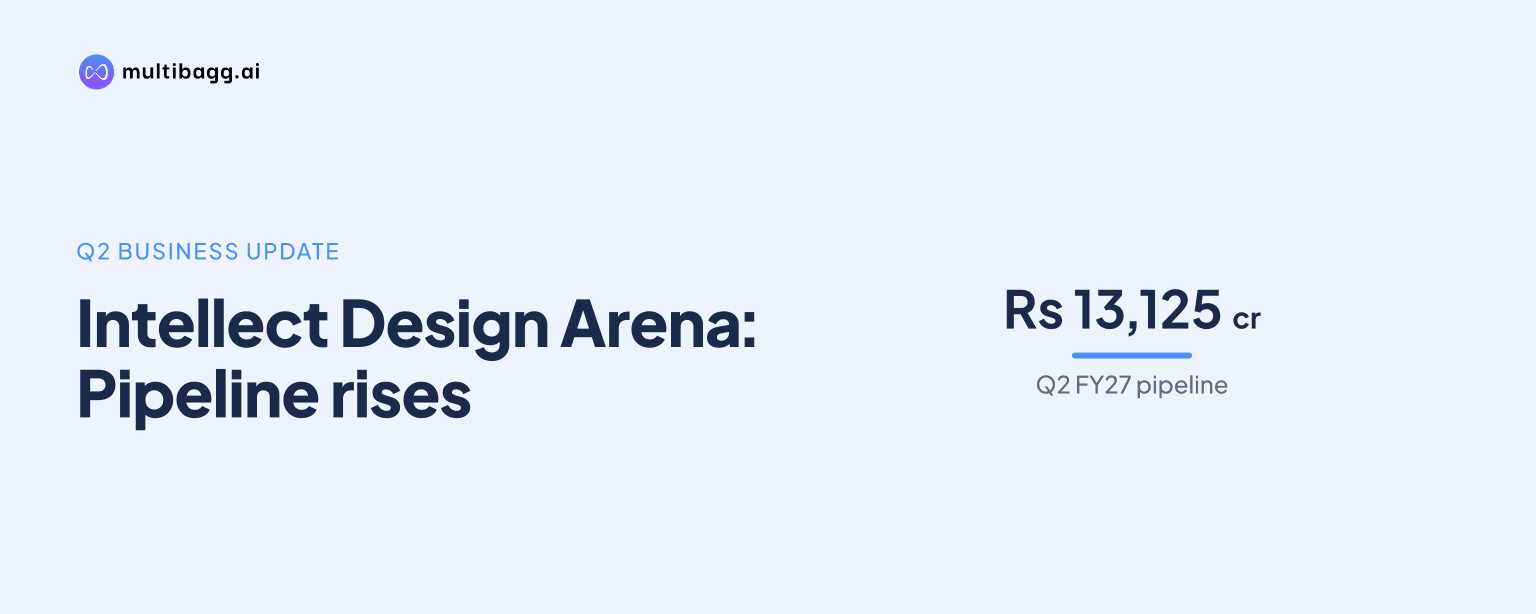
Intellect Design Arena Limited reported a ₹13,125 crore pipeline in Q2 FY27, while trailing 12-month total income rose 17% year-on-year to ₹3,388 crore, underlining management's focus on larger platform-led financial-services technology deals. The company also reported Q2 EBITDA of ₹199 crore and a 22.7% EBITDA margin.
Know Intellect Design Arena inside out
Results, valuation, peers and who's buying, in one view.
How did Intellect perform in Q2 FY27?
Intellect reported Q2 FY27 total income of ₹878 crore, with EBITDA of ₹199 crore. EBITDA represented 22.7% of total income, while gross margin improved to 57.2%. Profit before tax for the quarter was ₹137 crore and profit after tax was ₹104 crore, according to the reported Q2 FY27 financial summary.
The revenue mix remained weighted towards license-linked business. License-linked revenue, comprising licence, platform and annual maintenance contract, or AMC, revenue, was ₹457 crore in the quarter and accounted for about 52% of total income. Platform revenue was ₹133 crore, while AMC revenue was ₹160 crore.
The company said its trailing 12-month, or LTM, total income reached ₹3,388 crore, up 17% year-on-year. LTM revenue from operations was ₹3,286 crore. Management said income had increased in each of the preceding seven quarters, although it also identified improved conversion of revenue growth into earnings growth as a financial priority.
What is behind Intellect's ₹13,125 crore pipeline?
Intellect's pipeline stood at ₹13,125 crore at the end of Q2 FY27, up 9% year-on-year, supported by active pursuits in its financial-services software business. The company reported 103 destiny deals in the pipeline, up 6% year-on-year, including eight destiny-class wins during the quarter.
The deal pipeline included 29 pursuits valued above ₹50 crore, 35 in the ₹30 crore to ₹50 crore range, and 39 valued between ₹20 crore and ₹30 crore. These figures indicate that the pipeline includes a mix of large and mid-sized opportunities rather than a concentration in only one deal category.
Management also reported 21 customer wins and 25 financial-institution go-lives in Q2 FY27. Chairman and Managing Director Arun Jain said FY27 was an inflection point for the company and referred to 41 projects going live within eight months as part of its technology-led delivery strategy.
How is platform revenue changing Intellect's revenue mix?
Platform revenue was the fastest-growing reported LTM revenue component, rising 51% year-on-year to ₹591 crore from ₹392 crore. LTM license-linked revenue rose 18% to ₹1,768 crore from ₹1,497 crore and represented 52% of total income. AMC revenue increased 12% to ₹603 crore.
This composition matters because licence, platform and AMC revenues form a substantial share of the company's income base. In the Q2 presentation, Intellect highlighted the increasing contribution of licence-linked revenue and said it was pursuing higher-value, AI-native solutions. The supplied call commentary also referenced the launch of the MSOC platform, described as Making Enterprise Knowledge Computable.
The company reported LTM gross margin of 56.7%, compared with the quarterly gross margin of 57.2%. LTM EBITDA was ₹736 crore, equal to 21.7% of revenue. Adjusted EBITDA, excluding stock compensation costs, was ₹802 crore, while the company said it had invested more than ₹100 crore in AI.
Got a follow-up? Ask IRIS
What do collections and cash balances show about operations?
Intellect reported LTM collections of ₹3,282 crore, up 26% year-on-year, and cash and cash equivalents of ₹1,216 crore. Collections grew faster than LTM total income, which increased 17%, providing a relevant operational measure alongside reported revenue and profit figures.
LTM profit before tax was ₹503 crore and profit after tax before exceptional items was ₹378 crore. Both were reported as 6% lower year-on-year. Profit after tax after exceptional items was ₹355 crore. This means the company delivered income growth and higher collections while LTM profit measures remained below their year-earlier levels.
The company also stated during the call that improving the conversion of revenue growth into earnings growth remained a priority. That comment places attention on operating costs, stock compensation and investments in AI when assessing future profitability, rather than looking at top-line growth alone.
How did the Q2 FY27 update affect investors and the sector?
The Q2 update provided investors with a combination of revenue growth, margin data, cash generation and a large disclosed pipeline. The ₹13,125 crore pipeline is an indicator of active sales opportunities, but it is not the same as booked revenue. Its eventual conversion depends on contract awards, project execution and customer implementation schedules.
Intellect's reported figures also reflect the broader demand for core banking, treasury, insurance and other financial-services technology platforms. The company reported 25 financial-institution go-lives during the quarter, showing that delivery activity continued alongside new customer wins. The rise in platform revenue gives investors a specific data point on the contribution of this business line.
Market data cited on November 6, 2026 showed Intellect shares at ₹520.40, down ₹14.25 or 2.67% at 9:40 AM IST. The supplied information does not establish a direct causal link between that intraday movement and the earnings release. Investors therefore have the financial results, pipeline and margin trajectory as the disclosed measures for evaluating the quarter.
Conclusion
Intellect's Q2 FY27 update showed 17% LTM total-income growth to ₹3,388 crore, Q2 EBITDA margin of 22.7%, and a ₹13,125 crore pipeline. Platform revenue growth of 51% on an LTM basis and collections growth of 26% were notable operating indicators, while LTM profit before tax and profit after tax before exceptional items declined 6% year-on-year.
The next disclosed areas to watch are the conversion of the 103 destiny deals in the pipeline, delivery progress on the reported 41 live projects, and management's stated effort to translate revenue growth into earnings growth. Investors can also track whether platform and licence-linked revenue continue to increase their contribution to total income.