










Intellect ties FY27 margin gains to flat ₹680 crore costs
Key highlights
- Intellect reported Q2 FY27 total income of ₹878 crore and EBITDA of ₹199 crore, producing a 22.7% EBITDA margin.
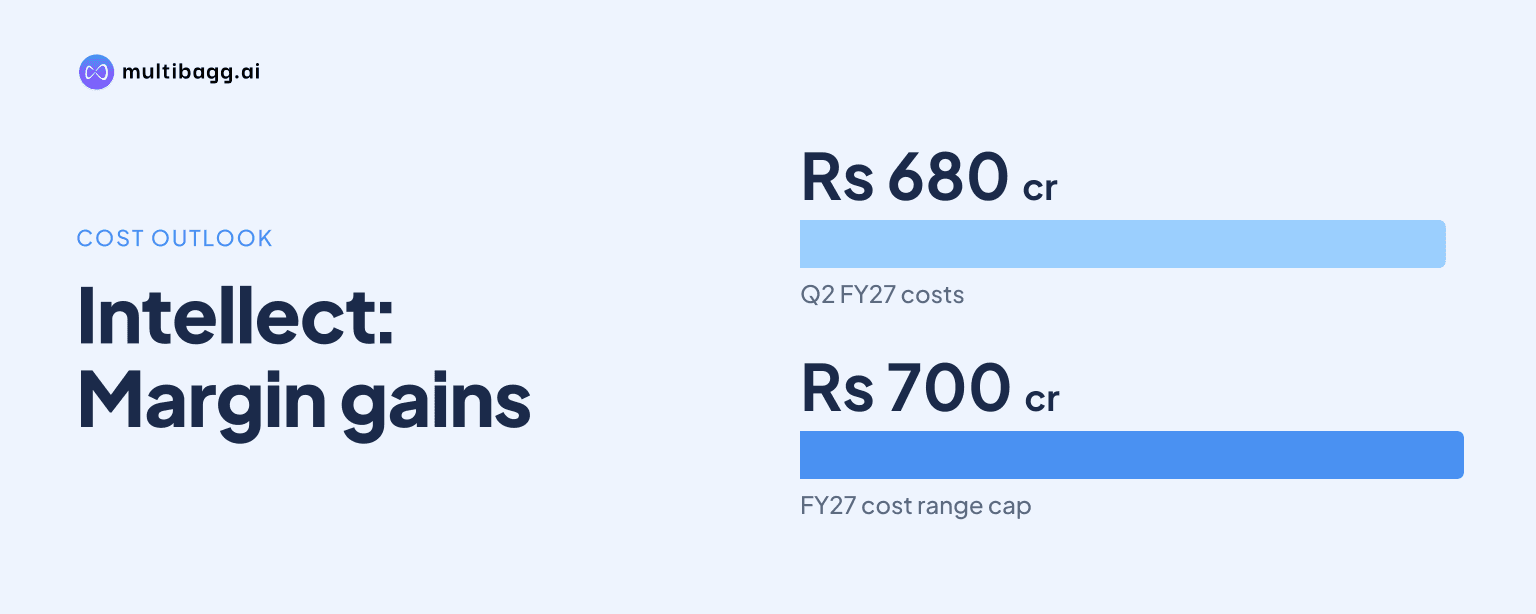
- Management said quarterly costs remained near ₹680 crore for two consecutive quarters and are expected to stay between ₹680 crore and ₹700 crore over the next few quarters.
- Intellect said approximately ₹40 crore of a ₹50 crore revenue increase from ₹850 crore to ₹900 crore could flow through to margins.
- LTM license-linked revenue rose 18% to ₹1,768 crore and represented 52% of total income.
powered by IRIS
Intellect says FY27 could mark a margin inflection if quarterly costs remain near ₹680 crore: management estimates about ₹40 crore of a ₹50 crore rise in revenue, from roughly ₹850 crore to ₹900 crore, would flow to margins. Q2 FY27 EBITDA margin was 22.7% on total income of ₹878 crore.
Know Intellect Design Arena inside out
Results, valuation, peers and who's buying, in one view.
Why does Intellect expect FY27 margins to rise?
Intellect’s FY27 margin case rests on operating leverage, rather than a forecast of immediate faster revenue growth. Management said it has calibrated the business for 20% growth and believes that rate can produce 40% to 50% growth in margins if costs do not rise proportionately with revenue.
Management illustrated the calculation using quarterly revenue increasing from about ₹850 crore to ₹900 crore. Of the additional ₹50 crore, approximately ₹40 crore would flow through to margins, according to management. This is an operating scenario rather than guidance for a specified EBITDA margin, profit before tax or net profit.
Reported Q2 FY27 profitability was above the last-twelve-months, or LTM, margin level. Intellect reported Q2 EBITDA of ₹199 crore on total income of ₹878 crore, compared with LTM EBITDA of ₹736 crore on total income of ₹3,388 crore.
Can Intellect keep quarterly costs near ₹680 crore?
Intellect said costs were ₹680 crore in the preceding quarter and remained at the same level in Q2 FY27. Management said costs had increased from ₹600 crore to ₹680 crore during its investment phase, but are now expected to remain between ₹680 crore and ₹700 crore over the next few quarters.
The Q2 income statement is consistent with that stated cost base. Total income of ₹878 crore less EBITDA of ₹199 crore leaves about ₹679 crore before items outside EBITDA, close to management’s cited ₹680 crore quarterly cost level.
Management said margin improvement would become more visible if revenue reaches ₹950 crore while costs stay within the ₹680 crore-to-₹700 crore range. It did not provide a date for ₹950 crore quarterly revenue or quantify the resulting margin.
What growth rate is Intellect planning for?
Intellect is planning for 20% growth and does not say it can predict when growth may accelerate to 25% or 30%. Management said customer decision-making cycles remain slow, making it unable to determine whether a move from about ₹850 crore to ₹1,100 crore of quarterly revenue would take 12 months or 24 months.
Management said quarterly revenue had earlier been in the ₹700 crore-to-₹730 crore range before reaching ₹850 crore in Q4. It said Q1 and Q2 remained close to ₹850 crore, creating what it described as a new baseline, while Q2 total income was ₹878 crore.
Intellect said it was confident of crossing ₹900 crore in one of the next two quarters. It reaffirmed its target of ₹4,000 crore in revenue by FY28, while management separately said it now had visibility toward ₹5,000 crore of revenue without attaching a period to that higher figure.
How does MSOCK support Intellect’s margin plan?
Intellect links its growth and cost case to MSOCK, its Multidimensional Multilayer System of Connected Knowledge, launched on 9 September. Management said MSOCK connects a financial institution’s knowledge across business capabilities, products, user journeys and call chains, and had generated 30 active conversations within six weeks of launch.
Management said 141 projects had gone live on MSOCK and cited an example in which work normally taking 12 months could be delivered in eight months. It expects that delivery capability to improve its ability to win work from an existing ₹13,000 crore pipeline, but did not disclose MSOCK contract wins or recognised revenue in Q2.
Intellect also said it was in active conversations with seven banks on mainframe-to-cloud migration after the MSOCK launch. Separately, Purple Fabric was being considered in at least 15 requests for proposal, or RFPs, and had gone live as a platform at two banks.
Got a follow-up? Ask IRIS
Which financial measures should Intellect investors track?
Intellect’s LTM revenue composition shows that platform revenue is expanding faster than total income. License-linked revenue, comprising licence, platform and annual maintenance contract, or AMC, revenue, rose 18% to ₹1,768 crore and accounted for 52% of total income, while platform revenue rose 51% to ₹591 crore from ₹392 crore.
AMC revenue rose 12% to ₹603 crore, slower than platform revenue but still adding recurring maintenance income. In Q2, license-linked revenue was ₹457 crore, platform revenue was ₹133 crore and AMC revenue was ₹160 crore, together accounting for approximately 52% of total income.
Cash and collections improved, while receivables remain a measure of execution. LTM collections rose 26% to ₹3,282 crore, Q2 collections were ₹815 crore, and cash and cash equivalents were ₹1,216 crore on 30 September, up 31% from ₹927 crore a year earlier. Days sales outstanding, excluding contractually not-due amounts, were 111 days.
What are the unresolved risks to the margin case?
The principal uncertainty is whether revenue converts from pipeline and discussions at the pace needed for operating leverage. Management said it cannot forecast when a possible increase from ₹850 crore to ₹1,100 crore of quarterly revenue will occur because customer decision cycles are still slow.
Central 1 customer churn is another unresolved item. Management said it had forecast 80% customer retention when it acquired Central 1, and said one, or a few, customers whose terms expired moved away during the quarter. It did not quantify the revenue effect because the timing can extend for as long as three quarters while a new vendor prepares its platform.
Intellect is also continuing product investment. On an LTM basis, it expensed approximately ₹230 crore of research and development through the profit and loss account and capitalised around ₹170 crore; in Q2, approximately ₹54 crore was expensed and about ₹42 crore to ₹43 crore was capitalised.
Conclusion
Intellect’s FY27 profitability case depends on a specific operating equation: maintain quarterly costs near ₹680 crore to ₹700 crore and grow revenue above the roughly ₹850 crore baseline. Q2 FY27 EBITDA margin of 22.7%, compared with 21.7% for the LTM period, provides an initial reported improvement, but management’s ₹40 crore incremental-margin illustration requires higher revenue.
The next disclosures to watch are whether Intellect crosses ₹900 crore of quarterly revenue in one of the next two quarters, whether its stated ₹680 crore-to-₹700 crore cost range holds, and whether MSOCK’s 30 active conversations convert into contracts. Management’s FY28 revenue target remains ₹4,000 crore, while the timing of faster growth and Central 1-related churn remains unresolved.