










Yatra air bookings rose 15% as margins reached 4.45%
Key highlights
- Yatra's Q2 FY27 air gross bookings increased 15% year-on-year to Rs 1,700.6 crore.
- Yatra's air gross margin rose to 4.45% from 3.95%, while air gross margin increased 29% to Rs 75.7 crore.
- Yatra's air passenger volumes declined approximately 2.4%, compared with an approximately 6% decline in domestic industry traffic.
- MICE gross bookings declined approximately 63% year-on-year but increased approximately 37% quarter-on-quarter in Q2 FY27.
powered by IRIS
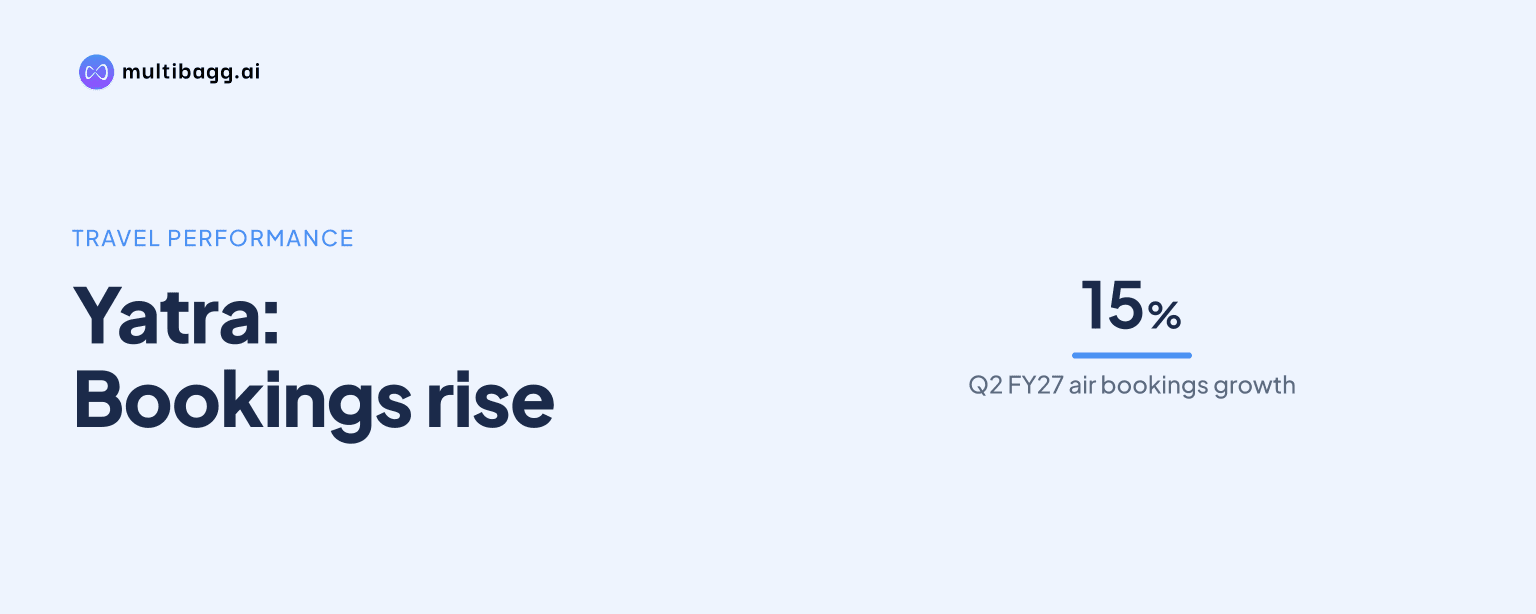
Yatra Online Limited increased air gross bookings by 15% year-on-year to Rs 1,700.6 crore in Q2 FY27 and lifted its air gross margin to 4.45% from 3.95%, despite an approximately 2% decline in air passenger volumes to 1,298,000. The result outpaced a domestic aviation market where passenger traffic declined approximately 6% year-on-year.
Know Yatra Online inside out
Results, valuation, peers and who's buying, in one view.
How did Yatra outperform a declining domestic aviation market?
Yatra outperformed the domestic aviation market because its air passenger volumes declined by approximately 2.4% year-on-year in Q2 FY27, compared with an approximately 6% decline in domestic industry passenger traffic. On a sequential basis, Yatra's domestic air passenger volumes increased approximately 4%, while the wider domestic market declined nearly 15%, according to management.
Yatra's air gross bookings nevertheless rose 15% year-on-year to Rs 1,700.6 crore in Q2 FY27, showing that booking value increased despite lower passenger volumes. Management said domestic air-ticket prices rose approximately 26% year-on-year as elevated fuel costs and pressure on airline profitability led to capacity rationalisation and higher fares.
Management attributed Yatra's relative performance to its distribution network, deeper engagement with existing partners and customers, and improvements in supply capabilities. It said these factors allowed Yatra to capture a greater share of travel demand in Q2 FY27, although it did not disclose an absolute market-share figure.
The contrast between volumes and booking value also reflects the fare environment. Higher domestic fares can raise gross booking value per passenger, while Yatra's smaller passenger decline than the industry supported its 15% air-booking growth. Management did not quantify how much of the booking increase came from fares, passenger mix or share gains.
Why did Yatra's air margin increase to 4.45%?
Yatra's air gross margin increased to 4.45% of gross bookings in Q2 FY27 from 3.95% in Q2 FY26, an expansion of 0.50 percentage points. Air gross margin rose 29% year-on-year to Rs 75.7 crore, exceeding the 15% increase in air gross bookings.
Management said stronger supplier commercials, improved revenue realisation and optimisation of the business mix supported the higher air margin. These factors increased the amount retained from air gross bookings after service costs, while passenger volumes in the Air Ticketing business declined approximately 2% to 1,298,000.
Affiliate-partner business also increased during the quarter and made a positive contribution margin, according to management. It said affiliate commissions increased other expenses on an accounting basis, so the higher expense line did not itself indicate that the affiliate channel had a negative contribution.
The air result supported consolidated gross margin, defined by Yatra as revenue less service costs, which was broadly flat year-on-year at Rs 125.5 crore in Q2 FY27. That stability came despite lower MICE volumes and a 39% year-on-year decline in consolidated revenue from operations to Rs 213.6 crore.
Got a follow-up? Ask IRIS
What drove the difference between air, hotels and MICE performance?
Yatra's core air, corporate-travel and stand-alone hotel activities grew in Q2 FY27, while MICE reduced the reported Hotels and Packages result. Stand-alone hotel gross bookings rose approximately 20% year-on-year, whereas MICE gross bookings declined approximately 63% from an unusually large international-program quarter in Q2 FY26.
The Hotels and Packages segment reported a 21% year-on-year decrease in gross bookings to Rs 405.4 crore and a 34% decline in gross margin to Rs 29.9 crore. Its gross-margin rate moderated to 7.37% from 8.86%, contrasting with the 0.50-percentage-point expansion in the Air Ticketing margin.
Management said corporate customers shifted from larger international MICE programmes to smaller groups because of higher travel costs, geopolitical uncertainty, destination choices and budget considerations. Smaller programmes typically faced greater competitive pressure, affecting both volume and margin, while international passenger traffic for Indian carriers declined approximately 19% year-on-year.
MICE showed sequential improvement despite the sharp year-on-year reduction. MICE gross bookings rose approximately 37% quarter-on-quarter in Q2 FY27, and management said Yatra entered Q3 FY27 with a stronger order book. It did not provide the order-book value or a timetable for the return of larger international corporate programmes.
Is corporate travel supporting Yatra's air business growth?
Yatra's corporate-travel gross bookings increased approximately 18% year-on-year in Q2 FY27, supported by expansion from existing customers and new-account additions. Management said approximately 54% of its existing corporate customers increased their business with Yatra, while 177 new corporate customers had gone live during FY27 to date.
Travel Pro, Yatra's offering for mid-market and small and medium-sized enterprises, recorded more than 30 customer closures during Q2 FY27. Management estimated annual business potential from those closures at approximately Rs 82.5 crore, but described the initiative as being at an early stage rather than reporting that potential as recognised revenue.
Yatra also reported 25 customer wins for RECAP, its expense-management offering, with eight customers live and another five approaching implementation. Separately, its Kanoo Travel partnership had begun generating revenue and was making a positive operating contribution, although management did not disclose revenue or profit amounts.
Automation was another stated support for scalability in Q2 FY27. Chats handled by Yatra's artificial-intelligence assistants grew approximately 25% sequentially and cancellations processed through chat increased 67%, while management reported an approximately 5% year-on-year improvement in operating headcount efficiency.
Yatra incurred approximately Rs 5.2 crore in Q2 FY27 costs for initiatives including Google Cloud Platform infrastructure, Kanoo, RECAP and Travel Pro. Management said these investments were at different stages of maturity and that their full revenue potential had yet to be realised.
Conclusion
Yatra's Q2 FY27 air performance differed from the industry's headline passenger trend: air passenger volumes declined approximately 2%, but gross bookings rose 15% to Rs 1,700.6 crore and air gross margin increased 29% to Rs 75.7 crore. Improved supplier terms and revenue realisation lifted the air margin to 4.45%, helping offset the effect of a 63% year-on-year decline in MICE gross bookings.
The next indicators are whether the stronger Q3 FY27 MICE order book converts into volume and whether Travel Pro's more than 30 Q2 FY27 customer closures produce the estimated Rs 82.5 crore of annual business potential. Management also plans to continue investing in Google Cloud Platform infrastructure, Kanoo, RECAP and Travel Pro after the Rs 5.2 crore of related Q2 costs.