










Yatra Online Limited Q2 FY27 Revenue Falls 39% as MICE Slows
Key highlights
- Yatra's Q2 FY27 revenue from operations fell 39% year-on-year to INR 2,136 million.
- Gross bookings increased 6% year-on-year to INR 21,655 million in Q2 FY27.
- Air gross margin rose 29% year-on-year to INR 757 million, with the margin rate improving to 4.45%.
- Yatra reported cash, cash equivalents and term deposits of INR 2,304 million as of September 30, 2026.
powered by IRIS
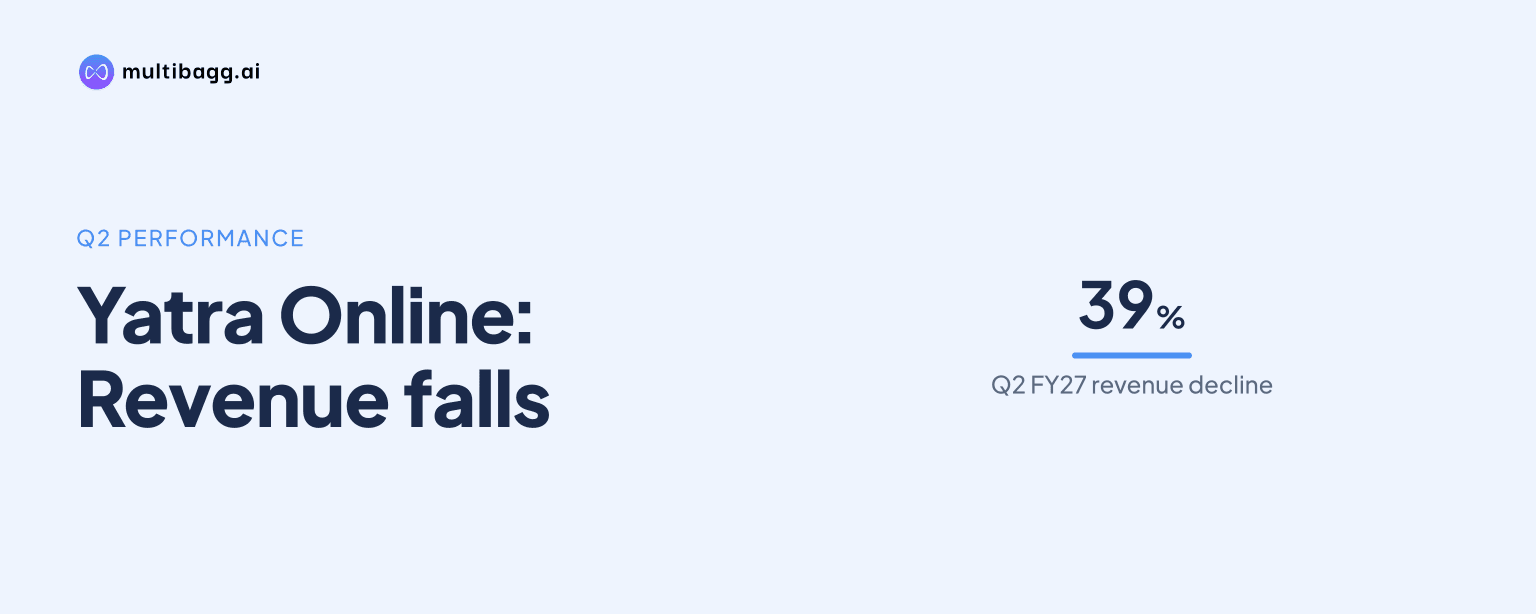
Yatra Online Limited reported Q2 FY27 revenue from operations of INR 2,136 million, down 39% year-on-year, as lower meetings, incentives, conferences and exhibitions, or MICE, volumes outweighed growth in air bookings and other core travel categories. The company posted a net loss of INR 22.3 million for the quarter ended September 30, 2026.
Know Yatra Online inside out
Results, valuation, peers and who's buying, in one view.
What were Yatra's Q2 FY27 financial results?
Yatra reported a sharp year-on-year decline in revenue in the September quarter, with revenue from operations falling to INR 2,136 million from the comparable prior-year period. The company said the reduction was primarily linked to lower MICE business volumes, particularly large international group programmes affected by geopolitical disruptions and a high comparison base.
Gross margin, defined by Yatra as revenue less service cost, was broadly unchanged year-on-year at INR 1,255 million. However, adjusted EBITDA moved to a loss of INR 32 million from a profit of INR 212 million in Q2 FY26. The adjusted EBITDA-to-gross-margin ratio was negative 2.57%, while the company reported a net loss of INR 22.3 million.
For the first half of FY27, revenue from operations declined 28% year-on-year to INR 4,015 million. Gross margin increased 3% to INR 2,482 million, indicating that the margin contribution from core travel operations held up better than reported revenue during the period.
Why did Yatra's MICE business affect quarterly revenue?
The MICE segment was the main reason for the revenue contraction because large group travel programmes declined materially from the prior-year level. Yatra said MICE gross bookings fell 63% year-on-year, reflecting reduced large international programmes and geopolitical disruption in West Asia. The previous year's base was also stronger.
MICE transactions can carry a higher reported revenue contribution than certain other travel categories, making a fall in this business meaningful for consolidated revenue. Therefore, growth in air bookings and some corporate travel activity did not fully offset the decline in group travel volumes during the quarter.
Management noted early signs of sequential improvement. MICE volumes rose 37% quarter-on-quarter as the business shifted towards smaller groups, and the company cited a stronger order book for the coming period. It also said recovery was not uniform across destinations, leaving near-term visibility dependent on the resumption of corporate travel programmes and traveller confidence.
The call did not include analyst questions, so management's statements on MICE trends and forward bookings were not further examined during the session. The company maintained a measured outlook, linking the pace of recovery to connectivity, affordability and conditions affecting travel demand.
Got a follow-up? Ask IRIS
How did Yatra's air and hotel operations perform?
Yatra's air business outperformed the broader domestic aviation market on passenger-volume trends and improved its margin take rate. Air gross bookings grew 15% year-on-year, while domestic air passenger volumes declined about 2.4%, compared with a 6% decline for the broader domestic aviation market.
Sequentially, Yatra's domestic air passenger volumes increased by about 3% to 4%, even as the domestic industry recorded a nearly 15% sequential decline, according to management. Air gross margin rose 29% year-on-year to INR 757 million, and the air gross margin rate improved to 4.45% from 3.95% a year earlier.
Hotels and Packages faced a weaker comparison. Gross bookings in this segment declined 21% year-on-year, while gross margin was INR 299 million. The segment's gross margin rate moderated to 7.37% from 8.86% in Q2 FY26. These results show that stronger air margins partly supported consolidated gross margin despite lower MICE activity.
Management said it remains focused on higher-margin air and hotel opportunities alongside its corporate travel operations. It also referred to Travel Pro for small and medium enterprises and Recap for expense management as products intended to expand its addressable customer base.
What does the quarter mean for Yatra's financial position and investors?
The quarter shows a divergence between Yatra's gross booking growth and its reported revenue and earnings performance. Gross bookings increased 6% to INR 21,655 million, but the changing mix away from MICE reduced revenue and pushed adjusted EBITDA into a loss. For investors, this makes the recovery of corporate group travel important alongside the performance of air and hotel categories.
Yatra ended September 30, 2026 with cash, cash equivalents and term deposits of INR 2,304 million. This liquidity position provides a disclosed balance-sheet reference while the company manages lower MICE volumes and continues investments in operations, automation and product expansion.
The company's management cited India's expanding consumer base, improving connectivity and greater participation from smaller cities as long-term travel market drivers. It also pointed to a shift toward organised online travel. These structural themes provide context for Yatra's strategy, although the Q2 numbers show that travel categories can be affected differently by disruptions in aviation capacity, destination conditions and corporate travel budgets.
Management said it expects 15% revenue and EBITDA growth in the medium term. That statement is an outlook from the company rather than a reported financial result, and its delivery will depend on the normalisation of MICE volumes as well as continued margins in air and hotels.
Conclusion
Yatra's Q2 FY27 results were shaped by a steep MICE contraction, which caused revenue to fall 39% and adjusted EBITDA to turn negative despite a 6% increase in gross bookings. Stable consolidated gross margin, improved air take rates and relative outperformance in domestic air passenger volumes provided support, but were insufficient to counter the decline in large group travel programmes.
The next area to watch is whether the stronger MICE order book and 37% sequential improvement in MICE volumes translate into a sustained recovery in Q3. Investors will also track air margin retention, hotel and package demand, and progress toward management's stated medium-term target of 15% revenue and EBITDA growth.