










Yatra Rebuilds MICE Volumes With Lower Programme Pricing
Key highlights
- Yatra said MICE bookings improved about 37% quarter on quarter in Q2 FY27.
- Yatra reported Q2 FY27 revenue from operations of Rs 21.36 crore, down 39% year on year.
- Air gross margin increased 29% year on year to Rs 7.57 crore in Q2 FY27.
- Management said approximately 60% of Yatra's cost base is fixed.
powered by IRIS
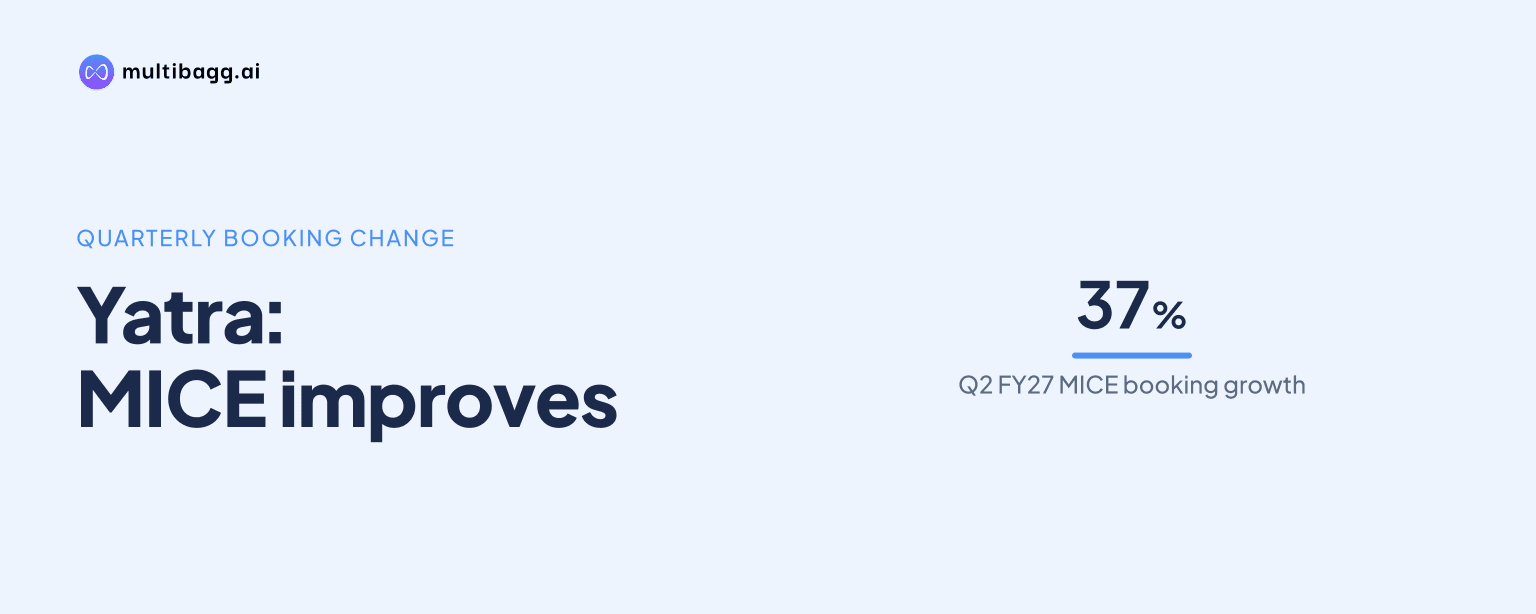
Yatra used more flexible pricing in its meetings, incentives, conferences and exhibitions business in Q2 FY27 to rebuild corporate volumes, with MICE bookings rising about 37% sequentially even though margins did not recover at the same rate. Management said the approach supported a stronger Q3 order book and renewed international group travel.
Know Yatra Online inside out
Results, valuation, peers and who's buying, in one view.
Why is Yatra using lower MICE programme pricing?
Yatra is using more flexible MICE pricing because corporate customers had limited event budgets while travel costs had increased. Chief Executive Officer Dhruv Shringi said the company accepted lower pricing in the short term to rebuild volume, re-engage customers and preserve corporate relationships rather than lose programmes during the disruption.
Management illustrated the pressure with a European incentive trip budgeted at Rs 1.5 lakh per person for 3,000 distribution sales officers, where the cost had risen to Rs 2.5 lakh per person. Yatra said it was seeking price points that remained viable for customers while allowing it to operate the programme and retain the relationship.
The company described this as a strategic and temporary decision, not a permanent change to its margin model. Management expects MICE margins to improve as prices rationalise and volumes return, while noting that Globe, its MICE-focused subsidiary, accounted for much of the impact on consolidated profitability.
How far has Yatra's MICE recovery progressed?
Yatra said MICE bookings rose about 37% quarter on quarter in Q2 FY27, and management reported a stronger order book for Q3. The recovery had initially been weighted toward smaller domestic groups in Q1, but international group travel began increasing as a share of the MICE mix during Q2.
Yatra did not disclose standalone MICE gross bookings, revenue or margin figures for Q2 FY27. It said, however, that margins lagged volume because it won some business at lower gross margins than in the prior year, while its teams worked on cost structures intended to restore margins toward last year's levels.
The Middle East disruption has had a greater effect on MICE and short-haul holidays than on broader corporate travel, according to management. Dubai and Abu Dhabi remain important for group events because of their convention capacity, with management citing a Big Four consulting firm that took 2,000 partners and spouses to Dubai in the previous year.
What do Yatra's Q2 FY27 results show across segments?
Yatra reported consolidated revenue from operations of Rs 21.36 crore in Q2 FY27, down 39% year on year, while gross margin, defined as revenue less service cost, was unchanged at Rs 12.55 crore. Adjusted earnings before interest, tax, depreciation and amortisation, or adjusted EBITDA, fell 41% to Rs 1.50 crore, and the company recorded a net loss of Rs 70 lakh.
Air performance improved while Hotels and Packages contracted, helping Yatra protect gross margin despite the MICE disruption. Air passenger volume fell 2% to 12.98 lakh, but air gross margin rose 29% and its margin on gross bookings increased to 4.45% from 3.95% a year earlier.
Hotels and Packages room nights declined 3% to 4.90 lakh in Q2 FY27, while segment gross margin as a share of bookings declined to 7.37% from 8.86%. In contrast, air bookings increased despite lower passenger volume, and air monetisation improved, creating a partial offset to pressure on MICE and hotels.
Got a follow-up? Ask IRIS
How are affiliate costs affecting Yatra's profitability?
Yatra said affiliate commissions were the largest contributor to higher other expenses in Q2 FY27. Management used affiliates to bring demand into the business and protect revenue less service cost while MICE was subdued, because greater air volumes can help Yatra reach airline commission slabs.
An analyst referred to approximately Rs 15 crore of additional year-on-year expenses, while Shringi put the increase at Rs 13 crore and said affiliate costs made up the larger portion. He said Yatra expected Rs 3 crore to Rs 4 crore of the elevated expense to taper in coming quarters, toward a more normal Rs 47 crore to Rs 48 crore level similar to Q1.
Management said the affiliate-led cost increase was a short-term measure rather than a permanent feature of the cost base. It may add a reconciliation in future investor presentations to bridge reported gross margin and variable costs, although it did not commit to changing reported financial statements because that could require prior-period changes and auditor review.
What could increase Yatra's operating leverage?
Yatra said approximately 60% of its costs are fixed, including salary, infrastructure and data-centre costs. Assuming the same business mix, management said about 60 paise of every additional rupee of income could flow through to profitability as volumes recover, because variable costs are mainly payment gateway charges and some affiliate commissions.
The company reported about 5% year-on-year improvement in operating headcount efficiency. Chats handled by its artificial-intelligence assistants increased about 25% sequentially, while cancellations processed through chat rose 67%, reflecting efforts to automate routine servicing workflows as corporate transaction volumes grow.
Travel Pro, Yatra's mid-market and small and medium enterprise offering, recorded more than 30 customer closures in Q2 with estimated annual business potential of about Rs 82.50 crore. RECAP, its expense-management product, had 25 customer wins, including eight live customers and five nearing implementation.
The Kanoo Travel partnership also began generating revenue and made a positive operating contribution, according to management. Yatra had managed only about 30% of Kanoo's corporate business for roughly 1.5 months in Q2, and management said later quarters should better reflect the partnership's revenue and margin contribution.
Conclusion
Yatra's MICE recovery is currently volume-led rather than margin-led. The company is accepting more flexible pricing to retain corporate relationships and restore programme activity, while improved air monetisation helped sustain gross margin even as Q2 FY27 revenue from operations declined 39% year on year to Rs 21.36 crore.
The next measure is H2 FY27 execution. Management said October and early-November trends pointed to MICE improvement from Q2, with a stronger Q3 order book and a better Q4 expected under its plan. Results will show whether MICE margins recover, affiliate costs taper by Rs 3 crore to Rs 4 crore, and Kanoo adds more after its initial 1.5 months of execution.