








ZAP revenue up 57%, expansion leaves EBITDA at Rs 2.7 crore
MAX Plan at ₹4,999/yr

Find your next multibaggerBe a Pro Investor
Research stocks and track your picks on the go. Download the app.
Key highlights
- ZAP sales rose 57% year on year to Rs 30.30 crore in H1FY26-27.
- ZAP reported EBITDA of Rs 2.70 crore after Rs 3.20 crore of long-term investment.
- ZAP disbursals increased 146% to about Rs 1,700 crore in H1FY26-27.
- ZAP's contribution to Finbud's overall business increased to 16% from 14% a year earlier.
powered by IRIS
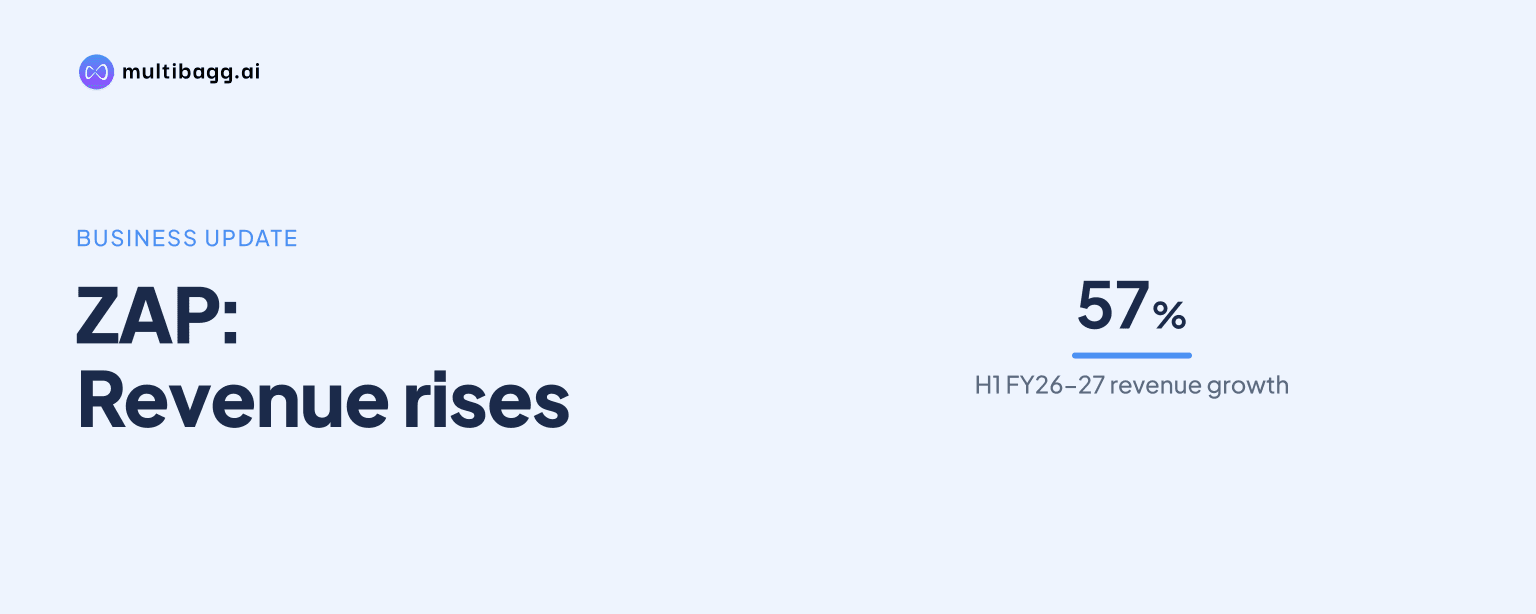
ZAP Private Ltd grew sales 57% year on year to Rs 30.30 crore in H1FY26-27, but earnings before interest, tax, depreciation and amortisation (EBITDA) were Rs 2.70 crore after Rs 3.20 crore of investment in technology, data science and leadership hiring. Management said these hires support new categories and an artificial intelligence-first framework.
Know Finbud Financial Services inside out
Results, valuation, peers and who's buying, in one view.
How fast did ZAP grow in H1FY26-27?
ZAP grew sales to Rs 30.30 crore in H1FY26-27 from Rs 19.30 crore in H1FY25-26, a 57% increase. The H1FY26-27 sales figure equalled 73% of the Rs 41.50 crore reported for the full FY2025-26, showing that the digital operation generated most of the preceding year's sales level within six months.
ZAP's contribution to Finbud's overall business increased to 16% in H1FY26-27 from 14% in H1FY25-26 and 13% in FY2025-26. Finbud reported total sales of Rs 188.30 crore for H1FY26-27, compared with Rs 138.60 crore a year earlier, while agency-business sales were Rs 158 crore, up 32% from Rs 119.30 crore.
ZAP's disbursals reached about Rs 1,700 crore in H1FY26-27, up 146% from about Rs 690 crore in H1FY25-26. The H1 disbursal figure also exceeded the Rs 1,682 crore delivered by the digital business in all of FY2025-26, while sales increased at the slower 57% rate.
Why was ZAP's H1FY26-27 EBITDA Rs 2.7 crore?
ZAP reported H1FY26-27 EBITDA of Rs 2.70 crore after recording Rs 3.20 crore of long-term investments. Management said EBITDA before those investments was Rs 5.90 crore and would have represented a 19.5% margin, which it said was in line with earlier guidance.
The reported Rs 2.70 crore EBITDA represented an 8.91% margin on Rs 30.30 crore of sales. Management attributed the incremental expenditure to new human resources in technology, data science and leadership functions, saying these teams are building new categories and an artificial intelligence-first framework but have not yet contributed to business volumes.
The spending also formed part of Finbud's broader first-half profitability outcome. Finbud's loan-aggregation business reported profit after tax (PAT) of Rs 5.10 crore, unchanged from H1FY25-26, despite total sales rising 36% to Rs 188.30 crore; management highlighted the Rs 3.20 crore ZAP investment in explaining the flat PAT.
Which ZAP products generated the disbursal increase?
ZAP's gold-loan disbursals rose to about Rs 1,125 crore in H1FY26-27 from about Rs 155 crore in H1FY25-26, while personal-loan disbursals increased to about Rs 575 crore from about Rs 535 crore. Gold loans therefore accounted for most of the approximately Rs 1,010 crore increase in the digital business's total disbursals.
Personal loans represented about 34% of ZAP's approximately Rs 1,700 crore H1FY26-27 disbursals, while gold loans represented about 66%, based on the two disclosed product figures. Although personal-loan disbursals grew by about Rs 40 crore, the expansion in gold loans was about Rs 970 crore year on year.
ZAP also increased focus on its Health & Wellness category in H1FY26-27, selling about 4,950 policies and collecting about Rs 2.85 crore in premiums. The category generated Rs 1.95 crore of revenue, or 6.4% of ZAP's H1 revenue, through insurance products embedded with loans.
Got a follow-up? Ask IRIS
What customer-acquisition issue did ZAP identify?
ZAP said changing Meta promotional-marketing guidelines led to lower loan-customer acquisition in August and September of H1FY26-27. Management identified this issue amid wider challenges in digital-lending market dynamics, but did not quantify the customers, disbursals or revenue affected during the two months.
Management's stated response is to diversify marketing channels and expand into new categories. The plan accompanies the Rs 3.20 crore investment in technology, data science and leadership resources during H1FY26-27, which management said are intended to support longer-term objectives and remain unreflected in current business volumes.
Finbud's agency business is also a customer-acquisition channel for ZAP, according to management. The agency operation delivered Rs 4,890 crore of disbursals in H1FY26-27, up 34% from Rs 3,655 crore, and reported a 4.2% EBITDA margin while management said it could increase customer lifetime value for customers acquired by ZAP.
How did ZAP's investment affect Finbud's wider H1 results?
Finbud and ZAP reported total revenue of Rs 189.32 crore in their unaudited consolidated financial statement for the half year ended September 30, 2026, compared with Rs 138.73 crore in the corresponding prior-year period. PAT in that statement was Rs 5.06 crore, compared with Rs 5.10 crore a year earlier, as the revenue measure includes Rs 1.05 crore of other income.
The wider Finbud, ZAP and LTCV Credit Private Limited, or Equall, financial view showed net profit of Rs 2.70 crore after Equall recorded a Rs 2.40 crore loss. Management said Equall was in its first full financial year, had spent on team building and infrastructure, and was expected to break even by the end of FY2026-27.
Equall's loan book stood at Rs 21.40 crore on September 30, 2026, following H1 disbursals of Rs 18.60 crore, comprising Rs 7.40 crore in the first quarter and Rs 11.20 crore in the second quarter. It also raised Rs 31.17 crore at Rs 191 per share, with Finbud Group investing Rs 14 crore in the fundraise.
Conclusion
ZAP combined 57% sales growth, an increase in its contribution to Finbud's business to 16%, and 146% growth in disbursals during H1FY26-27. Gold loans drove most of the disbursal expansion, while the Rs 3.20 crore technology, data-science and leadership investment reduced reported EBITDA to Rs 2.70 crore from the Rs 5.90 crore level management calculated before those investments.
The next disclosed operating points are whether diversified marketing channels address the lower customer acquisition reported in August and September, and whether the new hires begin adding business volumes. At group level, management has set a target for Equall to achieve monthly operating breakeven by the end of the fourth quarter of FY2026-27.

