










Zydus Consumer Wellness sales rise 76.1% as channels reach 38%
Key highlights
- Consumer Wellness sales were Rs 1,122.3 crore in Q2 FY27, up 76.1% year-on-year.
- Consumer Wellness domestic business grew 29% year-on-year in Q2 FY27.
- Organised channels accounted for 38% of domestic sales in H1FY27, including 23% from e-commerce.
- Skin and hair care grew 37% year-on-year, versus 25% for food and nutrition in Q2 FY27.
powered by IRIS
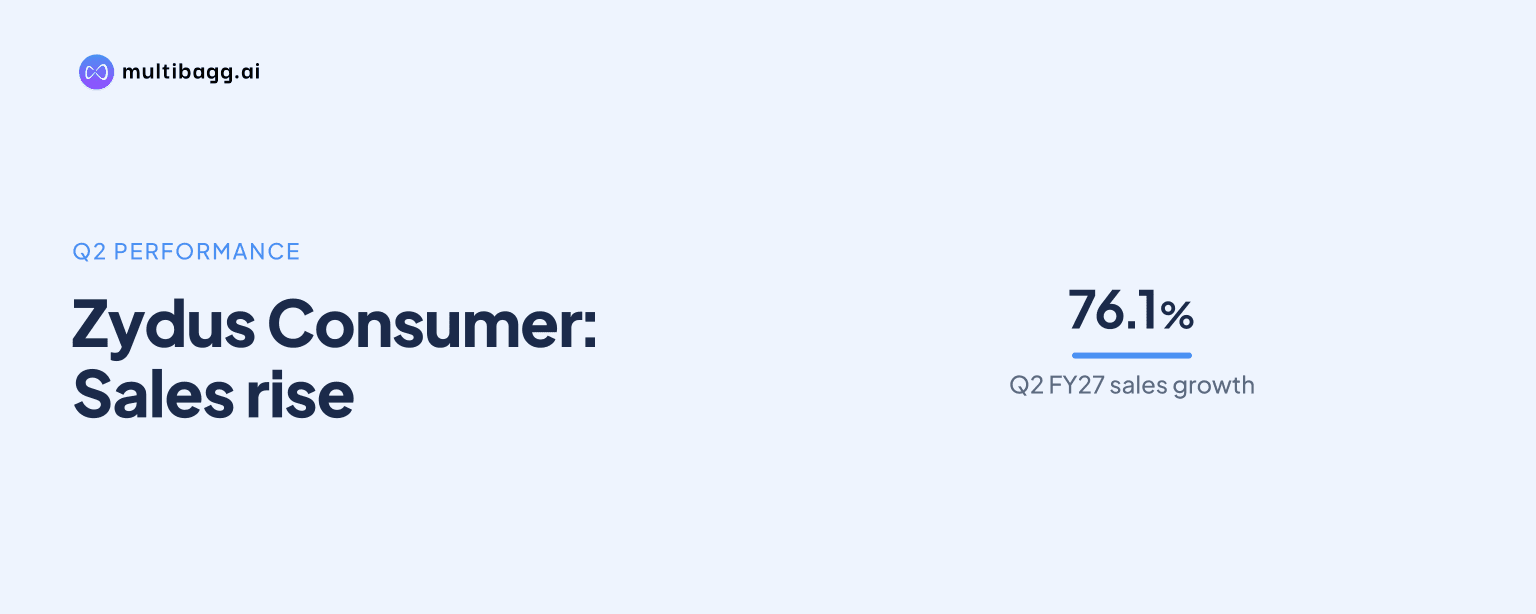
Zydus Consumer Wellness sales increased 76.1% year-on-year to Rs 1,122.3 crore in Q2 FY27, while its domestic business grew 29% and organised channels accounted for 38% of domestic sales in H1FY27. Consumer Wellness attributed domestic category momentum to steady urban recovery, improving rural demand, product innovation, disciplined execution and quick commerce.
Know Zydus Lifesciences inside out
Results, valuation, peers and who's buying, in one view.
How did Consumer Wellness sales change in Q2 FY27?
Consumer Wellness reported Rs 1,122.3 crore of sales in Q2 FY27, up 76.1% year-on-year from Rs 637.4 crore in Q2 FY26. The business contributed 14% of total revenue in Q2 FY27, according to the presentation. That annual growth rate was higher than the 29% growth reported for the domestic business, while the international business, including CCL, grew 12% year-on-year on a like-to-like basis.
Sales declined 21.5% quarter-on-quarter from Rs 1,429.2 crore in Q1 FY27. The sequential fall followed Rs 1,463.3 crore in Q4 FY26, the highest figure in the five-quarter series disclosed by Consumer Wellness. The data therefore show a large year-on-year increase in Q2 FY27 alongside a decline from the preceding two quarters, rather than uninterrupted sequential expansion.
Consumer Wellness identified product innovation, disciplined execution and quick commerce as growth drivers. The presentation does not split the Rs 1,122.3 crore Q2 FY27 sales figure between domestic and international operations, so the relative revenue weight of the 29% domestic growth and 12% like-to-like international growth cannot be calculated from the disclosed data.
What drove Consumer Wellness domestic growth?
Consumer Wellness domestic business grew 29% year-on-year in Q2 FY27, supported by positive momentum across categories. Management attributed this result to steady urban recovery and improving rural demand. The cited drivers cover the consumer categories rather than a single brand or channel.
Skin and hair care grew 37% year-on-year, making it the faster-growing of the two domestic portfolio groups specifically quantified by Consumer Wellness. Food and nutrition grew 25% year-on-year in the same quarter. The 12-percentage-point gap shows that skin and hair care expanded faster than food and nutrition, although Consumer Wellness did not disclose their respective sales bases or shares of segment revenue.
The domestic performance also needs to be read alongside the 76.1% overall sales growth rate. Domestic growth of 29% was below total segment growth, while international operations including CCL grew 12% on a like-to-like basis. Since the presentation provides neither reported international sales nor the effect of CCL in the year-earlier comparison, it does not quantify the factors behind the difference between segment and domestic growth.
Got a follow-up? Ask IRIS
How important are modern trade and e-commerce to Consumer Wellness?
Organised channels represented 38% of Consumer Wellness domestic sales in H1FY27, comprising 15% from modern trade and 23% from e-commerce. E-commerce was therefore the larger disclosed organised channel, exceeding modern trade by 8 percentage points. The 38% figure leaves 62% of domestic sales outside the two disclosed organised channels.
The channel data cover H1FY27, whereas the 29% domestic growth figure applies to Q2 FY27. That difference in measurement periods means the presentation does not establish how much of the Q2 domestic growth came directly from modern trade or e-commerce. It does, however, identify quick commerce among Consumer Wellness growth drivers and shows that digital and organised retail had a disclosed 38% saliency by the first half.
Consumer Wellness did not provide an earlier-period organised-channel share, so the presentation does not measure the pace of channel migration. It also does not separately quantify quick commerce within the 23% e-commerce share or elsewhere. The available evidence supports 38% organised-channel saliency in H1FY27, but not a precise estimate of quick-commerce revenue.
Which Consumer Wellness brands hold leading positions?
Consumer Wellness reported number-one market ranks for Glucon-D, Nycil, Sugar Free, Everyuth Naturals Scrub and Everyuth Naturals Peel Off, based on Nielsen and IQVIA moving annual total, or MAT, September 2026 data. Glucon-D had a 60.0% market share, Nycil 32.8%, Sugar Free 96.0%, Everyuth Naturals Scrub 50.2%, and Everyuth Naturals Peel Off 75.6%.
Everyuth Naturals Facial Cleansing held an 8.4% market share and ranked fourth, while Complan had 3.9% and also ranked fourth. Consumer Wellness defines the facial-cleansing segment as face wash, scrub and peel-off. The company therefore disclosed leadership in the narrower scrub and peel-off categories while reporting a fourth rank in the broader facial-cleansing grouping.
Nutralite Fat Spread and RiteBite MAX PROTEIN Nutrition & Protein Bar, Protein Cookies & Chips were ranked first according to company estimates, but the presentation listed their market shares as not available. Nutralite Dairy and Other RiteBite MAX PROTEIN Nutrition Products were also marked not available for share and, for the latter, rank. These source labels distinguish Nielsen and IQVIA market data from ranks estimated by the company.
Conclusion
Consumer Wellness combined 76.1% year-on-year sales growth in Q2 FY27 with 29% domestic growth and a 38% H1FY27 contribution from modern trade and e-commerce. Skin and hair care grew 37%, ahead of food and nutrition at 25%, while several brands retained leading category positions, including Glucon-D, Nycil and Sugar Free.
What to watch next is whether Consumer Wellness sustains domestic momentum as urban recovery and rural demand develop, and whether quick commerce contributes further to the 38% organised-channel saliency. Management identifies innovation, disciplined execution and quick commerce as growth drivers, but the presentation gives no forward sales target, channel-growth target or separate quick-commerce revenue figure.