










Aaron capacity supports 3,500 monthly door systems without capex
Key highlights
- Aaron’s existing facilities can support 3,500 automatic door systems per month within one to two years without further capital expenditure.
- Aaron’s current automatic door-system capacity exceeds 5,000 units per month, leaving at least 1,500 units of monthly headroom against the 3,500-unit target.
- Aaron operates 3 production units in Surat across 1.5 lakh square feet, with capacity for more than 400 elevator cabins per month.
- Aaron reports more than 700 customers, service coverage across 60-plus cities and 60 confirmed EVOQ360 home-lift orders for phased dispatch through December 2026.
powered by IRIS
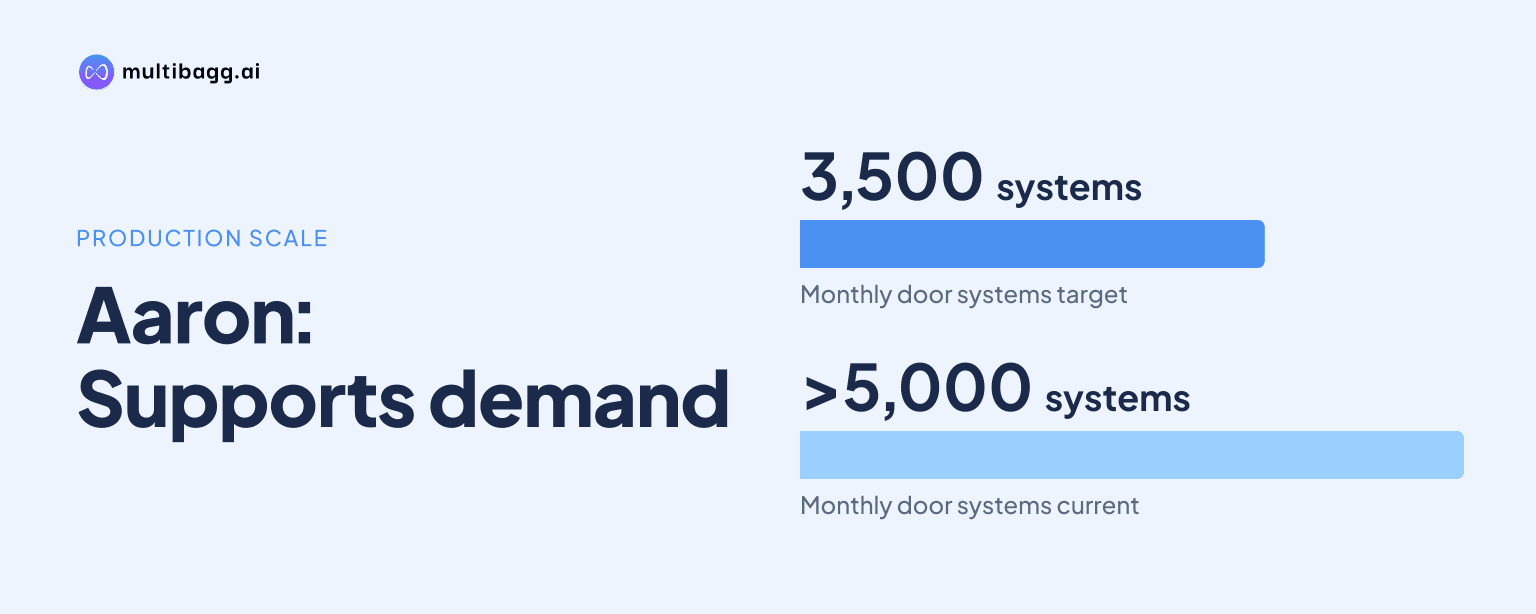
Aaron Industries Limited says its existing manufacturing base can support utilization of 3,500 automatic door systems a month within one to two years without further capital expenditure. That target is below capacity exceeding 5,000 systems a month, leaving at least 1,500 units of monthly headroom on the stated 5,000-unit threshold.
Know Aaron Industries inside out
Results, valuation, peers and who's buying, in one view.
What is Aaron's current manufacturing capacity?
Aaron's current capacity exceeds 5,000 automatic door systems per month and 400 elevator cabins per month. The capacities are spread across three production units in Surat, Gujarat, covering 1.5 lakh square feet and supporting its elevator and stainless-steel operations.
The door-system figure applies specifically to automatic door systems rather than the complete portfolio. Aaron also makes fire-resistant doors, auto centre-swing door systems, elevator cabins, cabin safety frames and the EVOQ360 pit-less home lift, while cabin output has a separately stated capacity of more than 400 units monthly.
Aaron describes the Surat facilities as vertically integrated from elevator doors, cabins and components through to in-house stainless-steel polishing. Its stainless-steel division processes raw coils into finished sheets, with the majority feeding the elevator division and the balance sold for elevator, interior-decoration and industrial applications.
How much unused door capacity does Aaron have?
Aaron has at least 1,500 automatic door systems of monthly headroom against its 3,500-unit utilization projection and the stated 5,000-unit capacity threshold. Actual headroom may be greater because the company says total capacity exceeds, rather than equals, 5,000 systems per month.
Aaron says the projected 3,500-unit utilization level can be reached without further capital expenditure. This is a target for the next one to two years, not a statement that Aaron is currently producing 3,500 systems monthly, and the presentation does not disclose present production or utilization.
The planned level is no more than 70% of the stated 5,000-unit capacity baseline. Aaron has therefore set out a path in which increased door-system output would be met from existing facilities rather than an immediate new investment cycle.
The presentation does not disclose revenue, selling price or margin per automatic door system, so the financial effect of moving towards 3,500 units cannot be calculated. It also provides no separate capacity target for EVOQ360 home lifts, fire-resistant doors or stainless-steel sheets.
Got a follow-up? Ask IRIS
How does automation support Aaron's planned output growth?
Aaron says its Unit 3 Salvagnini automatic line has enhanced output and reduced production cycle times. The company also lists multiple computer numerical control machines for elevator parts, polishing machines for stainless-steel sheets, an embossing machine and a physical vapour deposition machine for colour sheets.
According to Aaron, Unit 3 automation has reduced reliance on manual processes and supports quality consistency and cost discipline. The presentation does not quantify cycle-time reductions, labour savings, production gains or cost changes from the Salvagnini line.
Automation is paired with a broader elevator portfolio. Aaron says new elevator product lines have widened its offerings and addressable customer base, while its products include automatic doors, cabins, components and EVOQ360 home lifts for residential and commercial projects.
The stainless-steel process forms another production mechanism. Aaron procures coils, then cuts, polishes, embosses and finishes them under internal quality control before using most output in its elevator division; it says this supports cost optimization, consistent quality and timely production.
What demand channels could fill Aaron's available capacity?
Aaron's plan to increase utilization includes adding distributors and channel partners, increasing marketing and trade-fair participation, and pursuing strategic tie-ups with elevator manufacturers. The company says distribution reach, brand recall and short-term customer relationships remain constraints on converting elevator and stainless-steel demand into long-term growth.
Aaron reports a base of more than 700 customers, service across more than 60 cities and exports to more than two countries. Its trader and warehouse network covers locations including Surat, Mumbai, Pune, Bengaluru, Kolkata and Hyderabad, while Africa is identified as an expansion focus and a senior sales hire is planned for Punjab, Haryana and Uttar Pradesh.
EVOQ360 provides a disclosed measure of product demand, although it is not evidence of automatic-door demand alone. Aaron says it has supplied the home lift to more than 44 projects since launch, dispatched 19 units in Q2 FY27, and held confirmed advance orders for 60 units from 18 parties for phased dispatch through December 2026, subject to site readiness and customer-specific installation requirements.
Separately, Aaron says Gulf Elevators Private Limited ordered up to 30 EVOQ360 units, valued at an estimated Rs 2 crore excluding goods and services tax. The order is due on or before September 30, 2027, is not included in the 60 confirmed orders, and follows the onboarding of five EVOQ360 distributors.
Conclusion
Aaron's operating case rests on using existing capacity rather than immediate capital expenditure to pursue higher output. Its 3,500-system monthly utilization projection sits below capacity exceeding 5,000 automatic door systems a month, while three Surat units also have capacity for more than 400 elevator cabins monthly and in-house steel processing.
What to watch next is execution of the one-to-two-year utilization plan through distribution additions, manufacturer tie-ups and marketing activity. Aaron expects its 60 confirmed EVOQ360 orders to be dispatched in phases through December 2026, subject to site conditions, while the separate Gulf Elevators order is scheduled for execution by September 30, 2027.