










CSL Finance Limited wholesale book reaches 121 accounts at 36% LTV
Key highlights
- CSL Finance had 121 active wholesale accounts in Q2FY27, up from 110 in Q1FY27.
- CSL Finance reported a 36% average wholesale LTV and ₹12 crore average ticket size in Q2FY27.
- Wholesale represented 73% of CSL Finance’s ₹1,627 crore AUM in Q2FY27.
- Wholesale Large held ₹698 crore of AUM across 43 accounts, with a ₹15 crore average ticket size.
powered by IRIS
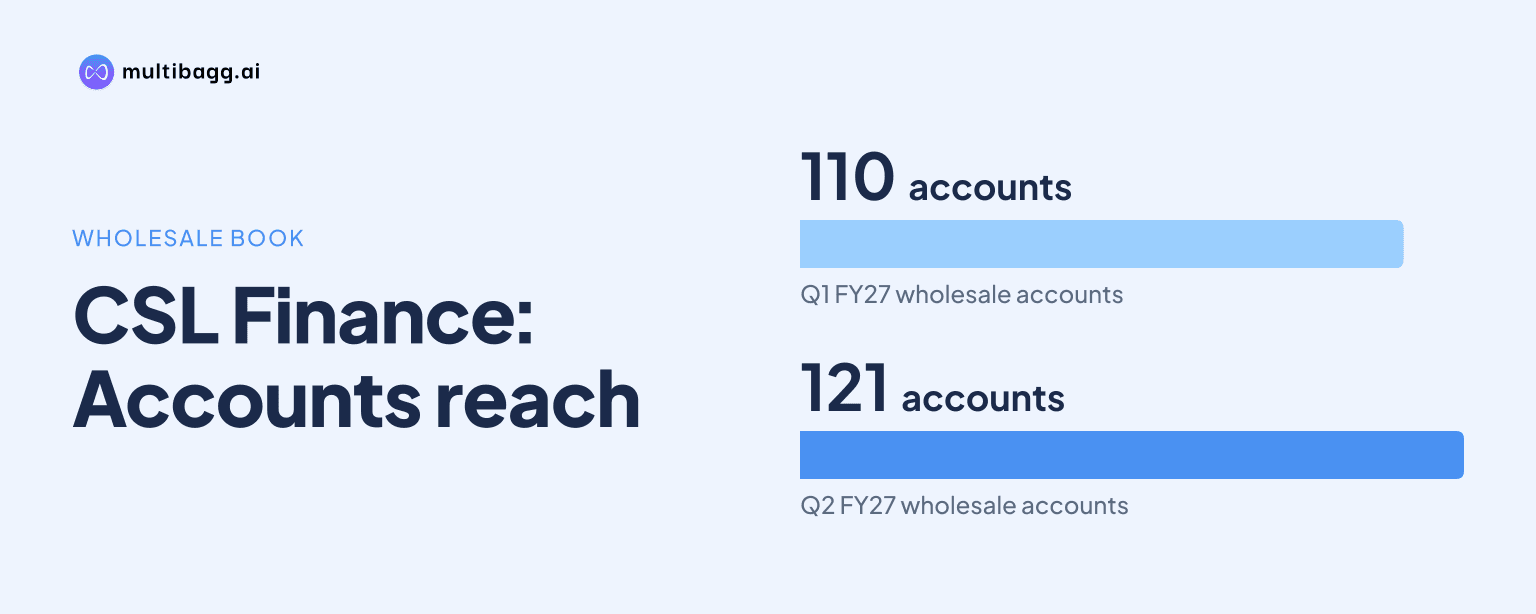
CSL Finance’s real-estate wholesale vertical had 121 active accounts in Q2FY27, with a 36% average loan-to-value (LTV) ratio and a ₹12 crore average ticket size. Wholesale represented 73% of the company’s ₹1,627 crore assets under management (AUM), making its account concentration, collateral structure and monitoring process material to the lending mix.
Know CSL Finance inside out
Results, valuation, peers and who's buying, in one view.
How large is CSL Finance’s wholesale lending book?
CSL Finance’s wholesale business accounted for 73% of its ₹1,627 crore AUM as of Q2FY27, and the company describes the entire wholesale book as secured. The vertical focuses on niche real-estate lending, particularly affordable housing, and had 121 active accounts. That base contrasts with 3,208 active accounts in SME retail, where SME means small and medium enterprises, illustrating the larger individual exposures in wholesale.
The ₹1,191 crore product-level wholesale portfolio comprised ₹698 crore in Wholesale Large, ₹361 crore in Wholesale Small and ₹132 crore in Wholesale Other Term Loan. Wholesale Large had 43 accounts and a ₹15 crore average ticket, while Wholesale Small had 60 accounts and a ₹7 crore average ticket. Wholesale Other Term Loan had 18 accounts with a ₹8 crore average ticket and included loans against properties, liquid securities and deposits.
Wholesale Large finances structured loans for mid-income and affordable group-housing projects. Wholesale Small provides construction loans against single plotted projects. The product split placed the highest AUM and highest average ticket in Wholesale Large, while Wholesale Small had the most accounts, at 60 of the 121 wholesale relationships in Q2FY27.
How did CSL Finance’s wholesale metrics change over five quarters?
CSL Finance’s wholesale active accounts rose to 121 in Q2FY27 from 110 in Q1FY27 and 114 in Q2FY26, while average LTV returned to 36% from 34% in the preceding quarter. Average ticket size increased to ₹12 crore from ₹11 crore in Q1FY27, but remained below ₹13 crore a year earlier and ₹16 crore in Q3FY26. Average tenure stayed at three years across all five reported quarters.
The quarter-on-quarter increase of 11 active accounts was accompanied by a ₹1 crore rise in average ticket size and a 2-percentage-point increase in average LTV. Compared with Q2FY26, active accounts were seven higher, LTV was unchanged at 36%, and average ticket size was ₹1 crore lower. The reported figures therefore show a larger account count at the end of Q2FY27 without a change in the three-year average tenure.
What collateral and project controls does CSL Finance use?
CSL Finance says its wholesale loans are 100% secured and that each deal has at least 2x security cover, with a charge on multiple assets. Its credit appraisal process includes due diligence, credibility checks, project and market screening, and assessment of local demand-supply trends. The company says transactions are structured individually according to project requirements rather than through a single standard format.
The lender’s sourcing framework concentrates on selected micro-markets in the National Capital Region, or NCR, and customer selection is based on end-use demand. It says it works primarily in last-mile funding, which management states reduces project-execution risk, and lends to developers it describes as reputed and credible. CSL Finance also identifies projects where promoters have made a capital contribution as a focus area for the wholesale business.
CSL Finance says its on-ground resources conduct fortnightly site visits after funding to review construction progress, sales, inventory, market prices and costs. The company says this process is designed to identify early-warning signals and increase engagement where needed, including early legal action for faster repayment. Collections are routed through escrow accounts, which the company identifies as its wholesale collection framework.
Got a follow-up? Ask IRIS
Which wholesale products create the largest individual exposures?
CSL Finance’s largest wholesale exposures are in Wholesale Large, which carried ₹698 crore of AUM across 43 accounts at an average ₹15 crore ticket size in Q2FY27. That average ticket was more than twice the ₹7 crore reported for Wholesale Small and above the ₹8 crore average for Wholesale Other Term Loan. Wholesale Large is used for structured funding of mid-income and affordable group-housing projects.
Wholesale Small had ₹361 crore of AUM, 60 active accounts and a ₹7 crore average ticket size, making it the highest-account-count wholesale product. Its construction lending is backed by single plotted projects. Wholesale Other Term Loan, at ₹132 crore across 18 accounts, included loans against properties and lending against liquid securities and deposits, with a ₹8 crore average ticket.
The differences between the three products show that the 43 Wholesale Large accounts held the largest ₹698 crore AUM pool, whereas the 60 Wholesale Small accounts were individually smaller on average. Across the wholesale book, the reported ₹12 crore average ticket in Q2FY27 sat between the ₹15 crore Wholesale Large average and the ₹7 crore Wholesale Small average. The company reported the 36% average LTV for wholesale as a whole rather than separately for the three products.
How does wholesale compare with CSL Finance’s retail operations?
CSL Finance’s wholesale share of AUM was 73% in Q2FY27, compared with 27% for SME retail, despite SME retail having 3,208 active accounts against wholesale’s 121. SME retail reported a 42% average LTV in Q2FY27, compared with wholesale’s 36%. The source separately reported an average ticket size of ₹10 lakh for SME retail and ₹12 crore for wholesale.
The company’s mid-sized loan-against-property business, classified separately from the wholesale statistics, had ₹102 crore of AUM and 50 active accounts in Q2FY27. Its average ticket size was ₹2 crore, average LTV was 37%, and average tenure was three years. This placed the mid-sized segment’s LTV one percentage point above wholesale’s 36%, while its ₹2 crore average ticket was ₹10 crore below the wholesale average.
Conclusion
CSL Finance’s Q2FY27 wholesale profile combined a 121-account base with ₹698 crore in its largest structured-housing product and a reported 36% portfolio-average LTV. The company’s stated controls include 100% secured lending, at least 2x security cover, multiple-asset charges, escrow collections and fortnightly project checks, while the product mix ranges from ₹15 crore average tickets in Wholesale Large to ₹7 crore in Wholesale Small.
Investors should watch subsequent disclosures for whether account growth beyond 121 changes the ₹12 crore average ticket, the 36% LTV or the three-year average tenure. Management has listed new products, a potential credit-rating upgrade and greater access to capital among its growth levers, but the presentation does not disclose a quantitative target for wholesale AUM, account growth or LTV.