










CSL Finance lists 35 lenders but no funding-cost figure
Key highlights
- CSL Finance reported 35 lending partners across banks, SFBs and NBFCs in Q2FY27.
- CSL Finance had ₹210 crore of undrawn sanctioned limits and ₹76.8 crore of liquidity on September 30, 2026.
- CSL Finance borrowings were ₹962.90 crore and its debt-to-equity ratio was 1.50x in Q2FY27.
- CSL Finance disclosed no borrowing-rate figure or quantified rating-linked funding-cost reduction.
powered by IRIS
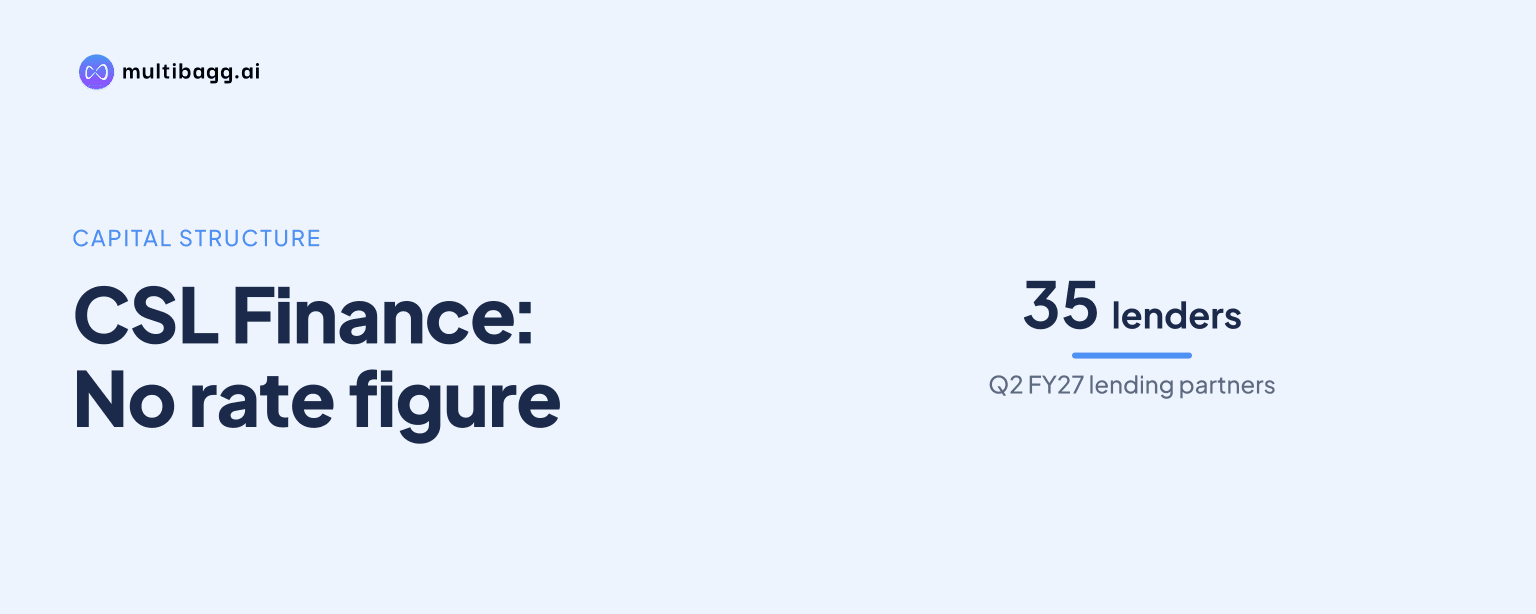
CSL Finance Limited reported 35 lending partners, ₹210 crore of undrawn sanctioned limits and ₹962.90 crore of borrowings as of September 30, 2026, but its presentation does not quantify a reduction in funding costs or directly link lender additions to its A- Stable rating.
Know CSL Finance inside out
Results, valuation, peers and who's buying, in one view.
Does CSL Finance say its rating is lowering funding costs?
No, CSL Finance does not disclose a borrowing-rate figure, a change in finance cost, or a quantified saving connected with its rating in the supplied presentation. The treasury update says Acuite Ratings & Research reaffirmed the company's A- Stable rating on March 31, 2026, while the operational update describes the rating as A-1 Stable. The presentation does not explain the difference between those descriptions.
CSL Finance reports growth in interest income and net interest income, but neither item isolates the cost of borrowings. Interest income increased to ₹70.10 crore in Q2FY27 from ₹65.87 crore in Q1FY27 and ₹59.21 crore in Q2FY26. Net interest income, which the company defines as interest income plus fees and commission income minus finance costs, reached ₹49.6 crore, up 10% quarter on quarter and 21% year on year.
The Q2FY27 increase in net interest income occurred alongside a larger loan book and higher borrowings. However, the presentation supplies neither finance costs nor an average cost of funds for Q2FY27, Q1FY27 or Q2FY26. It therefore does not establish whether the rating affected the price, availability or composition of CSL Finance's borrowing.
What funding capacity did CSL Finance report in September 2026?
CSL Finance reported ₹76.8 crore of cash and equivalents and unutilised cash-credit limits, in addition to ₹210 crore of undrawn sanctioned limits including non-convertible debentures, as of September 30, 2026. Its treasury update also states that asset-liability management, or ALM, was positive across all buckets, but gives no maturity-wise liquidity figures.
The liquidity chart shows undrawn credit facilities of ₹35 crore, ₹30 crore, ₹90 crore and ₹210 crore at displayed points, although it does not label every point by period. Cash and equivalents plus unutilised cash-credit limits were ₹76.8 crore at the latest displayed point, compared with ₹89.5 crore at the prior displayed point and ₹111.5 crore at the earliest displayed point. This shows a higher undrawn-facility amount alongside lower immediately available liquidity.
CSL Finance's total liabilities were ₹985.35 crore in Q2FY27, up from ₹931.65 crore in Q1FY27 and ₹809.89 crore in Q2FY26. Net worth rose to ₹640.03 crore from ₹636.70 crore in the preceding quarter and ₹574.82 crore a year earlier. The presentation reports a capital adequacy ratio, or CAR, of 40.87% in Q2FY27, versus 42.90% in Q1FY27 and 44.73% in Q2FY26.
How diversified is CSL Finance's lender base?
CSL Finance says its lender base stood at 35 institutions in Q2FY27, spanning public and private-sector banks, small finance banks, or SFBs, and non-banking financial companies, or NBFCs. The presentation describes this as a diversified funding profile, but does not give the amount borrowed from each lender category or the share of total borrowings supplied by any individual institution.
The named bank list includes State Bank of India, Canara Bank, Bank of Maharashtra, Indian Bank, Union Bank of India, Indian Overseas Bank and Punjab & Sind Bank. It also lists HDFC Bank, ICICI Bank, Kotak Mahindra Bank, Bandhan Bank, AU Small Finance Bank and Ujjivan Small Finance Bank. These names confirm representation from public-sector banks, private banks and SFBs.
The NBFC lender list includes Tata Capital, Bajaj Finserv, STCI Finance Limited, Tourism Finance Corporation of India Ltd., Small Industries Development Bank of India, Poonawalla Fincorp and Arka Fincap. CSL Finance does not provide dates for onboarding individual lenders, so the source cannot show which lenders, if any, joined after the March 2026 rating reaffirmation. Nor does it identify facilities that remain available under the ₹210 crore undrawn-limit figure.
Got a follow-up? Ask IRIS
How have borrowings and leverage changed at CSL Finance?
CSL Finance's borrowings increased by ₹78.83 crore quarter on quarter to ₹962.90 crore in Q2FY27 from ₹884.07 crore in Q1FY27. Borrowings were also ₹167.80 crore higher than the ₹795.10 crore reported in Q2FY26. Its debt-to-equity ratio, also described as the leverage ratio in the treasury update, rose to 1.50x from 1.39x in Q1FY27 and 1.38x a year earlier.
The increase coincided with expansion in loans and advances before expected credit loss, or ECL, provisions. That balance reached ₹1,572.42 crore in Q2FY27, compared with ₹1,467.75 crore in Q1FY27 and ₹1,287.15 crore in Q2FY26. Separately, CSL Finance reported assets under management, or AUM, of ₹1,627 crore, up 16% year on year and 8% quarter on quarter, while its on-book portfolio was ₹1,578 crore, up 21% and 7%, respectively.
Disbursements reached ₹384.99 crore in Q2FY27, up from ₹320.80 crore in Q1FY27 and ₹293.40 crore in Q2FY26. The company reported ₹706 crore of disbursements for H1FY27. Collections were ₹298 crore in Q2FY27, up 16% year on year and 5% quarter on quarter, while collection efficiency rose to 99% from 98% maintained over the preceding four quarters.
What lending mix is driving CSL Finance's funding requirement?
CSL Finance says wholesale lending led growth during Q2FY27 and is expected by management to remain the key FY27 growth driver. Wholesale accounted for 73% of AUM and SME Retail for 27%, compared with a 66% wholesale and 34% SME Retail mix a year earlier. The presentation says SME disbursements remained measured, although they increased sequentially from Q1FY27.
The company reported portfolio yields of 16.8% in wholesale and 18.1% in SME Retail in Q2FY27. Wholesale yield increased from 16.6% in Q1FY27 and 16.5% in Q2FY26, while SME Retail yield declined from 18.2% in both earlier periods. The source calculates yields using weighted-average outstanding amounts at quarter-end.
Asset-quality measures rose as the portfolio expanded. Gross non-performing assets, or NPA, were 1.13% in Q2FY27, up 18 basis points quarter on quarter and 62 basis points year on year, while net NPA was 0.71%, up 11 and 32 basis points, respectively. Gross Stage 3 assets were ₹17.84 crore, and the provision coverage ratio was 110.29%, compared with 123.20% in Q1FY27 and 229.06% in Q2FY26.
Conclusion
CSL Finance disclosed a 35-partner lender base, ₹210 crore of undrawn limits and positive ALM across all buckets as of September 30, 2026. Borrowings rose to ₹962.90 crore as loans, disbursements and the wholesale share of AUM increased, taking leverage to 1.50x. The presentation supports the existence of funding capacity and lender diversification, but not a measured claim that the rating reduced funding costs.
Management expects wholesale to remain the main FY27 growth driver and expects SME Retail to return to growth gradually during the year. The next disclosed indicators to watch are whether undrawn limits remain available as disbursements grow, whether the lender base moves from 35 institutions, and whether later reporting reconciles the A- Stable and A-1 Stable descriptions or provides explicit finance-cost data.