










CSL Finance reports paperless SME onboarding, 99% digital collections
Key highlights
- CSL Finance says SME onboarding is 100% paperless, with a roughly 30-minute door-to-login process.
- CSL Finance reports 99% digital collections and says about 90% of digital payment collections use NACH, UPI and Bharat BillPay.
- CSL Finance says its technology stack has reduced average turnaround time by 24–48 hours.
- CSL Finance reported 3,208 SME active accounts and a Rs 10 lakh average ticket size in Q2FY27.
powered by IRIS
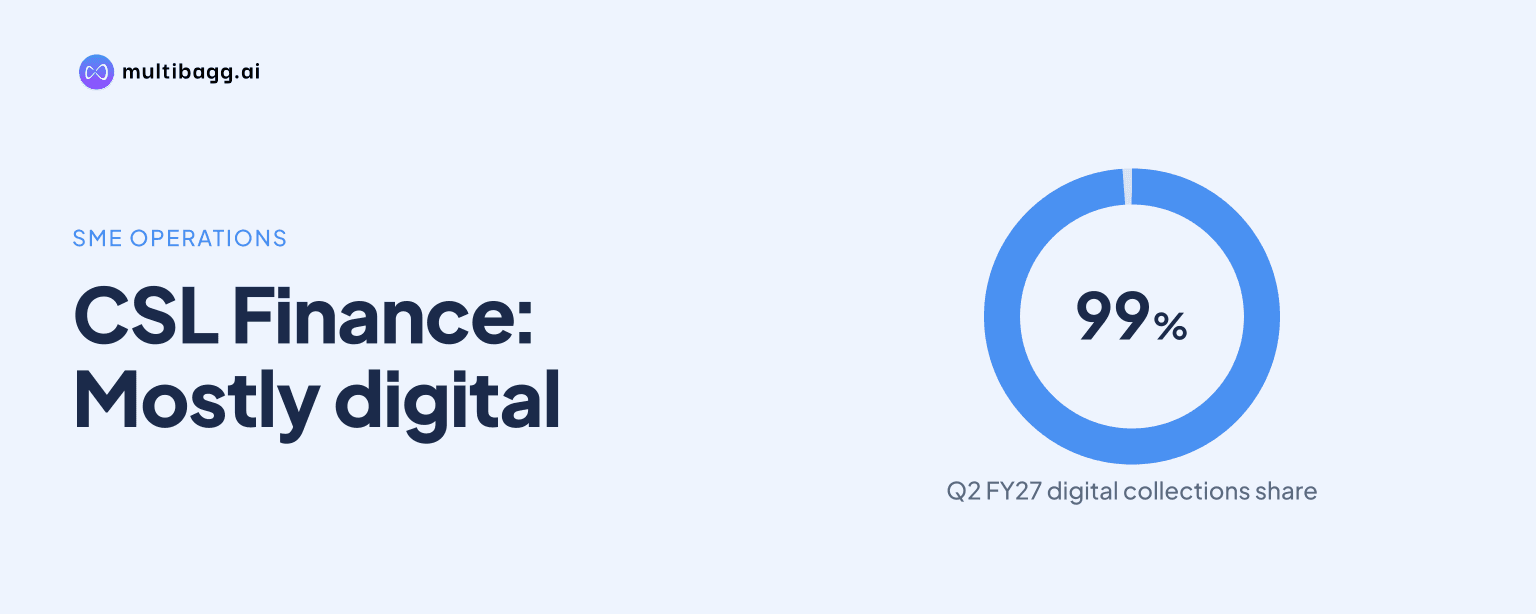
CSL Finance Limited says its SME lending operation has 100% paperless onboarding and 99% digital collections, with its current technology stack reporting an average turnaround-time reduction of 24–48 hours. CSL Finance also reports a roughly 30-minute door-to-login process, although physical personal discussions and collateral-document checks remain within its hybrid underwriting model.
Know CSL Finance inside out
Results, valuation, peers and who's buying, in one view.
How does CSL Finance onboard SME borrowers digitally?
CSL Finance says its borrower onboarding is 100% paperless and takes about 30 minutes from the customer’s door to login. The presentation separately says roughly 80% of the process is digital, with physical personal discussion, or PD, and collateral-document checks continuing as part of the loan assessment process.
The SME retail products using this operating setup include loans against property for self-employed non-professionals, schools and salaried borrowers. Loans for self-employed non-professionals and schools range from Rs 7 lakh to Rs 50 lakh, while salaried loans range from Rs 2 lakh to Rs 50 lakh; the presentation states an ROI range of 16% to 22% for these collateral-backed products.
What technology does CSL Finance use for underwriting?
CSL Finance says its onboarding and processing system is built on a modular application programming interface, or API, first architecture. The stated mechanism is intended to enable third-party service integration, rapid scaling and future compliance changes, while its proprietary mobility applications support sales and credit teams.
The lender’s multi-layered verification process covers identity, bank, geo-location and criminal checks for know-your-customer, or KYC, and fraud-prevention purposes. CSL Finance says hybrid credit decisioning combines bureau data, alternative data and real-time risk algorithms; the presentation identifies these mechanisms as part of its digital underwriting model but does not quantify their individual impact.
A screen from CSL Finance’s sales and credit mobility application shows 1,502 leads and 1,522 applications between 21 February 2025 and 21 May 2025. It also shows five deviations, 814 total queries and 812 open queries during that displayed period, alongside application-stage information including a completed PD status.
How digital are CSL Finance’s collections and servicing?
CSL Finance says 99% of its collections are digital. Its servicing channels include email, WhatsApp and a toll-free number, while the collections and servicing system includes real-time equated monthly instalment, or EMI, collection and settlement, digital welcome kits and digital signing for loan kits.
The presentation says about 90% of digital payment collections are made through the National Automated Clearing House, or NACH, the Unified Payments Interface, or UPI, and Bharat BillPay. CSL Finance also lists SMS and UPI-based one-click repayment links, a cloud-telephony-enabled call centre, and an automated communications engine using email, SMS and WhatsApp.
The 99% measure covers collections reported as digital, while the approximately 90% figure identifies payment collections via the three named rails. CSL Finance does not provide a numerical split for NACH, UPI and Bharat BillPay, or reconcile the remaining share of its digital collections through other channels.
Got a follow-up? Ask IRIS
How did CSL Finance’s SME lending metrics change in Q2FY27?
CSL Finance reported 3,208 SME active accounts in Q2FY27, down by 34 from 3,242 in Q2FY26. Over the same period, average loan-to-value, or LTV, increased to 42% from 38%, average ticket size declined to Rs 10 lakh from Rs 11 lakh, and average tenure stayed at seven years.
The SME account count moved through a narrow range over the five reported quarters, from 3,242 in Q2FY26 to a low of 3,179 in Q1FY27 before reaching 3,208 in Q2FY27. Average ticket size rose to Rs 13 lakh in Q4FY26 before falling to Rs 10 lakh in Q2FY27, while LTV rose from 38% in Q2FY26 to 42% from Q4FY26 onward.
Mid-sized loans against property had 50 active accounts in Q2FY27, compared with 48 in Q2FY26. This segment’s average ticket size fell to Rs 2.05 crore from Rs 2.75 crore, while average LTV rose to 37% from 36% and average tenure remained three years, compared with seven years for SME retail.
What operating gains does CSL Finance attribute to its technology stack?
CSL Finance says its current technology stack has reduced average turnaround time, or TAT, by 24–48 hours. It also lists improved fraud control and enhanced credit decisioning as achievements, but the presentation provides no earlier TAT baseline and no separate numerical fraud-control or credit-decisioning metric.
The technology programme includes real-time dashboards at multiple levels, automated accounting entries from the loan management system, or LMS, and automated incentive solutions. CSL Finance also says it is constantly upgrading its analytical BI tool and uses regulatory technology for Reserve Bank of India, or RBI, compliance and reporting, including real-time monitoring, stress testing and reporting requirements.
Conclusion
CSL Finance’s reported digital model combines paperless documentation, data-supported underwriting and digital repayment channels with physical PD and collateral verification. The operating evidence includes 100% paperless onboarding, 99% digital collections, a roughly 30-minute door-to-login process and a stated 24–48-hour average TAT reduction, while SME active accounts declined modestly to 3,208 in Q2FY27.
The next disclosure to watch is whether CSL Finance quantifies outcomes from its stated constant upgrades to the analytical BI tool and its API-first architecture. The presentation identifies further capability development in dashboards, LMS-linked accounting, incentive automation and RBI reporting, but does not set a future TAT target or give a timetable for additional digital milestones.