










Aaron retains processing margins through STELIX expansion
Key highlights
- Aaron operates three stainless-steel production units in Surat spanning 1.5 lakh square feet.
- Most processed sheets are used internally for elevator auto doors and cabins, while the balance is sold to external customers.
- STELIX covers premium stainless-steel products including matt and mirror polishing, embossing, press plates and PVD-coated colour sheets.
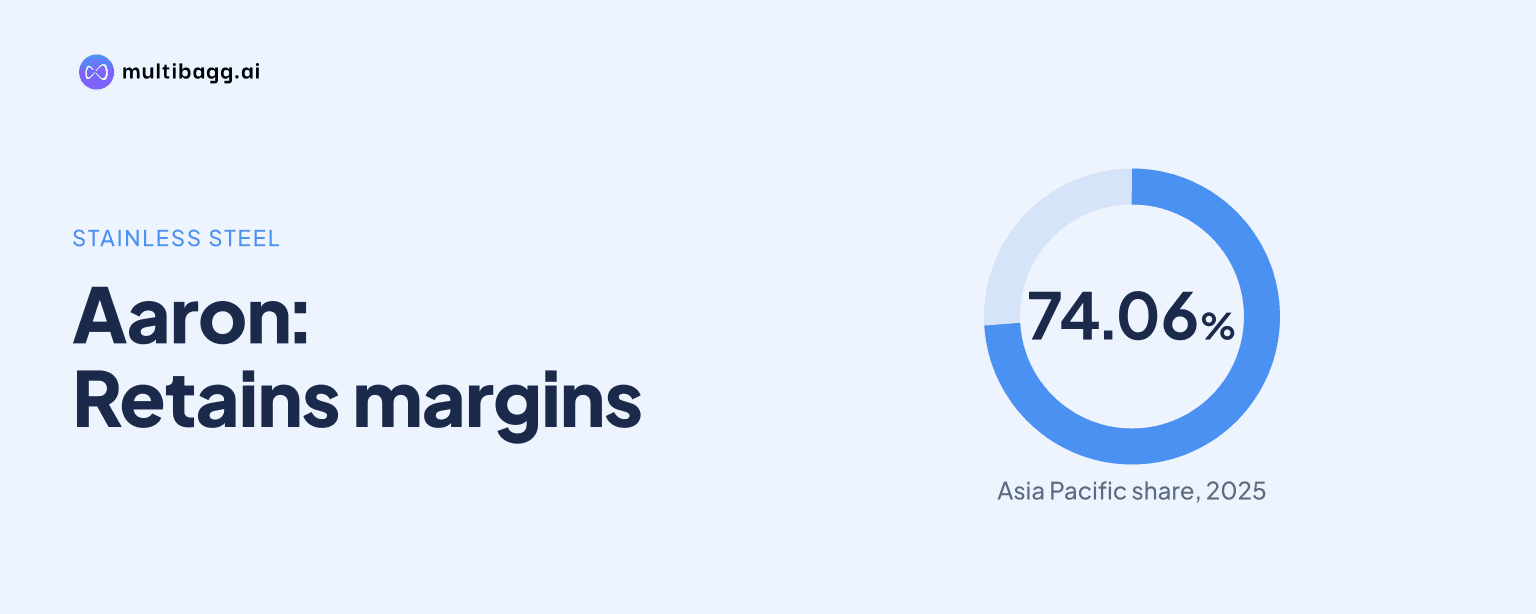
- Aaron cites Asia Pacific’s 74.06% share of the global stainless-steel market in 2025 and a 5.9% global market CAGR through 2034.
powered by IRIS
Aaron Industries Limited says it retains processing value by converting raw stainless-steel coils into finished sheets, using most in elevator operations and selling the balance externally. Its three Surat production units span 1.5 lakh square feet and include polishing, embossing and colour-sheet equipment. Aaron is positioning STELIX as a premium stainless-steel brand for decorative and designer sheets.
Know Aaron Industries inside out
Results, valuation, peers and who's buying, in one view.
How does Aaron's stainless-steel processing model work?
Aaron converts raw stainless-steel coils into finished, value-added sheets through an in-house sequence of cutting, polishing, embossing and finishing. The process begins with coils procured from established suppliers and continues under the company’s stated quality-control system, producing customized surface finishes and designs to client specifications rather than selling coils in their raw form.
The finished sheets serve two channels. Aaron says the majority is consumed by its own Elevator Division, where stainless steel is used in products including elevator auto doors and cabins. The balance is sold externally to other elevator manufacturers and into interior-decoration and industrial applications, creating a second sales outlet for the same processing operation.
This model connects the stainless-steel division with Aaron’s wider elevator manufacturing activities. The company describes its integrated supply chain as extending from elevator doors, cabins and components to in-house steel polishing, a structure intended to support timely production, quality consistency and control over the supply of processed material.
Aaron’s manufacturing footprint provides the operating base for this model. It has three production units in Surat, Gujarat, spanning 1.5 lakh square feet, with polishing machines for stainless-steel sheets, an embossing machine for embossed sheets and a physical vapour deposition (PVD) machine for colour sheets listed among its equipment.
How does Aaron retain processing margins on stainless steel?
Aaron retains the processing margin on sheets it consumes internally because it processes raw coil in-house before using finished material in its Elevator Division. In contrast, buying an already processed sheet from an outside supplier would place that processing step outside the company’s own production chain; Aaron identifies in-house processing as the mechanism for cost optimization and consistent quality.
The external-sales channel adds a separate margin opportunity on the portion of finished sheets not used internally. Aaron specifically states that it earns a second margin on sheet sold outside the company, including to other elevator makers. The internal and external channels therefore differ in destination: the majority supports Aaron’s elevator output, while the balance becomes a diversified revenue stream.
The integration is not tied to a single announced order or one project. Aaron says the arrangement applies to ongoing production, which means the processing, internal consumption and external-sales model operates alongside regular elevator manufacturing rather than being presented as a temporary capacity use.
Quality compliance is another stated part of the model. Aaron says Bureau of Indian Standards certification reinforces product quality and compliance for its processed stainless-steel products. The presentation does not disclose sheet volumes, segment revenue, processing margins or the internal-versus-external sales mix, so the financial contribution of each channel cannot be quantified from the disclosed material.
Got a follow-up? Ask IRIS
What is STELIX and which products does it cover?
STELIX is Aaron’s stainless-steel brand and represents its expansion into premium stainless-steel solutions. The brand is associated with finished decorative and designer stainless-steel sheets, rather than raw coil, and the company says it is built around strength, durability and innovation.
The STELIX product set includes matt and mirror polishing, embossing, press plates, PVD coating and decorative stainless-steel sheets. These offerings reflect the processing steps available in Aaron’s stainless-steel division: polishing changes the surface finish, embossing adds patterned designs, and PVD coating is used for colour-sheet production.
The branded approach is distinct from internal supply to the Elevator Division. Internal consumption supports Aaron’s own auto doors and cabins, while STELIX provides a market-facing identity for finished sheets that can also be sold to other elevator makers and used in interior-decoration or industrial applications. This separates the company’s elevator-component use case from the stated premium-sheet brand expansion.
Aaron says STELIX broadens its product portfolio and is intended to strengthen domestic and international brand recognition. The presentation does not give STELIX-specific sales, export revenue, distributor numbers or a launch date. It instead frames the brand as part of a broader strategy based on design, customized finishes and sales channels beyond the company’s own elevator requirements.
What stainless-steel demand segments is Aaron targeting?
Aaron is targeting stainless-steel sheet applications linked to manufacturing, elevators, interiors and industrial use, while its market overview identifies broad demand from machinery, automobiles, food equipment and aerospace parts. The company’s own external-sales description is narrower, naming other elevator makers, interior decoration and industrial use as current application areas for its finished sheets.
The presentation identifies stainless-steel grades by end use rather than claiming that Aaron produces a particular grade. It says 304 sheets lead because of corrosion resistance and strength, 310 is the fastest-growing type for high-temperature applications, and 316 is used prominently in marine and chemical applications. These segments differ by operating environment and intended application.
Regionally, Aaron cites Asia Pacific as holding a 74.06% share of the global stainless-steel market in 2025, led by China and India. It also cites a 5.9% compound annual growth rate for the global market through 2034. The comparison indicates that Asia Pacific is the largest regional segment in the cited 2025 data, while the market forecast describes growth over the 2025-to-2034 period.
Aaron’s stated route to address demand includes adding distributors and channel partners across its Elevator and Stainless-Steel Sheet businesses, with domestic and export-market penetration as the goal. It also plans marketing through print and digital platforms, participation at national and international trade fairs, and long-term ties with elevator manufacturers as both a stainless-steel sheet supplier and contract manufacturer.
Conclusion
Aaron’s presentation describes a vertically integrated stainless-steel model in which raw coils are transformed into finished sheets, with most output supporting its own elevator products and the remainder sold externally. STELIX gives the externally marketable decorative and designer sheet range a separate premium brand identity, while the shared processing base is intended to retain value from polishing, embossing and coating within Aaron.
What to watch next is execution of Aaron’s stated distribution and partnership plans. Management plans to add channel partners, improve brand visibility through marketing and trade fairs, and pursue long-term arrangements with elevator makers as sheet customers and contract-manufacturing partners; the presentation does not yet disclose STELIX revenue, sheet volumes or the proportion sold outside the company.