










Aarti Pharmalabs Limited: 10-12 projects drive Rs 800 crore CDMO
Key highlights
- Aarti Pharmalabs said 10 to 12 CDMO projects can generate Rs 700 crore to Rs 800 crore of Rs 1,000 crore potential.
- Management described a 60-project CDMO pipeline comprising 39 higher-certainty projects and 21 under-development projects.
- API sales represented 43% of total sales in FY25, close to 36% in the following year and close to 30% in the current financial year.
- The peptides and oligonucleotides laboratory is expected to be operational by the end of FY27, with financial contribution from FY28 onward.
powered by IRIS
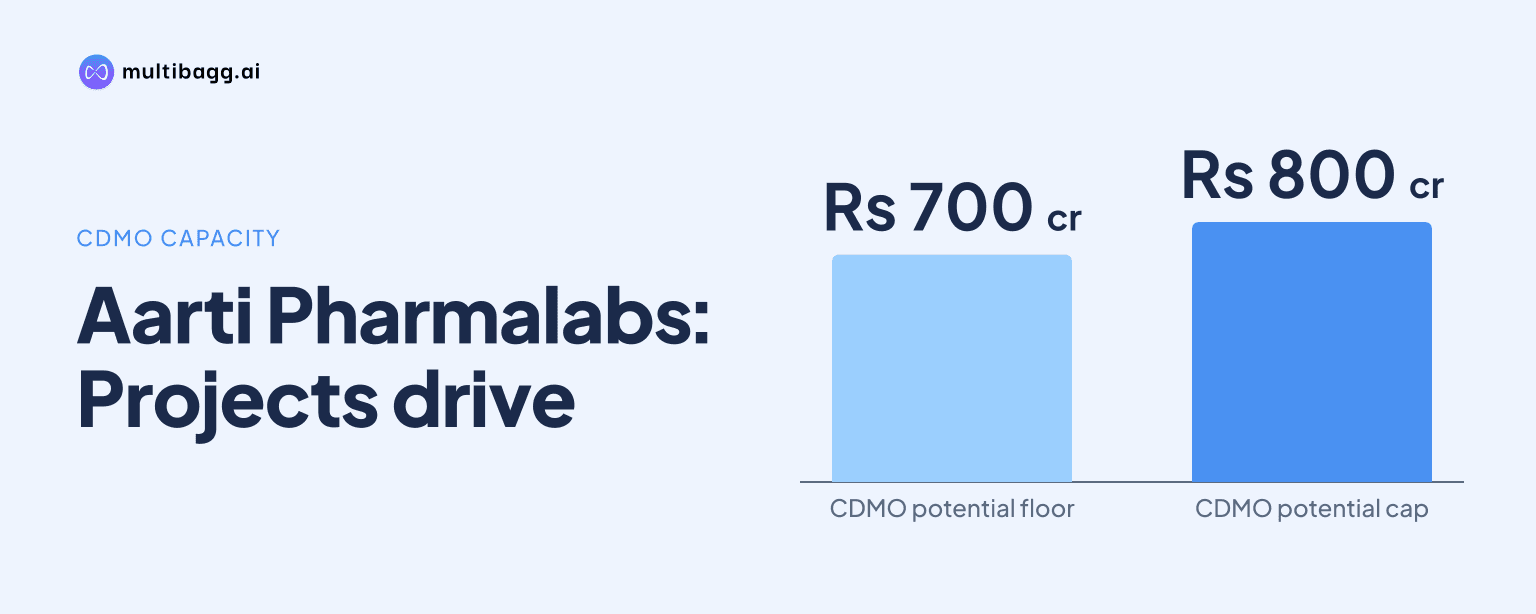
Aarti Pharmalabs said 10 to 12 of its 60 contract development and manufacturing organisation (CDMO) projects can generate Rs 700 crore to Rs 800 crore of its Rs 1,000 crore revenue potential over two to three years, concentrating most of the ambition in roughly one-fifth of the pipeline.
Know Aarti Pharmalabs inside out
Results, valuation, peers and who's buying, in one view.
How much of Aarti Pharmalabs’ CDMO target depends on a few projects?
Aarti Pharmalabs said 10 to 12 projects, or about 20% of its 60-project CDMO pipeline, will drive Rs 700 crore to Rs 800 crore of its Rs 1,000 crore potential. That means this smaller set could account for 70% to 80% of the stated revenue ambition, with the rest of the pipeline contributing the remaining amount.
Management made the disclosure after an analyst asked whether the current set of commercial and under-development molecules could support Rs 800 crore to Rs 1,000 crore of CDMO revenue in two to three years. Aarti Pharmalabs did not identify the 10 to 12 projects, provide individual sales estimates, or state when each programme could reach commercial revenue.
The company’s comment is therefore an indication of revenue concentration rather than product-level guidance. Management described the overall opportunity as Rs 1,000 crore potential, while specifically assigning Rs 700 crore to Rs 800 crore of that amount to a limited number of projects.
Why has Aarti Pharmalabs’ CDMO pipeline count not risen steadily?
Aarti Pharmalabs said the CDMO pipeline is a moving number because new projects enter while projects that fail in clinical phases leave. The company said the count is not cumulative, so a broadly stable development-project total does not mean that no molecules have progressed, been added or been discontinued.
Management described 39 projects as having greater certainty than the 21 projects under development, together making up the 60-project pipeline. Its distinction indicates that projects in development carry a higher risk of exit, while the 39 projects offer relatively greater visibility, although no revenue forecast was assigned to that group.
An analyst said six molecules had moved into commercialisation over about 18 months, increasing the commercial count from 33 to 39 across FY25, FY26 and the first half of FY27. The analyst also said the under-development count had been broadly unchanged for three to four years; management attributed that pattern to additions and deletions within the active pipeline.
Management also said some projects transferred from China as customers adopted a China Plus One sourcing strategy were not large programmes. These products may add to the number of projects but have approval cycles and campaign-production cycles, meaning their commercial status does not necessarily produce recurring sales in every period.
What does the 80/20 rule mean for Aarti Pharmalabs’ CDMO revenue?
Aarti Pharmalabs said the 80/20 rule applies to its CDMO business, with about 20% of projects driving about 80% of revenue. The stated Rs 700 crore to Rs 800 crore contribution from 10 to 12 projects out of 60 broadly reflects that concentration within the Rs 1,000 crore potential.
The concentration explains why an increase from 33 to 39 commercial molecules may not translate into a proportional rise in CDMO revenue. Management said some recently transferred projects are campaign products and not very large, while a smaller group of programmes can produce the bulk of the sales outcome.
A commercial designation also does not guarantee a uniform annual run rate. For projects transferred under China Plus One arrangements, management cited approval requirements and campaign cycles, which can affect both the timing and frequency of manufacturing revenue from a programme.
Management did not disclose the customers, therapeutic areas, end markets or order visibility for the 10 to 12 high-potential projects. It also did not quantify how much revenue the remaining 48 to 50 projects could provide, leaving the achievement of the Rs 1,000 crore potential dependent on the broader pipeline as well as the concentrated group.
Got a follow-up? Ask IRIS
What CDMO capabilities is Aarti Pharmalabs building?
Aarti Pharmalabs said its Atali facility will be used for CDMO and intermediate business, with no active pharmaceutical ingredient (API) business planned at the site. The facility’s intended mix therefore differs from the company’s generic API operations and is directed toward contract manufacturing and intermediates.
The company is also building capabilities in peptides and oligonucleotides, which management described as large-molecule modalities. It said it plans to offer small molecules, peptides, oligonucleotides and linkers, including antibody-drug conjugate (ADC) linkers, to innovator customers.
Management expects the peptides and oligonucleotides laboratory to be operational by the end of FY27, with financial numbers beginning to reflect from FY28. It declined to give revenue guidance or estimate the share of total revenue that peptides and oligonucleotides could represent in FY28 and later years.
Aarti Pharmalabs also said research and development spending will increase as it expands peptide and complex-chemistry work. Management said its new chief scientific officer had joined in the previous nine months, a new API research and development head had joined, and further recruitment was continuing; it did not disclose the planned research spend.
How does Aarti Pharmalabs’ CDMO focus compare with its API business?
Aarti Pharmalabs said API sales accounted for 43% of total sales in FY25, close to 36% in the following year and close to 30% in the current financial year. Management said the overall revenue pie and research activity were increasing, while API sales had declined in the prior year, reducing the segment’s share of sales.
Management said it first needs to regain the previous-year API sales level and is targeting a new, higher number in the current year, while adding that the outcome depends on how the year progresses. An analyst cited API sales of about Rs 920 crore in FY25 and Rs 650 crore subsequently, but management did not confirm those absolute figures in its response.
For APIs, Aarti Pharmalabs cited a portfolio of 61 products and said several patent expiries are expected in the next financial year. It expects launches with partners in their markets, but said growth will depend on the market share those partners and dossier customers capture.
Management named anti-diabetic products, blood thinners, anti-hypertensives, inhalation steroids and oncology as API growth areas for the next few years. It also cited alternate vendor development as a way to gain new customers for existing products, alongside the separate Rs 1,000 crore CDMO potential.
Conclusion
Aarti Pharmalabs’ CDMO ambition depends substantially on a small number of programmes: 10 to 12 projects are expected to account for Rs 700 crore to Rs 800 crore of Rs 1,000 crore potential. The 60-project count remains relevant, but management’s explanation shows that additions, clinical failures, commercial transfers and campaign cycles can alter the pipeline without producing a steady increase in reported project numbers.
The next disclosed milestones are progress toward the two-to-three-year Rs 1,000 crore CDMO potential and the planned commissioning of the peptides and oligonucleotides laboratory by the end of FY27. Management expects financial contribution from those newer modalities from FY28, but has not provided revenue guidance for them or identified the 10 to 12 projects behind most of the CDMO potential.