










Aarti Pharmalabs says pass-through can lower xanthine sales
Key highlights
- Aarti Pharmalabs targets Rs 1,400 crore to Rs 1,500 crore of xanthine revenue if prices remain high.
- Aarti Pharmalabs said lower raw-material prices would reduce xanthine turnover through pass-through pricing.
- Aarti Pharmalabs plans full production of xanthine finished products and intermediates by the end of the year.
- Aarti Pharmalabs said Q2 CDMO sales were almost double Q1 sales and targets 40% to 50% CDMO growth this year and next year.
powered by IRIS
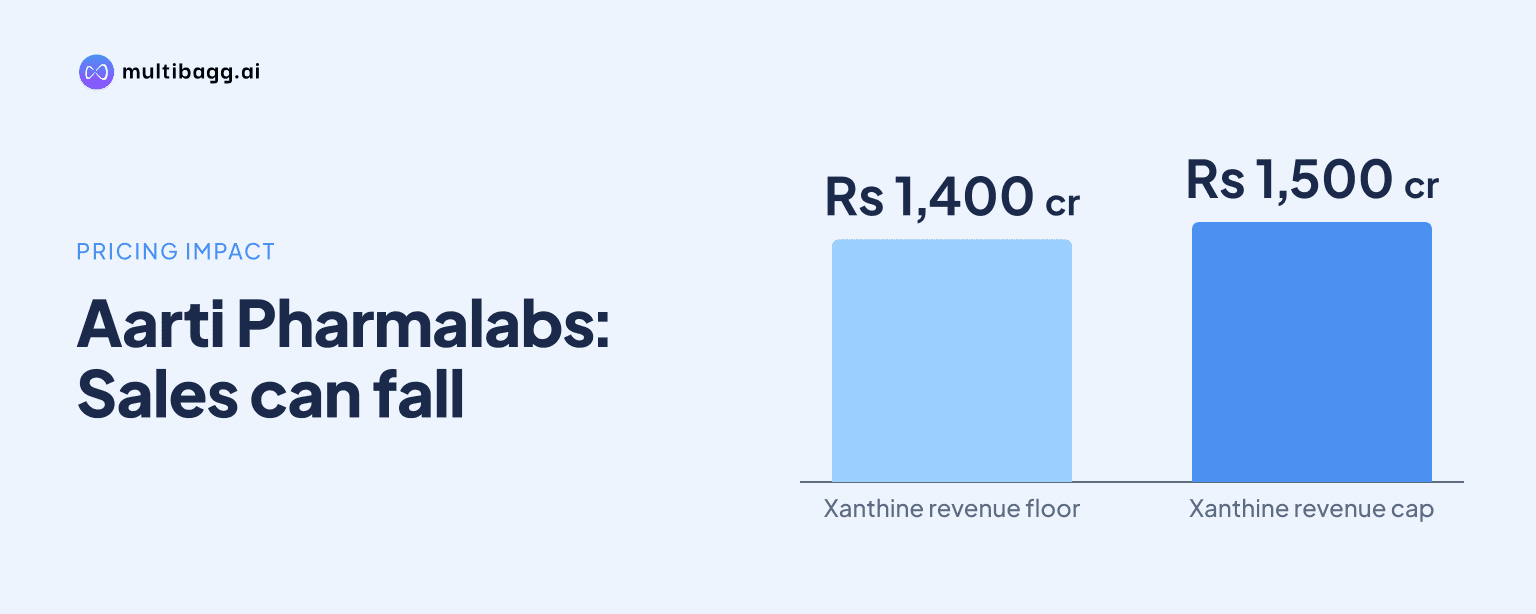
Aarti Pharmalabs said its xanthine business could generate Rs 1,400 crore to Rs 1,500 crore of revenue when expanded capacity is fully used and prices remain high, but reported sales would decline if raw-material prices fall because those costs are passed through to customers. The range is therefore conditional on both pricing and ramp-up.
Know Aarti Pharmalabs inside out
Results, valuation, peers and who's buying, in one view.
What xanthine revenue does Aarti Pharmalabs target?
Aarti Pharmalabs targets Rs 1,400 crore to Rs 1,500 crore of xanthine revenue if prices remain high. Managing director Rashesh Gogri gave that range after an analyst said the previous two quarters implied an annualised run rate above Rs 1,200 crore before full utilisation of the expanded xanthine capacity.
Aarti Pharmalabs did not endorse the analyst's separate Rs 1,500 crore to Rs 1,600 crore scenario. Its stated range was Rs 1,400 crore to Rs 1,500 crore, and management expressly attached the condition that prevailing prices remain high. The company did not provide a volume target, a capacity number or a timetable for reaching that revenue range.
The comparison between the more-than-Rs 1,200 crore annualised reference and the Rs 1,400 crore to Rs 1,500 crore range does not isolate a volume change. Management linked the range to the xanthine expansion and to selling prices, meaning reported turnover can reflect output, product mix and the pass-through of input costs.
When will Aarti Pharmalabs complete the xanthine expansion?
Aarti Pharmalabs plans to bring both the finished-product and intermediate stages of its xanthine expansion to full production capacity by the end of the year. Management said the finished-product phase was already operating and being ramped up, while the intermediate-production phase was also expected to become fully operational by that point.
Management expects full capitalisation of the xanthine project by the end of the year. This timing places the Rs 1,400 crore to Rs 1,500 crore revenue discussion before the entire project was fully operational, rather than presenting it as revenue already being generated by a completed asset base.
The company also told investors that xanthine sales in the quarter were constrained by shipment issues. Management said it would have recorded higher xanthine sales without those dispatch constraints and expected the issue to be resolved in the current quarter, allowing overall xanthine and allied-chemistry sales to increase.
Why could lower raw-material prices reduce xanthine sales?
Aarti Pharmalabs said lower raw-material prices would reduce reported xanthine revenue because the business passes those costs through to customers. In response to the question on the Rs 1,400 crore to Rs 1,500 crore range, Mr Gogri said the top line would come down if input prices declined.
This is a pricing mechanism, not a statement that lower inputs would necessarily mean lower xanthine volumes. If a lower cost is incorporated into the customer price, reported sales can fall even when physical production or shipments do not. Management did not quantify the share of xanthine revenue subject to pass-through.
Aarti Pharmalabs described the same mechanism in xanthine and allied chemistry more broadly. It said it normally passes on higher raw-material costs and had also obtained some price increases in active pharmaceutical ingredients, or APIs. Management attributed a decline of a couple of percentage points in earnings before interest, tax, depreciation and amortisation, or EBITDA, margin partly to the timing of higher input costs and their recovery through pricing.
Got a follow-up? Ask IRIS
What changed in xanthine sales during the quarter?
Aarti Pharmalabs said xanthine sales were lower during the quarter because shipments were delayed, while sales of allied products were higher. Management identified dispatch constraints as the reason xanthine sales did not rise as they otherwise would have, and said the constraint could be resolved in the current quarter.
An analyst had said xanthine top line was broadly similar in Q2 and Q1 and noted that domestic sales had become a higher proportion than export sales. Management did not disclose Q1 or Q2 xanthine volumes, price changes, domestic revenue or export revenue, so the call does not support a numerical comparison of those components.
The Q2 outcome therefore differs from the full-capacity revenue range. The quarterly movement involved delayed dispatches and a larger allied-product contribution, whereas the year-end plan involves ramping finished-product and intermediate production. Aarti Pharmalabs said overall sales should increase once the shipment issue is addressed.
How could CDMO and new assets affect margins?
Aarti Pharmalabs said higher contract development and manufacturing organisation, or CDMO, sales could improve EBITDA percentage in the third and fourth quarters, although raw-material prices and the CDMO mix would determine the final outcome. Management said Q2 CDMO sales were almost double Q1 sales and that third- and fourth-quarter CDMO sales should be higher.
Management is targeting 40% to 50% growth in CDMO this year and next year. It also said CDMO sales are typically more weighted to the second half, helping explain higher inventory and working capital in the first half. The working-capital cycle was described as about 165 to 167 days, while another management response put the cash conversion cycle at around 150 to 160 days.
Costs will also move into the profit and loss account as facilities are capitalised. Aarti Pharmalabs expects Atali Phase 1B and the xanthine-related assets to be capitalised in the second half, adding recurring expenses and depreciation. Finance cost was expected to remain at almost similar levels because most capex financing had already been arranged.
Atali Phase 1A is a commercial scale-up line, while Phase 1B is a smaller line for early work on newer CDMO projects, according to management. Aarti Pharmalabs expects to completely utilise the Atali asset in the second half of the financial year, although it said Phase 1B would not have a major bearing on overall capacity addition.
What should investors track in the next quarter?
Aarti Pharmalabs' disclosed near-term markers are resolution of the shipment constraint in the current quarter and completion of the xanthine finished-product and intermediate ramp-up by the end of the year. These events are directly relevant to the Rs 1,400 crore to Rs 1,500 crore range because the assets were not yet fully operational when management discussed it.
Management said second-half capitalisation would not exceed Rs 300 crore and could be lower if projects move to the first quarter of the next year. Total capital expenditure for the year is targeted at Rs 350 crore to Rs 400 crore, while depreciation and recurring operating costs are expected to rise as assets are capitalised.
Conclusion
Aarti Pharmalabs has set a conditional revenue framework for xanthine rather than a fixed sales promise. The Rs 1,400 crore to Rs 1,500 crore range depends on high prices and expanded production reaching full capacity, while the pass-through mechanism means lower raw-material costs can mechanically reduce reported turnover without necessarily signalling weaker business activity.
The next indicators are whether shipment constraints are resolved in the current quarter, whether xanthine capacity and intermediates reach full production by the end of the year, and whether Atali is fully utilised in the second half. Management also expects higher second-half CDMO sales, but says raw-material pricing and CDMO mix will determine the margin percentage.