










ABB: Data-centre orders reach 15%-20% of its order backlog
Key highlights
- ABB said data-centre orders accounted for 15%-20% of its Rs 12,927 crore order backlog.
- ABB reported total orders of Rs 4,700 crore, up 56% year on year, while base orders grew 43%.
- ABB said Electrification orders grew 117% and Electrification revenue increased 40% year on year.
- ABB said colocation data-centre orders take three to four quarters, while hyperscale contracts can extend for six to eight quarters.
powered by IRIS
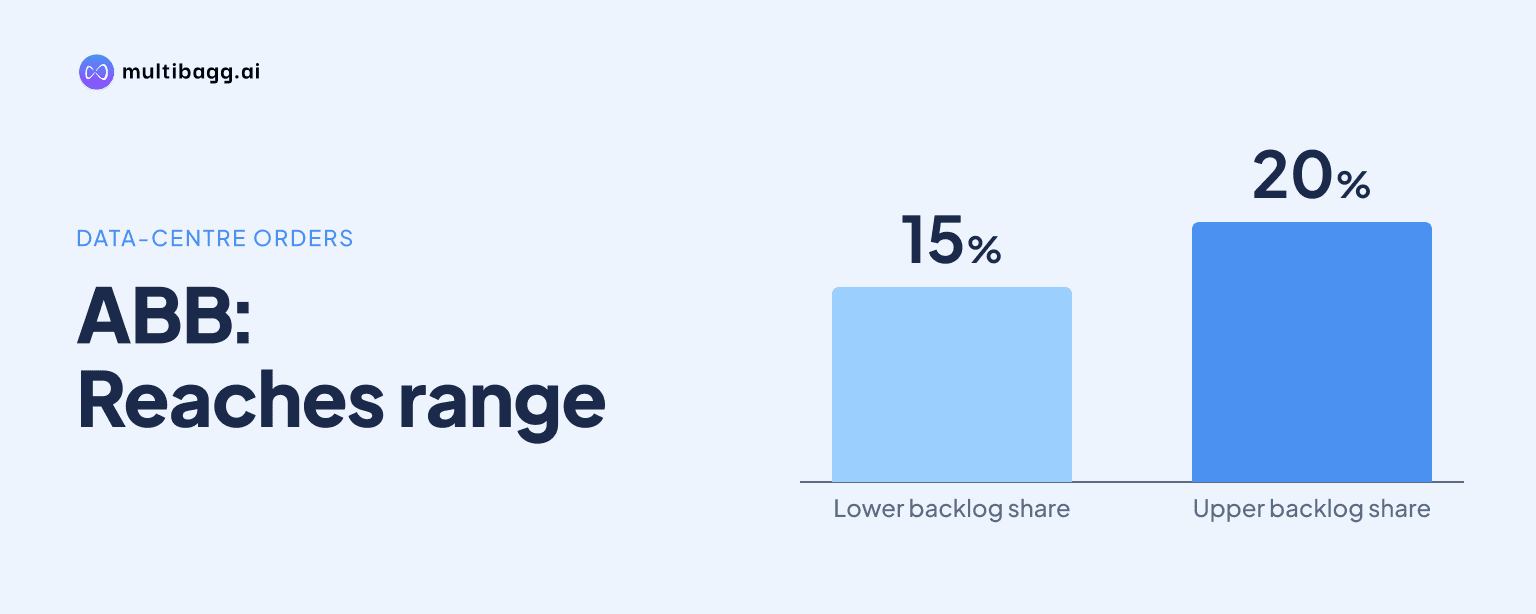
In the reported quarter, ABB India said data-centre orders accounted for 15%-20% of its Rs 12,927 crore order backlog, above its usual 10%-15% range. ABB said these mainly domestic orders have agreed delivery schedules, while price-variation clauses apply when customers defer deliveries beyond contracted dates.
Know ABB India inside out
Results, valuation, peers and who's buying, in one view.
How much of ABB's backlog comes from data centres?
ABB said data-centre orders represent 15%-20% of its Rs 12,927 crore order backlog in the reported quarter. Management described the steady-state share as roughly 10%-15%, with exposure rising to 20% when cyclical orders are high. The current range therefore places data-centre demand near the upper end of ABB's stated normal cycle.
ABB did not provide a rupee value for data-centre orders or a split between Electrification and Motion. It said the exposure is local rather than overseas, noting that export contribution would have been higher if data-centre orders were export-led. In the reported quarter, 87% of revenue came from domestic markets and 13% from exports.
Data centres contributed to large orders, but base demand also increased. ABB reported total orders of Rs 4,700 crore, up 56% year on year, while base orders grew 43%. Management said the net change in large orders between the prior-year period and the reported quarter was about Rs 500 crore, including orders from some data centres.
Are ABB data-centre delivery schedules protected from delays?
ABB said data-centre contracts have agreed fixed delivery dates and include price-variation clauses if customers defer delivery. Ganesh Kothawade, speaking on systems orders, said deliveries have so far been made in line with the schedules agreed with customers and that deferments have been very limited.
Management said it does not see timeline-related execution risk in the data-centre backlog because contracts specify delivery timing and address delays through price variation. This is a contractual protection rather than an assurance that customers will not reschedule projects. ABB did not disclose the formula for price variation, the financial effect of a deferral, or whether every contract uses the same provision.
The wider backlog has a mix of execution periods. ABB said 40% of its backlog consists of large orders that are executed over several quarters, while the balance is executable within four to five quarters. This mix reflects standard products, engineered systems, projects and services, rather than a single order type or delivery cycle.
How long do ABB data-centre orders take to execute?
ABB said colocation data-centre orders generally have an execution cycle of three to four quarters. Kiran Dutt said customers typically place Electrification orders after progressing construction and other project infrastructure, meaning building availability and equipment such as transformers can shape the overall project timetable.
ABB said its flow business in Electrification is not usually the constraint on a customer's wider data-centre project cycle. The company enters the project after civil infrastructure is available, while other equipment and construction milestones determine whether the site is ready. This makes colocation work relatively short-cycle compared with the longer contracts used by some hyperscale customers.
Hyperscale data-centre orders can run for six to eight quarters because they may be structured as frame contracts with deferred deliveries. Management said these arrangements can begin from the next quarter and extend over subsequent quarters. ABB's data-centre backlog thus combines shorter colocation orders with longer scheduled hyperscale programmes.
Got a follow-up? Ask IRIS
What is driving ABB's Electrification order growth?
ABB said Electrification orders grew 117% in the reported quarter, supported by data centres, food and beverage, energy and chemicals. The company said it participates in 23 market segments and presented data centres as an important growth market rather than the only driver of its order momentum.
Electrification represented 51% of reported-quarter revenue and 50% of business on a nine-month trend. Revenue in Electrification increased 40% year on year, compared with 14% growth in Motion. ABB did not quantify physical volume growth because its revenue includes products, projects and engineered systems with different pricing and delivery structures.
Management said growth reflects both prices and volumes, particularly in Motion, where commodity prices had been erratic. ABB does not disclose quantitative price increases, calling the information competition-sensitive. It said pricing is determined by business division, customer segment, product mix, localisation and market conditions.
Pricing also varies with order duration. ABB said standard products can be delivered within weeks, projects can take 12 to 18 months, and engineered-to-order systems can take longer. Management said cost changes are typically reflected in pricing with a lag, rather than through an immediate, uniform adjustment across all products and projects.
What supports ABB's order pipeline beyond data centres?
ABB said its pipeline includes building and infrastructure, cement, oil and gas, renewables, food and beverage, energy and chemicals, manufacturing, mobility and process industries. Ganesh Kothawade said demand outside data centres also showed higher double-digit growth, indicating that the reported 56% total order increase was not dependent on a single market.
The company's revenue mix was 83% products, 7% projects and 10% services in the reported quarter. This mix explains the differing backlog timelines: products can move quickly, services can be delivered immediately, and projects can extend over 12 to 18 months. Data-centre work similarly ranges from short-cycle colocation supply to multiquarter hyperscale contracts.
ABB said increased Electrification assets reflected inventory purchases needed to support higher backlog and revenue. Management said net working capital as a percentage of revenue remained steady, while inventory buying was strategic and measured during a growth phase. The company also said its baseline annual capital expenditure is Rs 300 crore to support normal capacity building.
Management said it had announced a Rs 625 crore investment programme earlier in the year, of which about Rs 500 crore related to the listed entity, mainly across Motion and Electrification. ABB said capacity is built in advance across business lines, but did not allocate the programme specifically to data-centre demand or provide a completion timetable.
Conclusion
ABB's disclosure shows that data centres have become a material, primarily domestic part of its order book, accounting for 15%-20% of the Rs 12,927 crore backlog. That contribution coincided with 117% order growth in Electrification, but ABB also reported 43% growth in base orders and cited demand across 23 market segments. Contractual delivery dates and price-variation clauses are intended to limit the effect of customer deferrals.
The next issue to watch is the mix of new colocation and hyperscale orders, because colocation work is expected to execute in three to four quarters while hyperscale frame contracts can extend for six to eight quarters. Management also said it may be selective in coming quarters while addressing commodity costs, and it plans capacity investment across Motion and Electrification.