










ABB India says new capacity will arrive only in late 2027-28
Key highlights
- ABB India expects new factory capacity only from late 2027 through the later part of 2028 after an eight-to-10-quarter build cycle.
- ABB India said routine annual capital expenditure is Rs 300 crore, separate from the announced factory programme.
- Electrification revenue rose 40% year on year and Motion revenue rose 14% in the reported quarter.
- Data centres represented around 15% to 20% of backlog, compared with a typical range of roughly 10% to 15%.
powered by IRIS
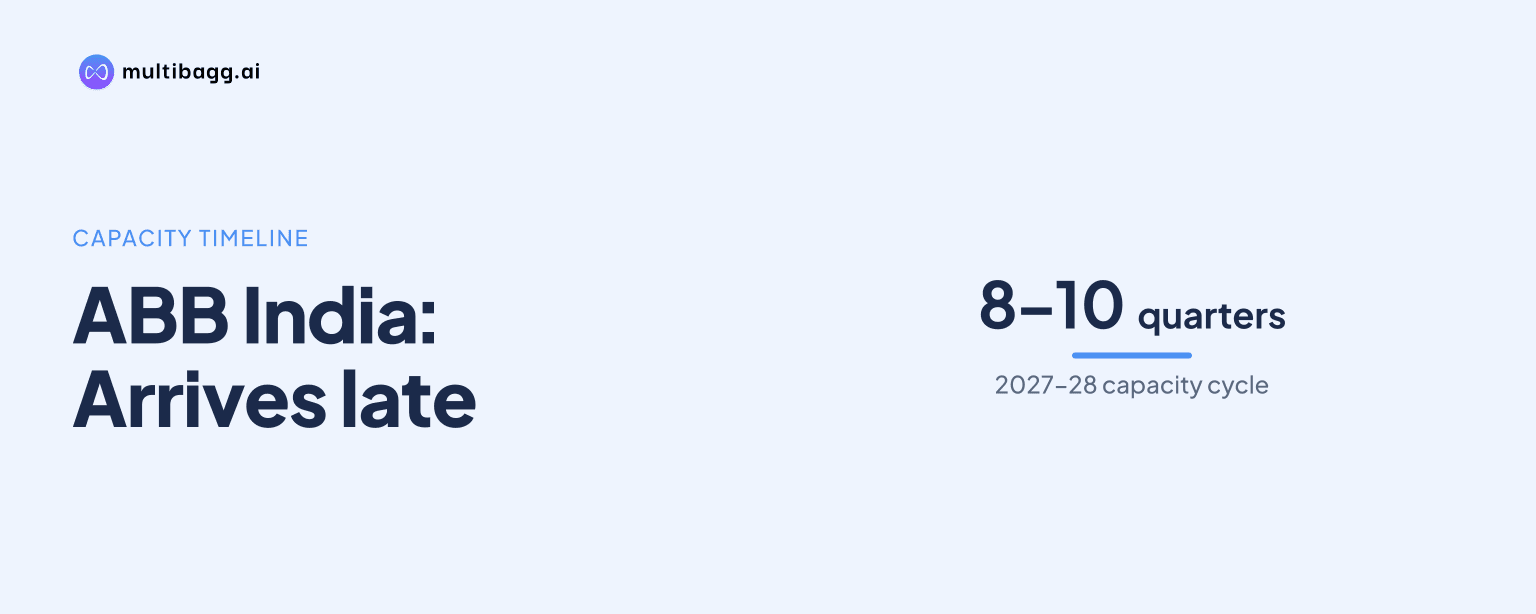
ABB India Limited said its announced factory expansion programme will make new capacity available no earlier than late 2027 and into the later part of 2028, because construction, installation and commissioning require at least eight to 10 quarters. The projects mainly cover Motion and Electrification products and are intended primarily to serve domestic demand.
Know ABB India inside out
Results, valuation, peers and who's buying, in one view.
What does ABB India’s expansion programme cover?
ABB India said the programme is being executed in phases and is focused mainly on building new factories and products for Motion and Electrification, with a smaller component for Automation. Management linked the fixed-asset programme to capacity planning across its Indian operations, where several business lines can share a single manufacturing location rather than requiring standalone facilities for each segment.
The expansion sits alongside ABB India’s routine capital expenditure of Rs 300 crore a year for normal capacity building and market development. Management said this recurring spending is the baseline level used to maintain and expand operations, while the announced projects represent a separate build-out of new factories and product capacity in businesses seeing higher demand.
Management did not disclose spending incurred to date, annual allocations, or a segment-by-segment split for the announced programme. An analyst asked about expenditure during CY2026 and potential spillover into CY2027 and CY2028, but management instead pointed to the project scope, which it said principally covers Motion and Electrification and includes a limited Automation element.
The rationale for planning capacity across businesses was visible in the reported quarter’s revenue trends. Electrification revenue rose 40% year on year, while Motion revenue increased 14%, although management did not provide a quantitative division between price and volume growth because its products and projects have different delivery models.
When will ABB India’s new capacity become available?
ABB India said new-factory construction normally takes at least eight to 10 quarters from start to finish, followed by installation and commissioning before capacity can be used. Management initially referred to end-2026 as an earliest possibility, then corrected the timing to end-2027 and the later part of 2028, making the latter period the stated availability window.
The timetable means the announced factories are a medium-term project rather than a near-term solution for the current order book. Management said capacity is built in advance of market development, while inventory and existing operations are used to support nearer-term delivery requirements, especially in Electrification, where revenue grew 40% year on year in the reported quarter.
ABB India distinguished factory capacity from inventory held for backlog execution. Management said higher Electrification assets reflected strategic, measured inventory buying to manage supply chains and serve growing orders, while net working capital as a percentage of revenue was steady. Inventory can therefore support current deliveries, whereas factory construction requires the separate eight-to-10-quarter development cycle.
Data-centre orders illustrate the difference between customer delivery cycles and the factory-expansion timetable. Management said colocation data-centre orders usually have a three-to-four-quarter execution cycle, while hyperscale arrangements can begin from the next quarter and extend for six to eight quarters under framework-style contracts with deferred deliveries.
Got a follow-up? Ask IRIS
Is ABB India building this capacity mainly for exports?
No. ABB India said robust local demand and potential new domestic markets, rather than a plan for exports, are the principal reasons for the capacity expansion. Management said certain products could still gain export opportunities, but it rejected the assumption that the planned factories were designed mainly to create a material increase in export orders from other regions.
The company described its data-centre exposure as local. Data centres accounted for around 15% to 20% of backlog at the time of the call, compared with a normal steady-state range of roughly 10% to 15%, and management said there was no overseas component in that exposure. This demand is therefore part of the domestic market supporting the capacity plan.
ABB India also cited the breadth of smaller orders as an indicator of demand beyond large data-centre projects. Total orders in the reported quarter were Rs 4,700 crore, up 56%, while base orders rose 43%. Management attributed part of the difference to roughly Rs 500 crore of net large data-centre orders compared with the prior-year period.
Over the nine-month period, base orders increased by more than 30%, according to management. It described this as evidence that demand was not dependent on a small number of large orders, while also noting that Tier 2 and Tier 3 cities were contributing to market growth across its business base.
What demand is behind ABB India’s factory plan?
ABB India identified three broad drivers for its Electrification-related demand: an ageing power grid, the energy transition, and rising electricity consumption from data centres and industry. These mechanisms are relevant to the factory plan because Motion and Electrification are the main businesses named for new products and facilities.
Data centres are a significant but not exclusive source of demand. Management said data-centre orders have agreed delivery schedules and that it had seen very little deferment from contracted dates. It also said contracts contain price-variation clauses if delivery is deferred, reducing timing risk in the data-centre backlog.
The company is also introducing products that could address evolving data-centre requirements. ABB India said it had launched the global Infinitus solution in India for direct-current applications, but management said acceptance in the Indian market remained to be established. Medium-voltage direct-current technology is already being used by hyperscale customers globally, although management expects its adoption in India to take time.
Automation provides a smaller part of the expansion plan but has a demand pipeline in oil and gas, power, water, specialty chemicals, metals, mining and cement. Management said Automation growth was 4% relative to previous quarters, with offshore projects moving after a long gap and midstream oil-and-gas activity remaining consistent, while downstream projects were still sluggish.
ABB India’s pricing comments also underline why capacity additions will not alone determine financial outcomes. Management said commodity-related price recovery has a lag because input costs are incurred before customer price adjustments are realised. For Motion, management said the reported 14% revenue growth reflected both price increases and volumes, without assigning a numerical contribution to either factor.
Conclusion
ABB India’s expansion programme is a long-cycle manufacturing investment aimed mainly at meeting domestic demand in Motion and Electrification, not at rapidly increasing output or driving exports. The reported 40% year-on-year growth in Electrification revenue, 14% growth in Motion revenue and more than 30% nine-month increase in base orders provide the operating context for building new capacity ahead of anticipated demand.
The next point to watch is execution against management’s end-2027 to later-2028 construction, installation and commissioning window. Investors can also monitor whether domestic demand remains broad-based, whether data centres sustain their 15% to 20% share of backlog, and whether Automation’s stated pipeline converts into orders as customer project decisions progress.