










ABB India Orders Rise 56% as Q3 Revenue Reaches ₹3,738 Crore
Key highlights
- ABB India’s Q3 CY2026 orders rose 56% year on year to approximately ₹4,700 crore.
- Q3 CY2026 revenue increased 19% year on year to ₹3,738 crore.
- Profit after tax rose 10% year on year to ₹440 crore in Q3 CY2026.
- ABB India’s backlog reached approximately ₹13,000 crore, up 36% year on year.
powered by IRIS
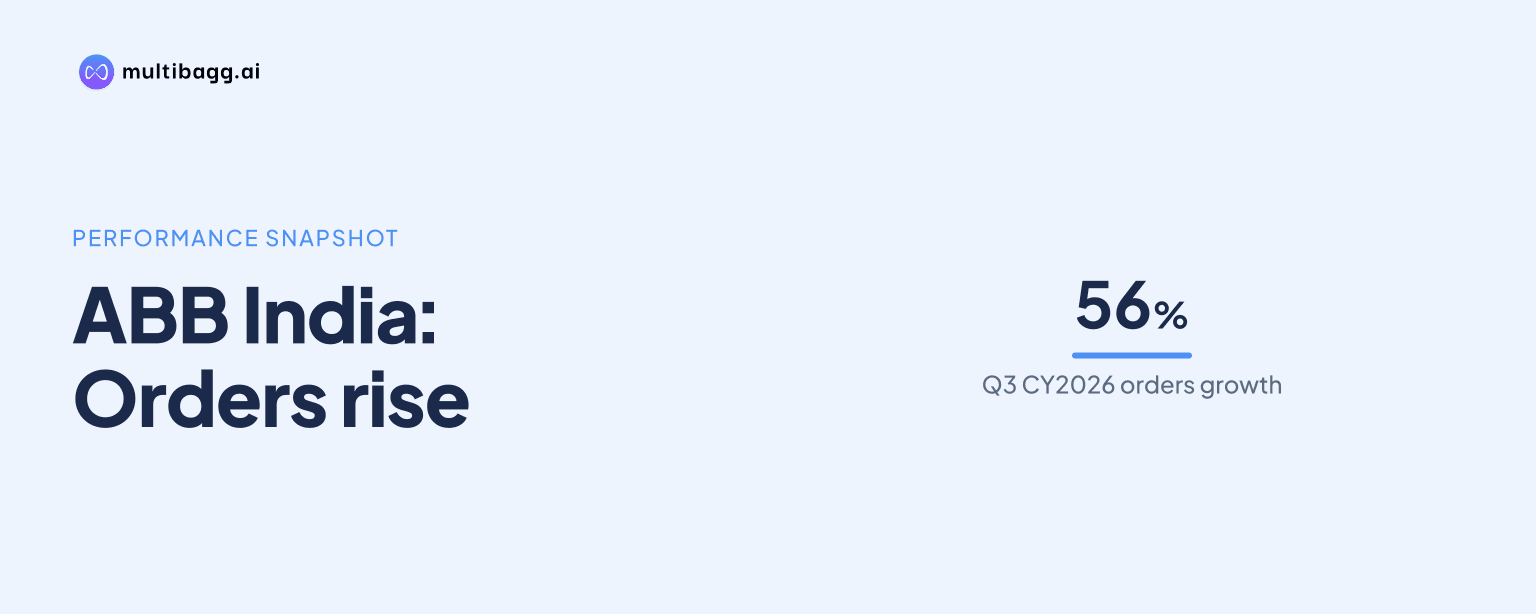
ABB India Limited reported 56% year-on-year order growth to about ₹4,700 crore in the July-September 2026 quarter, while revenue increased 19% to ₹3,738 crore and profit after tax rose 10% to ₹440 crore. The sharp increase in orders lifted the company’s backlog to roughly ₹13,000 crore.
Know ABB India inside out
Results, valuation, peers and who's buying, in one view.
What did ABB India report for Q3 CY2026?
ABB India reported broad-based growth in orders and revenue for Q3 CY2026, its July-September 2026 quarter. Order inflows grew 56% year on year to approximately ₹4,700 crore, while base orders increased 43%. Management said the growth was spread across all business divisions and 23 market segments.
Revenue rose 19% year on year to ₹3,738 crore. Operational EBITDA increased 15%, and profit after tax rose 10% to ₹440 crore. The company reported an EBITDA margin of 14.8%, compared with 15.5% in the comparable period, as higher material costs and a changed business mix affected profitability.
The order book reached approximately ₹13,000 crore, with another reported figure placing the backlog at ₹12,927 crore. This represented 36% year-on-year growth in the backlog. Nine-month orders totalled ₹14,000 crore, up 40% from the corresponding period.
Which sectors supported ABB India’s order growth?
ABB India said data centres, renewables, infrastructure and core industries contributed to the strong order inflow. The company also identified food and beverage, energy and chemicals, and manufacturing among the demand areas during the quarter.
Data-centre orders were a notable contributor. Management said these orders added roughly ₹500 crore on a net year-on-year basis. This helped lift overall quarterly order growth, while the 43% increase in base orders indicated that demand was not limited to large project wins.
During the analyst call, T.K. Sridhar, Chief Financial Officer and Country Managing Director-designate, said the company had recorded order growth across its business divisions and market segments. Kiran Dutt, who leads the Electrification division, and Balaji, who leads the Automation segment, also joined the call along with Country Managing Director Sanjeev Sharma.
Why did ABB India’s EBITDA margin decline?
ABB India’s EBITDA margin declined to 14.8% in Q3 CY2026 from 15.5% a year earlier because of higher material costs and changes in the sales mix. Even with this margin movement, operational EBITDA increased 15% year on year as revenue expanded.
The difference between order growth and profit growth shows the role of execution costs and mix in the quarter. Orders rose 56%, revenue increased 19%, and profit after tax grew 10%. These figures show that a strong pipeline and revenue growth did not fully prevent margin pressure in the reported period.
Some call summaries described margins as affected at the segment level, while another summary referred to an EBITDA margin of 15.5%. ABB India’s Q3 presentation data cited in the supplied material reports the quarter’s margin at 14.8% and the prior comparison at 15.5%. The company did not provide a separate quantitative breakdown of material-cost pressure by division in the supplied information.
Got a follow-up? Ask IRIS
How does the ₹13,000 crore backlog affect ABB India?
ABB India’s roughly ₹13,000 crore backlog provides visibility for future execution, subject to project schedules and customer requirements. The backlog was up 36% year on year and followed three consecutive quarters in which order inflows exceeded ₹4,500 crore, according to the earnings-call discussion.
A larger order book is important for an industrial equipment and automation supplier because orders are typically converted into revenue over time. ABB India’s 19% revenue growth in the quarter was reported across all business divisions, while the higher backlog reflects continuing demand from sectors including electrification, automation, infrastructure and renewables.
For investors, the key reported factors are the pace at which the company turns the backlog into revenue and whether material-cost and mix pressures persist. The available information does not provide financial guidance or a target for margins. Management described demand conditions positively while remaining cautious about macroeconomic headwinds.
What does ABB India’s quarter indicate for its operating environment?
ABB India’s Q3 CY2026 results indicate that demand for its electrification and automation offerings remained active across a diverse set of industries. Data-centre investments, renewable-energy activity, manufacturing demand and infrastructure projects supported order inflows, while order growth was reported in all business divisions.
The results also underline that revenue growth and order intake can move faster than margin expansion. Higher material costs and business mix reduced EBITDA margin despite the 15% increase in operational EBITDA. This is relevant to the wider industrial sector, where project composition, input costs and execution timing can influence quarterly profitability.
ABB India is listed on both the BSE and NSE and follows a January-to-December reporting year. Its Q3 CY2026 earnings call was held on November 16, 2026, after the July-September reporting period. The company publishes quarterly financial results, presentations and analyst-call materials for shareholders and market participants.
Conclusion
ABB India combined rapid order growth with higher revenue and profit in Q3 CY2026. Orders of about ₹4,700 crore, up 56% year on year, and a backlog near ₹13,000 crore demonstrate strong demand across data centres, renewables, infrastructure and industrial markets. However, the EBITDA margin decline to 14.8% shows that material costs and business mix remained important factors in profitability.
The next areas to watch are the conversion of the expanded order book into revenue, the contribution of data-centre and base orders, and any movement in material costs or operating margins. ABB India has disclosed its nine-month order intake of ₹14,000 crore and its Q3 financial materials, but the supplied information contains no numerical outlook for future revenue or margins.